It might seem from this that the little people in Japan have just as comfortable and happy a time as the little people in the United States. Of course, in Japan, as elsewhere, there are all sorts. Some homes are real homes, but as we understand the term, there are very, very few homes in that country. The Japanese language has no word for home. The mothers do not know nearly so much about caring for their children as do most mothers in this land. The mothers are not loved and honored by the fathers as in this land.
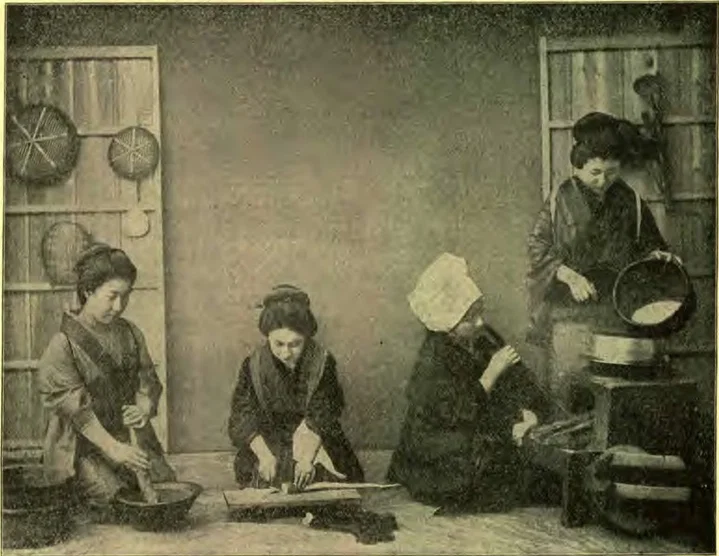
There are more than thirty-eight million “common people” in Japan, many of whom are extremely poor. Many families have not more than five dollars of our money to live on a month—the whole family,—and some have not that much. Their food is not nourishing and wholesome. It consists mainly of rice, which is poorly cooked, and not usually well masticated. Salty pickles, cucumbers, egg plant, etc., including a monstrous radish called dai-kon, peculiar to Japan, are eaten with the rice. The better grades of fish are too expensive for the masses to use commonly. The poorer grades do not appear very appetizing.
The dish most commonly prepared for the sick is the gruel poured off the cooked rice. You get mother to put extra water on the rice some day, and before taking up the rice, pour this off. Don’t put any salt in it, but drink it, and imagine yourself with little else to eat during days of illness, and then decide how the lot of the sick little Japanese brother or sister compares with yours.
The public schools in Japan, which are government schools, are said to be “free,” but in fact a small tuition is charged. It is not more than fifteen cents a month, probably, but that is impossible in a good-sized family where the income is so small as I have indicated. So thousands of children do not go to school. To have these children playing in the streets, and often around the idols in the temple inclosures, is a sad thing. Many missionaries have felt this a great burden on their hearts, and about two hundred charity schools have been established. These are open sometimes only half a day, as the parents wish the children to work the rest of the time. There are night schools too for older ones who must work all day and can only have a little leisure in the evening for study. The Bible is taught in these schools. The children memorize a great deal of scripture—the ten commandments, the beatitudes, the sermon on the mount, and many other portions. Often the children go home and tell the parents what they have learned, and as a result many a father and mother has come to meetings and found the way to Jesus.
Here in the United States we have very many people to do Christian work in school and church, but in Japan the force is small as yet,—only one missionary to about one hundred thousand persons. The Japanese do a great deal, but they need much help. Especially in matters of home life and the training of children, they need the illustration of a Christian family. It is a very little way to help, too, but is worth while, to save your pretty scripture cards, get an address of a missionary or nature worker, and mail him a bundle tied up, not sealed, carefully weighed and stamped. And the children can specially guard against all that Jesus would not have them do by thinking they would like to set a good example for their far-away relatives. Some day you may go and help to teach them the way to God.
LAURA DE LANY GARST.