MORE than a thousand feet down in the bowels of the earth, Polish miners at Wieliczka, eight miles from Cracow, Poland, have been blasting and working rock salt. Twelve hundred men work day and night in the mines, for which they receive a bare twenty-five cents a day. They work, too, under hazardous conditions,—dangers from gas, fire, collapsing salt columns, and from the salt itself, which has a very disastrous effect upon the health.
Once “a fire broke out while fodder for the horses was being lowered. It raged for seven months, consuming even the boats upon the subterranean lakes, and the little railroad stations, cafés, restaurants, and other buildings in this strangest of cities.
“There are hundreds of horses employed in the underground city, hauling little steel wagons full of rock salt. Many of these animals are entirely blind, having been born in the mines and having lived for years without seeing the light of day.”
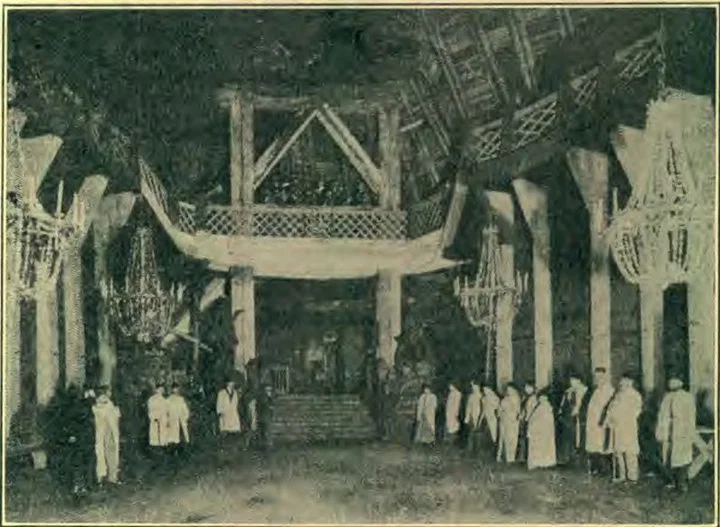
The salt is mined according to plans made by some master mind, so that the visitor sees ballrooms, chapels, railroad stations, massive chandeliers, throne chairs, and many other things of interest.
The enormous chamber known as the Letow Ballroom is doubtless the product of centuries of human toil. This chamber lies 230 feet below the surface of the ground, and was first used as a ballroom in 1809. There is surely no “more remarkable hall in the world than this ballroom, with its ancient twisted pillars, elaborate galleries, gigantic chandeliers, and statues carved out of the glittering crystals.”
“A thousand and one candles and electric lights scattered in all parts of the mine when all are allowed to do their part in the illumination, make the place seem like an enchanted fairyland.
“At one end are high reliefs hewn in the salt walls symbolizing Knowledge and Labor. There are weird-looking statues, too, of Vulcan and Neptune also cut in salt; and a triumphal archway surmounted by the figure of a miner saluting. A Polish inscription is carved beneath. These Galician miners maintain an excellent orchestra among themselves, and on festival days the salt-cut ballroom is a strange and merry scene with wild Slav music and dancing couples all in native costume.
“On the second level of the mine is another magnificent apartment known as the Michatovice Chamber. This is nearly 100 feet long, 60 feet wide, and no less than 121 feet high. It supplied salt for forty-four years; and in parts the sides and roof are made secure by means of lofty tree stems placed one above the other and strutted together. Depending from the center is a huge cluster of salt crystals, which is eight feet in diameter and twenty feet high. This unique chandelier takes 200 candles, which, when fully lighted, make the great chamber a spectacle of weird grandeur.
“The Kaiser Francis Chamber, which is nearly 200 feet long and 104 feet high, contains memorials of a visit from an early emperor and empress, as is recorded on two rock-salt pyramids.
“The Archduke Frederick Chamber slopes down between the second and third levels; and a strange effect is produced on the visitor as he walks down the spacious floor by the light of red Bengal flares, and hears in the distance the wild strain of the miners’ band below.
“Some 250 yards away and about 500 feet below the surface of the earth, one reaches the Count Goluchowski Station, excavated three centuries ago, and in 1854 turned into the main railroad station of the underground city, since it is the point of convergence for so many of the galleries, with their little trolley lines and horse cars.
“On great holidays friends of the miners and visitors generally assemble on the station platform, where is a café seating 400 persons. In a gallery above—of course cut in the salt—an orchestra of miners plays selections to the passengers who are about to make a trip altogether unique. Just westward of the station are two beautiful grottoes, respectively the Rudolph and Stephanie, connected by a tunnel filled with salt water sixteen feet deep.
“Farther along, this broadens out into a lake, and rising out of the water is a colossal statue of St. John, with lovely shining salt stalactites all around him. Immediately beyond, one enters the marvelous cathedral of St. Anthony, with altars, statues, columns, and so on, all hewn from the sixteenth century onward out of ruby-red rock salt.
“You can imagine no experience more impressive than to enter this crystal-hewn church behind a party of men provided with flaming pine torches and bunches of magnesium ribbon. Its reputation for sanctity is so great that the church is resorted to by thousands of pilgrims annually. The miners have their own chaplain, with special prayers adapted to their perilous calling, and never a shift is changed but prayer is offered in the subterranean cathedral which grew so slowly under the ax and chisel of these devout Galicians.
“Of the many marvels to be seen in the mine, the most wonderful, perhaps, is a second large subterranean lake, lying 700 feet below the surface of the earth. The waters are dark, thick, and heavy, and as the boat in which visitors are carried glides overp. 10 its surface, the spreading ripples roll up against the sides of the grotto with a ghostlike swish. The little waves splash against the greenish and ruby sides of the grottoes, making weird echoes and giving the visitor an overwhelming sense of remoteness from the world. The boat is substantial, and accommodates many people. It is guided through the grottoes in a curious fashion, by ropes running on pulleys along the sides of the boat. The trip across and back takes fifteen or twenty minutes, as the boat moves slowly through the sluggish brine. A gun fired in the middle of the lake makes a long and lingering echo, and the voice of the boatman, as he calls out that all is ready, seems like the voice of a giant from the depth of chaos. There are sixteen of these lakes in the mine, but visitors are allowed upon only two of them.
“The laborers produce 65,000 tons of salt per annum. As might be supposed, their implements are of the most primitive kind, but still these simple men continue patiently cutting their way through the solid crystals, leaving behind them strange pillared streets with statues, signposts, obelisks, queer animals, and a hundred other fantasies.”