W. S. CHAPMAN
One great source of wonderment to a foreigner on a first visit to China is the thronging, teeming crowds of people. In the European quarters in the large cities, with their wide and cleanly kept streets, the oppressiveness of the multitudes is not felt, but on passing beyond, into the limits of the old city, with its distinctive Chinese population, the immense numbers of human beings in the streets is a constant source of astonishment.
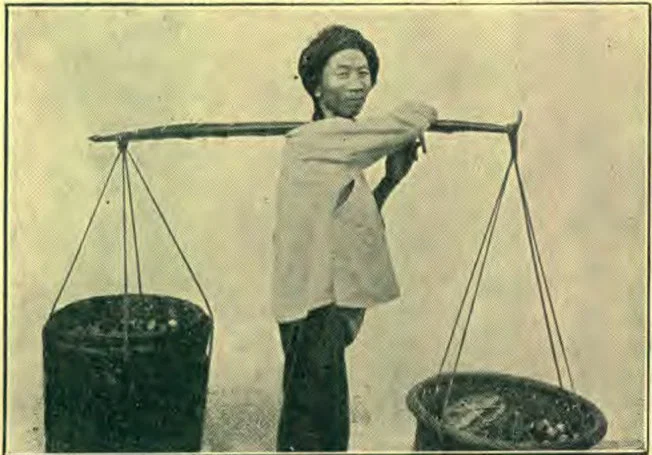
The next great marvel to a foreigner is the courtesy and forbearance shown, and the astonishing good nature of the people. Down the narrow, crowded street will come the countryman with his two packs of brushwood, which, slung at the ends of bamboo poles, just fit the six feet of passageway, if he ventures to turn sidewise. A coarse, ill-featured, dirty, and ragged specimen of a man, yet, like a lord, he cries as he moves: “Clear the way!” “I’ll bump you!” “Fly, fly!” “Go to the side!” and all, rich and poor, high and low, smilingly crowd to the sides, squeezing themselves into the shop tables to give him room. Following may be a string of burden bearers with their loads also strung on poles, who make room for themselves by the cry of “Oil, oil!” or, “Fish, fish!” at which dread sounds even the haughty scholar gathers his gown hastily and snugly for fear it will be soiled, and smilingly presses as far back as obstacles will allow.
Amid the myriads of street cries there is one, and only one, the people dread to hear. This strikes terror to every heart. It is the cry, purposely given in a hollow, mournful tone, I-O, accompanied by the beating of gongs. As soon as it is heard, all occupations cease, and every soul that can do so seeks safety in flight; others press humbly out of the way; all, in submission, unfasten their queues from under their caps, letting them drop down their backs, and stand with lowered eyes and clasped hands in trembling, humble attention. This cry precedes the coming of the mandarin. Before him walk in a row the villainous-looking men who give the cry. In their hands they carry long rattans, with which they mercilessly beat any one found obstructing the way, while back of them is a body of murderous-looking men carrying chains. If a poor soul is guilty of any irregularity, these heartless fiends seize and bind him and drag him off to jail and possible torture. This terror-inspiring cry is the only outward shadow, seemingly, on the jovial street life of this peculiar people.
Rarely is a street in the Chinese portion of a city over twelve feet in width, and that width is found only in the principal business streets; and seldom in any street is the passageway for pedestrians over five to six feet in width, because the merchants put out their tables with merchandise, which occupy five or more feet of the total width.
The shops are dingy, dark, and dirty one-story buildings without fronts. The wooden shutters that close them at night are used during the day, generally, as tables for the exhibition of merchandise. In some of these dirty rooms are often stored thousands of dollars’ worth of valuable goods, yet to a foreigner it seems as if they contain nothing for sale. Often the stock is stowed away out of sight, and such articles as silk and cloth are carefully wrapped in paper to keep out dust and light. Only in the cheaper stores is the stock of merchandise exposed for sale.
As a rule, in the large cities, the merchants of a like business congregate together, the shoe merchants in one street, the silk dealers in another, the fish markets in another, and so on. In some respects this is convenient and economical, because competition lowers prices, but it necessitates much traveling to complete all purchases. However, the greater part of the household buying is done by the servants, mainly the cook. These agents usually retain a percentage, and when considered safe to do so, further “squeeze” — steal — from their employers, as opportunity offers.
Many of the peddlers of China are what might be called a necessity, especially for the women, who are forbidden to shop on the streets, and have to depend upon these traveling salesmen for the goods and trinkets they require. These men are actually doing a revolutionary work among the women, bringing to their notice the wearing apparel and jewelry worn byp. 4 the “outside kingdom” women, or foreigners, creating a longing for such things, and thus bringing about great changes in their costumes, remodeling and modernizing their appearance.
Then there are the peddlers in cakes, the dealers in “sweets and sours,” and most popular of all, the “candy man.” Each has his peculiar and particular cry, the last named wielding a huge pair of shears with which he cuts the candy. At the sound of the clanking of these shears, every boy within hearing distance starts for the candy stall with a shout, holding up the cash he has saved for the occasion.
In some cities where sedan chairs are in use, these chair bearers are most provoking. They literally shove their way through the crowd. One hears their shrill cry far down the street, “Pei-a, pei-a, pei-a!” that is, “Mind your back, mind your back, mind your back!” If this warning is not heeded, one is bumped in the back. Sometimes a mother with her baby strapped upon her back will be encountered. It looks strange to see her turn around and use the baby as a bumper to receive the shock. The youngster is in no danger, as he is heavily swaddled in cotton-batting clothing. To the uninitiated, however, it looks like a dangerous experiment, remembering the cash value of a boy in China. Should the baby be injured or killed, the woman would in all probability pay the forfeit with her life.
One of the most interesting characters met with is the scholar, a man held in high respect everywhere. His clothing may be shabby and threadbare, and poverty be stamped on all he has and is, yet there is a proud and calm look of superiority in his face and in the unruffled dignity of his movements, that commands respect. Thousands of these men who have passed examinations which entitle them to government positions, live half starved all through their lives, waiting for the commissions that never come. Too proud either to work or to beg, it is a mystery how they eke out an existence.
Every merchant is a “character,” let him own a shop or roam the streets as a peddler; each has ways and tricks so peculiar to himself that they form a delightful study. You enter a silk shop. The goods are wrapped in paper on the shelves. Several idle clerks stand around, but make no effort to wait on you. Instead, they all indulge in a conversation in which they criticize your dress and appearance. You express a wish to look at some silks. Then, and not until then, the proprietor comes forward, and two or three clerks are sent into a back room for goods to show you. After selecting what suits, you ask the price, and the merchant names a sum far in excess of the real value. Individually or through an interpreter, you make an offer. The merchant, with a sweet smile, answers:—
“Mai puh tao” (“Sell not arrive”).
Still smilingly, the merchant names a price a trifle lower. It is then your turn to raise your offer a trifle, too.
“Mai puh tao,” he still smilingly answers, with a feint to rewrap the silk. Then you raise the offer again, and so the bargain progresses until the sum named by you meets with approval, when with an air of lordly indifference, the merchant cries:—
“Mai teh, mai teh!” (“Buy attain, buy attain!”) and the silk is yours. Possibly the total difference has been but a few cents.
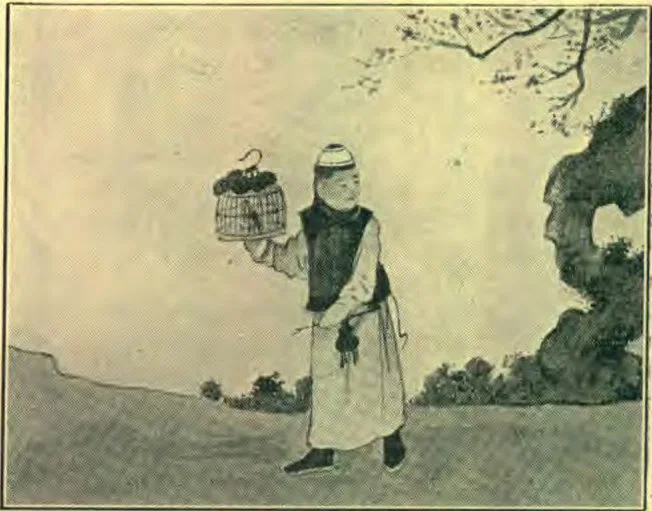
Most shops keep a bird in a cage for good luck. It is a common sight to see men on the streets carrying with the utmost care, as they would a baby, a bird in its cage for its morning airing.
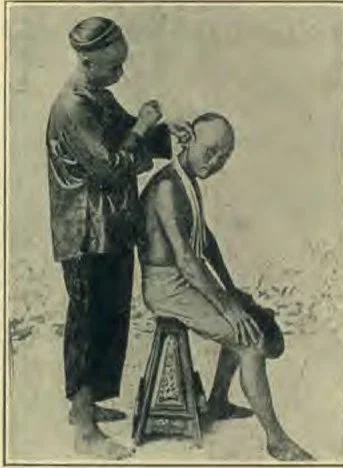
In some recess in the street where the crowd will not press in too closely, one will find the fortune teller. His stock in trade consists of a few bamboo sticks inscribed with cabalistic characters, and a Java sparrow in a cage. A man approaches and asks to be told his fortune, paying his cash in advance. The bamboo sticks are spread out on the board, and the door of the cage is then opened, when the sparrow will hop out, pick up one of the sticks, dropping it to receive the grain of rice as his reward, and then return to the cage. The fortune teller reads the result from the stick the bird indicated, and if satisfactory, the customer disappears, and the fortune teller and bird compose themselves to wait patiently the coming of another inquirer. If, however, the result is “not good,” another trial is generally resorted to, and thus both bird and master profit by the ill success. Then there are the street readers and letter writers, and the ever-interesting street barber, while the street storyteller always has a gaping crowd about him.
Among the strange sights, however, are the multitude of movable kitchens with their stock of cooked foods, found wherever the crowds are the greatest. The kitchen consists of two stands slung on bamboo poles in such a way that they can be lifted to the owners’ shoulders and transported quickly to a new location if necessary. In one of the stands a large pan of rice is placed over a very slow fire, where it remains hot, but does not cook. The top of the other stand is used as a show place on which the various delicacies for sale are laid out on small plates. These are side dishes to tempt the appetite of the customers, and are placed on top of the bowl of rice as ordered.
The cheapest dish is salted turnips, then come bean curds, cucumbers, celery, lettuce, salted beans, and plates of various kinds of fish, with different styles of soy, to be sprinkled on the rice as an appetizer. Why do so many people eat on the streets? Have they no homes? Surely a man without a home, and sons to perpetuate his memory, is a rarity. Possibly the question cannot be answered.
But the saddest of all sights are the opium dens, the “foreign medicine” dealers as they are called, now happily being suppressed by law. These buildings differ from the others in that they have no fronts, and all the windows are closed tightly. There is an entrance door, but a heavy screen is hung just back of it, preventing the interior from being seen. Pushing aside this screen and entering, one sees a dimly lighted room, strongly impregnated with the odor of burnt opium. Around the walls are benches for the customers to recline on when smoking, for the drug temporarily paralyzes the user, rendering any movement impossible.
In the center sits the proprietor, busily engaged in molding small pellets of opium into various-sized balls, which are deposited in tiny cups, made up in advancep. 5 for future customers who, he knows, are sure to come. By experience the man knows just what quantity each of his customers requires, and prepares the dose in advance, as the men are always crazily hungry to obtain the drug, and inhale the smoke without a moment’s delay.
After all, when summed up, the strangest of all the strangenesses of a Chinese city is the absence of noise. There is something uncanny about the street life of this people, who live for their dead. The roar of European cities, with their electric cars and cabs, their automobiles and trucks, and the hundred other noise producers, is absent. Not even the clatter of a horse’s feet breaks the weird stillness. Only occasionally is a street cry heard, while the people come and go, but pass and repass like ghosts, making no noise. One sees, but does not hear them; their cloth shoes or bare feet give no sound. Even the mules shuffle silently through the dirt of the streets. All seems ghostlike and weird. As one turns and passes out again into the European quarters with its automobiles and “outside kingdom” noises, the change is sometimes startling, and you query, Will this people ever abandon tradition and accept the progress of modern nations? If not, what is to be the ultimate fate of China?