SPEAKING on the point that Daniel, though a very busy man, found time to pray, D. L. Moody said: “I am reminded of the words of an old Methodist minister: ‘If you have so much business to attend to that you have no time to pray, depend upon it you have more business on hand than God ever intended you should have.’”
One of the best governors of the Isle of Man was impeached for treason in the civil wars, and sentenced to death. The king granted a pardon, but it fell into the hands of a bitter enemy of the governor, who never delivered it, and the governor was executed. We hold in our hands the pardon of the world; shall we hold it back?
Dr. W. L. Watkinson describes a physician demonstrating to an audience before whom he was lecturing how the pulse varied in certain diseases. The lecture-room was placed in telegraphic communication with the hospital, fifteen miles distant; and then, by means of special apparatus and a vibrating ray of magnesium light, the pulse beats of a patient were exhibited upon the wall. “There is not a throb of our heart,” adds the preacher, “but makes its sign upon the Great White Throne.”
A missionary said she did her best teaching when she dressed the dear little body of the baby that had left her, putting on its prettiest frock, brushing back its flossy hair, laying a rosebud in its waxen fingers, and then called in the heathen women to look at it. They sobbed out in their astonishment, “You’ve fixed your baby up to go to a lovely place, and you expect to see her again. When ours die, we throw their poor little bodies out for the dogs to eat. They have gone into darkness, and we have no hope of ever seeing them again. We want to know about your Jesus who will take care of your baby, and let you have her again.”
A missionary in China writes of a girl in the mission school under her care, that one night she came to her and said, “Teacher, I want you to pray that I may be a whole Christian.” Struck by the expression, the teacher inquired what she meant. So the girl told her of certain things she had done that day that she felt to be wrong, and of things she had failed to do, which her teacher had commanded her. All this she instinctively felt was not in keeping with the spirit of the gospel. So she came with tears in her eyes at the close of day, saying, “Oh, teacher, I want you to pray for me that I may be a whole Christian!”
John Wesley was walking one day with a troubled man who expressed his doubt of God’s goodness. “I don’t know what I shall do with all this worry and trouble,” he said. At that moment Wesley noticed a6cow looking over a stone wall. “Do you know,” asked Wesley, “why that cow is looking over that wall?” “No,” replied his troubled companion. “I will tell you,” said Wesley: “because she cannot see through it. That is what you must do with your wall of trouble—look over it and above it.” Faith enables us to look over and above every trouble, to God, who is our help.
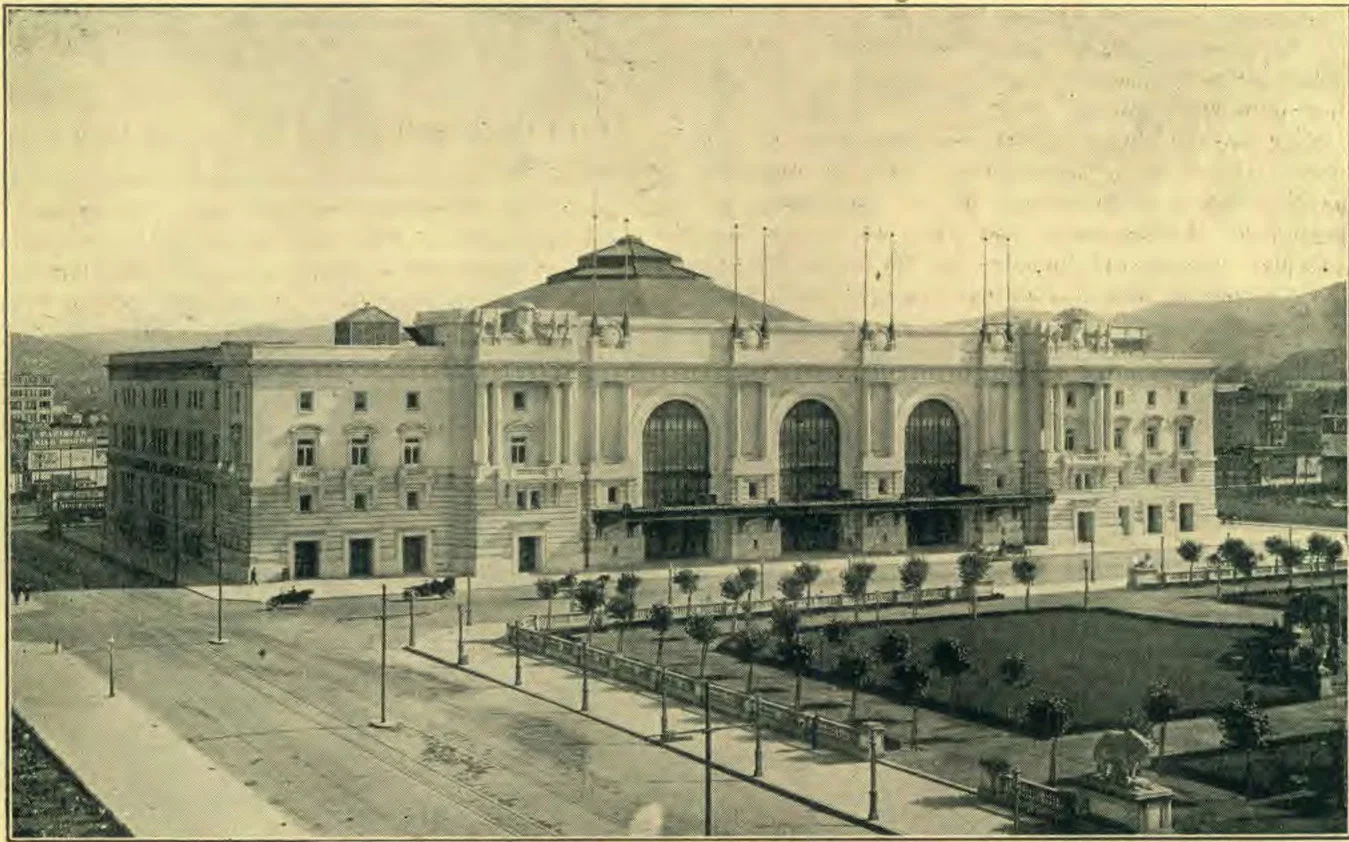
EXPOSITION MEMORIAL AUDITORIUM
In the early days of emigration to the West, a traveler once came, for the first time in his life, to the banks of the mighty Mississippi. There was no bridge. He must cross. It was early winter, and the surface of the great river was sheeted with gleaming ice. He knew nothing of its thickness, however, and feared to trust himself to it. He hesitated long, but night was coming on, and he must reach the other shore. At length, with many fears and infinite caution, he crept out on hands and knees, thinking thus to distribute his weight as much as possible, and trembling with every sound. When he had gone in this way, painfully, about halfway over, he heard a sound of singing behind him. There in the dusk was a colored man, driving a four-horse load of coal across the ice, and singing as he went! Many a Christian creeps tremblingly out upon God’s promises, where another, who is stronger in faith, goes singing through life upheld by the same Word.
Speaking of the Cuban War and his Rough Riders, Colonel Roosevelt declared: “The men I cared most for in the regiment were the men who did the best work; and therefore my liking for them was obliged to take the shape of exposing them to the most fatigue and hardship, of demanding from them the greatest service, and of making them incur the greatest risk. Once I kept Greenway and Goodrich at work for forty-eight hours without sleep and with very little food, fighting and digging trenches. I freely sent the men for whom I cared most where death might smite them, as it did the two best officers in my regiment, Allyn Capron and Bucky O’Neil. My men would not have respected me had I acted otherwise.” One must not be surprised if Jesus chooses the same method of winning his battles.