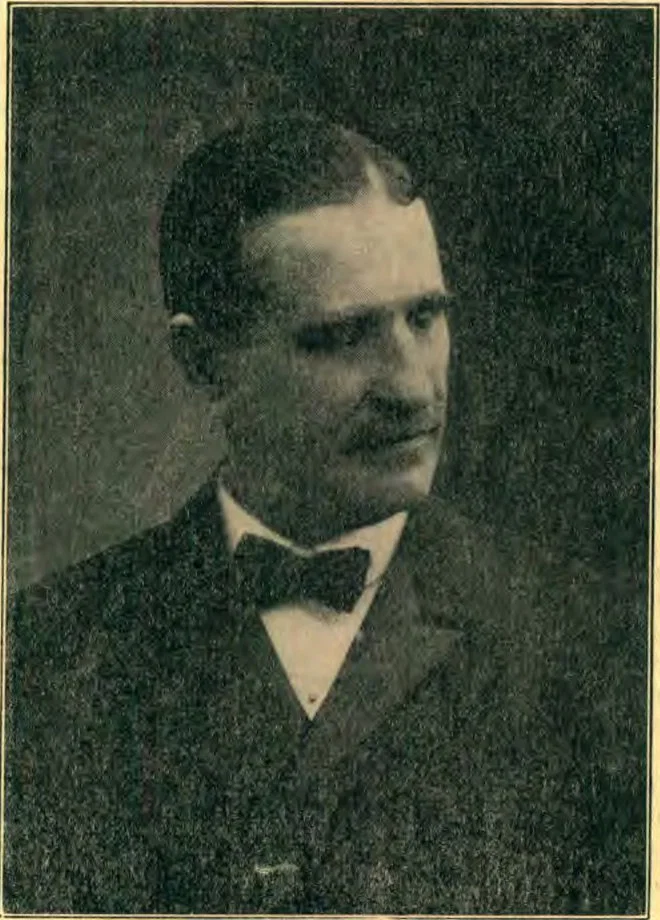
Dr. Adam Geibel is without doubt the greatest living blind composer in the world, and is also one of our most eminent musicians. He has composed much vocal music, both solo and counterpart, and also many instrumental pieces for the piano and the violin. He plays the violin, piano, and pipe organ. Dr. Geibel came to Washington, D. C., a few weeks ago to conduct the presentation of his great masterpiece, “The Incarnation,” which was rendered by a large chorus of students from Washington Missionary College. During the time he was in Washington the writer had the opportunity of obtaining first-hand the story of his life. In spite of his misfortune of being blind, he always seems cheerful. He is very modest, and speaks of his achievements as if they were only commonplace.
ADAM GEIBEL
Dr. Geibel commenced his narrative by saying, “I do not know whether it is wise or not for me to say where I was born. I am a thorough American, and it is not my honor, but my misfortune that I was born in Germany.” He was born in the little village of Neuenheim, near Frankfort-on-the-Main, Sept. 15, 1855. When he was nine days old he lost his sight through an incompetent physician, who treated inflammation which had settled in the eyes, with caustic. The solution was too strong and destroyed his sight. For years every possible effort was made to restore the use of his eyes. He was taken to the greatest oculists in Europe, but all in vain. It was too late, and he was compelled to go through life deprived of one of the greatest blessings God has given to man,—the sense of sight.
At the age of six he first began to show his wonderful talent for music. At that time there were in Central Europe a great number of itinerant musicians and wandering minstrels going from village to village. Whenever they came to the town where he lived, young Geibel would listen to them for hours at a time, wholly absorbed in the music. Then he would go home, and with wonderful exactness, play the pieces which he had heard, on the little spinet or harpsichord that was in his home.
In 1862, he with his parents came to America, settling in Philadelphia. Two years later he was admitted to the Pennsylvania Institution for the Instruction of the Blind, where he received practically all his education. Here his natural talent for music soon showed itself. It was found that he possessed a sense of absolute pitch,—something very few people ever acquire. He could instantly distinguish any note or combination of notes that might be struck. He also memorized by ear very readily. At this college he obtained a thorough training in all the various branches of music.
Dr. Geibel says that the blind are not taught by ear, as many people believe. They are taught almost as the sighted are. The only difference is that the blind must be instructed through the eyes of some other person, or by means of raised letters. Their minds are trained for music and literature just as the sighted are trained.
The first instrument Geibel learned to play was the violin. This was followed by the piano and the pipe organ. He had never planned to become a solo artist, but worked along general musical lines. However, when he was graduated in 1874, he was considered an excellent church organist. There were five in his graduating class, and their work was to compose music for the twenty-third psalm as an anthem for both solo and chorus with organ accompaniment. Each was to do the work independently, and a bronze medal was to be given to the winner. Dr. Geibel was awarded the medal.
He remained at the school for two years after being graduated, taking postgraduate work and teaching. For the next few years his time was devoted to teaching the sighted. Harmony and composition had always been his specialties, and he has taught many who are now famous throughout the country. In 1884, there was a vacancy on the staff of this same school for the blind, and being urged by his friends, he applied for the position and was successful in obtaining it. After being absent from the school nearly ten years, he returned to his dear old Alma Mater, where for seventeen years he taught as assistant of the music department.
Dr. Geibel first began to compose music in 1872.4
His first composition was a little piano piece called “Evening Bells.” He searched for two years before he found a publisher. It was a success, however, and was the means of introducing him to the music-loving public. In 1875 he wrote a two-part song for ladies’ voices, called “Good Night, My Love, Good Night.” This was produced at the dedication of Machinery Hall on the Centennial grounds July 4, 1875, by a large chorus from the Girls’ Normal School of Philadelphia, accompanied by a large orchestra. From that time on his compositions were well received. In 1882, he received his first foreign order. It was from the house of John Curwin, London, for the preparation of a collection of two-part songs for ladies’ voices. A book, called “The Geibel Album,” was the result of this order. During the next few years he devoted all the time he had aside from his teaching to the work of composing two-, three-, and four-part songs for men’s, women’s, and mixed voices. Most of these compositions have since become well known. In 1897 he began publishing sacred music with Mr. R. Frank Lehman as partner, under the firm name of Geibel & Lehman. His compositions were now so successful that in 1901 he resigned from the school, and devoted his entire time to composition work. Five years later Mr. Lehman retired, and the Adam Geibel Music Company was organized, of which Dr. Geibel is president. The company is located in Philadelphia, and publishes music principally for the church and Sunday school.
Without doubt many will be interested in the way his works are dictated and published. All his compositions are dictated to a copyist, whom he calls his amanuensis. It was the privilege of the writer a short time ago to see him compose and dictate music for a church hymn. After thinking for some time, he began to dictate the music something like this: Key of B flat, six eight time. Soprano—d a quarter, e an eighth, slur, b a dotted quarter; next measure, g a quarter, and so on, until he had given the entire soprano score. Then, in the same way, he gave consecutively the notes for the alto, tenor, and bass. All his compositions are dictated in this way and written in pencil by the copyist. They are then played, and after being corrected, are sent directly to the engraver or typographer for publication.
Among Dr. Geibel’s best-known compositions are the following: “The Storm at Sea,” “Constant Devotion,” “Floating Song,” “The Angel’s Refrain,” “March Forward,” “Our Nation,” and his latest work, “Marnus.” Among his cantatas, “The Nativity,” “Light Out of Darkness,” and “The Incarnation” are the best known. The most popular of his secular numbers is “Kentucky Babe.” This song is sung the world over.
Dr. Geibel has done a great work for the blind people in the United States. For years, three different systems of raised letters were used in this country. In order to be able to read the literature written for the blind, it was necessary for one to learn all three systems, and this was a large task. Dr. Geibel has always been heartily in favor of the French system, which is used throughout Continental Europe. He has been one of the leaders in urging the universal adoption of this system in the United States. After much effort and hard work, the success of this system is now assured. It is being rapidly adopted throughout this country. The adoption of this system is a great blessing to the blind, and it will make their task of obtaining an education very much lighter.
Dr. Geibel spends much of his time now in lecture and recital work. He usually gives a short account of his life, plays and sings selections from his own compositions, and completes the program by composing different music for any hymn the audience may select.