RUTH WILCOX
IN choosing leaders for his work, God has always chosen men who were simple in faith and faithful in service. The paths they have walked have not always led them in pleasant and well-traveled roads; many have had to climb up the rugged and rocky mountain of difficulty. Then, when they reached the top, they could encourage and direct more sympathetically those who were still climbing. As Christ was called upon to meet every temptation that comes to us in order that he might sympathize with and help us, so many tests have been given to human leaders that they may be an encouragement to others.
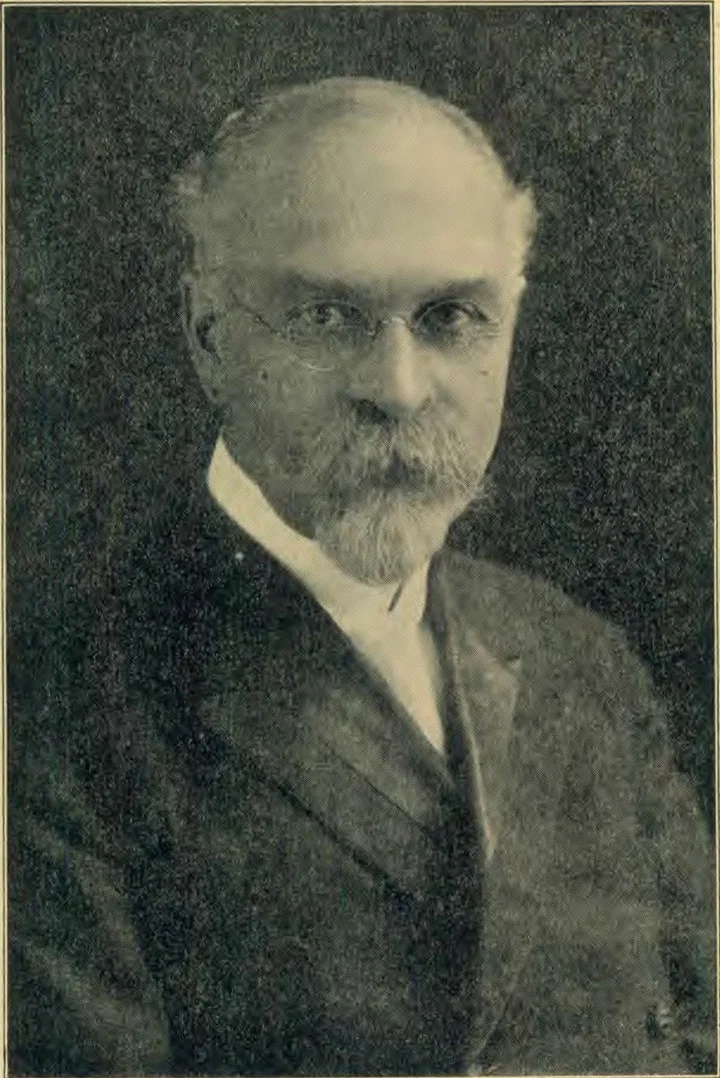
This has been so in every age of the church. Our own denomination affords some notable examples of this principle. We wish to speak of one in this connection; namely, the president of the General Conference.
Arthur Grosvenor Daniells was born in West Union, Iowa, Sept. 28, 1858. His father, a physician, was English. Mrs. Daniells, the mother, was Scotch-Irish.
The country at this time was engaged in a great controversy. The question of slavery was being debated by the North and the South. The climax was reached in 1861 when war was declared.
Answering his country's call, Dr. Daniells left his home and family to minister to the wounded soldiers. A year of anxiety had passed for the mother when word came that her husband was dead.
Mrs. Daniells was left in needy circumstances. For a time separation from her three children was made necessary. Under these circumstances she played the part of a true mother, maintaining the bonds of love between her children. Through prayer and counsel she sought to mold their lives for God. After several years she was able again to establish a home, through a second marriage. In her new country home she was once more united with her children.
Arthur, as the elder son, manfully did his part in the support of the family. In spite of many difficulties he found an opportunity to attend school and lay a foundation for a future education. After availing himself of such privileges as the district school afforded, the way was providentially opened for him to attend Battle Creek College. Difficulties met him here, but he persevered. While others were enjoying their favorite sports, he was sawing wood to help defray his school expenses. By earnest industry he was able to secure the advantages of this school, which did much to determine the purposes and currents of his life.
Elder Daniells's religious convictions dated from early childhood. He always attributed this to the earnest prayers of a godly mother. At the age of ten he was baptized by Elder George I. Butler and united with the Seventh-day Adventist Church. From this time on he had a desire to live a life of usefulness. As he grew older, the desire increased. He longed to devote his life to God's service.
In the early days of our work, when the cause was small and the treasury empty, little opportunity was afforded the young men wishing to enter the ministry. Thus, when Elder Daniells wished to enter this work, instead of being urged on by the leading men, he was forced on by the conviction that he must be connected with God's work.
However, in 1878 he began work in Texas as tent master for Elder R. M. Kilgore. Although he was now connected with God's work and living a life of service, trials came to him as heretofore. The work in Texas was new, material comforts and even necessities were lacking, and wages were low. The young preacher was paid seven dollars a week during the first year. But he kept ever before him his one aim — to make workers. He proved faithful in every detail. Later he returned to Iowa, and in 1880 began his work as a licensed preacher. Having proved his call to the gospel ministry, two years later he was ordained by Elder Butler.p. 7
The faithful work of Elder Daniells had so inspired the confidence of the leaders in the homeland that when the call came for a worker to enter New Zealand, he was sent to that field. As a pioneer in the work there, great opportunities were open to him. In spite of prejudice and opposition he organized in that country two good-sized churches and several smaller ones.
Four years later he was called from the presidency of the New Zealand Conference to the larger field of Australia, where he acted as president of the Australian Conference. It was on this large island that the first union conference was formed. Elder Daniells became its first president. During the time he labored in Australia the church grew from a membership of a few Sabbath keepers to one of several thousand believers. A sanitarium and college were established. The printing work which had just been organized was greatly strengthened. Mrs. White, recognizing the importance and possibilities of the Australian work, with her son, joined Elder Daniells in building up a strong conference. As a result, Australia today sends missionaries not alone to the surrounding islands, but to far-off India and China.
In 1900 Elder Daniells returned to the United States as a delegate to the General Conference. Providence had in store for him a still greater opportunity. At this meeting he was unanimously elected president of the General Conference. He has served in this capacity for nineteen years, the longest term of office held by any president. During his administration our work has continued to progress. New fields have been opened, and the work in old fields has grown. Special attention has been given to foreign missions. Under his leadership, mission stations have been built which practically belt the globe. Elder Daniells has personally visited all the great mission fields, with the exception of South America.
A work which is continually expanding needs a strong organization which is capable of adaptability and expansion. This our denomination has. Under the blessing of the Lord, Elder Daniells has been used to lead out in this strong organization. The educational, medical, and missionary work has been greatly strengthened.
A sketch of the life of this leader would be incomplete without particular mention of his wife, Mrs. A. G. Daniells, who has been associated with her husband from the earliest days of his ministry as a faithful helpmeet. She has shared his labors and travels in every part of the world. The preservation of Elder Daniells's health during these trying years is largely due to her wifely care.
In the midst of his busy public life, Elder Daniells has found time to devote to literary work. He contributes to all our large magazines, and has written two books, “The World War” and “A World in Perplexity,” both of which have had a large circulation.
He is working as earnestly today as he ever has in his life, and has led many to devote their lives to service at home and abroad. He has fully accomplished his aim — to make workers.
“Lives of great men all remind us We can make our lives sublime, And, departing, leave behind us Footprints on the sands of time; “Footprints, that perhaps another, Sailing o'er life's solemn main, A forlorn and shipwrecked brother, Seeing, shall take heart again.”