The Story of the Rebellion Against the Government of King Jehovah
By Carlyle B. Haynes
The Great War — No. 3
The Story of the Rebellion Against the Government of King Jehovah
The Dominions of King Jehovah
CARLYLE B. HAYNES
It is important at the very beginning of this story that we get some adequate conception of the vastness of the kingdom of God. If we view this subject of the existence of evil and the origin and work of Satan from the viewpoint of this world only, we shall never find any satisfactory solution of the great problem which it presents. But if we view this subject from the standpoint of the entire universe, with its unnumbered millions of created intelligences and its far-flung boundaries reaching out into infinite space, we may gain some slight idea of the majesty and justice of Almighty God in permitting Satan to work his will among the inhabitants of this earth.
And so, in this chapter, we shall start out upon a journey which will reveal to us something of the greatness of the dominion over which Jehovah sits as king. In imagination we shall travel through the vast reaches of space which separate the parts of the kingdom, until thought and imagination fail and the heart faints with the greatness of the mind of God, who spoke it all into existence.
A Wonderful Journey
Before starting upon this journey let us view that part of the kingdom of Jehovah upon which we now dwell—the earth itself. This earth is a globe 8,000 miles in diameter and about 25,000 miles in circumference. Its surface contains nearly 200,000,000 square miles. It is diversified with great divisions of land and water,—continents, oceans, islands; mountains which push their mighty heads through the clouds; depths of ocean which are unfathomed; vast subterraneous caverns, and volcanoes belching flames; lakes, rivers, forests, and swelling hills clothed with verdure. Millions of animals of every form and size, from the elephant to the ant, roam over the earth; unnumbered schools of sea animals, from the whale to the shrimp, play in the ocean; birds of all kinds and without number fly through the air above. And over all these and the earth itself, numerous tribes and nations of men suppose themselves to be the rulers.
It is only with laborious thought that the mind takes in the vastness of the bulk of this globe. If we were to take our station on a mountain from which we could see 40 miles in every direction, a circle 80 miles in diameter and 250 miles around its outer rim, our eyes would cover an area of 5,000 square miles. With the hills, valleys, rivers, lakes, villages, farms, roads, and cities which such a scene would present, we should find it difficult really to grasp it all in our mind’s eye at once. But when our eye covers such an area we are looking at but one forty-thousandth of the entire area of the earth’s surface. That is, 40,000 such views must pass before us before we have seen all the surface of the earth.
And if we were to keep our station on that lofty mountain peak while one such scene as this passed before our eyes every hour, and were to devote twelve hours every day, day after day, to this work, we should be compelled to remain there nine years and forty-eight days before we had seen the whole surface of this majestic ball upon which we live. And then most of the objects would have passed by us at a great distance, of from twenty to forty miles, and would have been very indistinct.
And should we be determined to see everything distinctly before we leave on our long journey to other planets and systems, and come down from the mountain top to walk through every square mile of the surface of the earth, and walk thirty miles every day, 18,264 years would have passed before we had finished our journey. If we had started when Adam was created, we should now be but one third through.
And consider the bulk of the earth. It is 8,000 miles through it, that is, its solid contents amount to 263,858,149,120 cubic miles. After laborious effort, the mind fails to take in the thought of such a vast amount of matter. How great the power of Jehovah must be, who spoke it all into existence from nothing! How limitless must be his might “who hath measured the waters in the hollow of his hand, and meted out heaven with a span, and comprehended the dust of the earth in a measure, and weighed the mountains in scales, and the hills in a balance.” Isa. 40: 12.
VIEW OF THE STARRY HEAVENS
RELATIVE SIZES OF THE PLANETS
Thus before we have left our own domain, we find ourselves bewildered at the immensity of this almost the smallest of planets, and we have advanced but a single step upon our journey into the dominions of the God of all the universe. This globe of ours, yes, even the entire solar system, is but a grain of sand in comparison with the material universe over which Jehovah presides.
Other Worlds
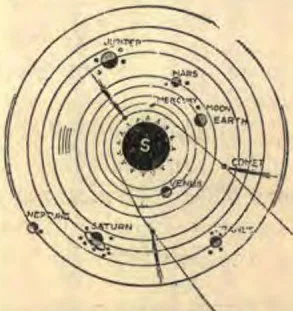
But we have taken only the first step, and must hasten on. Taking our flight out into the planetary5system, the system which is controlled by our sun, which is its center, we find that one of the planets is 770 times as large as the earth, and is encircled by a ring which reaches out from its surface nearly as far as the moon is from the surface of the earth. Another of the planets is 1,400 times as large as the earth, though it appears but as a bright star to the naked eye at night. Taking all the great orbs which circle round the sun, we find that they contain a mass of matter 2,500 times greater than that of the earth.
That immense ball, the sun, which controls them all and dispenses light and warmth to them all, weighs 750 times as much as all the planets and their satellites together, and 330,000 times as much as the earth, throwing the light and warmth out from its surface to the outermost planet, which is 2,790,000,000 miles away. The imagination can contemplate no more glorious and magnificent object than this, wielding its controlling influence over the planets which swing through space around, governing this great family with a power which never for one instant fails.
Mercury is the nearest of the planets to the sun, being 36,000,000 miles distant; Venus is 67,000,000 miles away; the earth 93,000,000; Mars, 141,500,000; Jupiter, 483,300,000; Saturn, 886,000,000; Uranus, 1,780,000,000; and Neptune, 2,790,000,000. Taking a copper penny to represent the weight, or mass, of the earth, that of Mercury and Mars together would then be represented by the old silver three-cent piece; Venus by the ten-cent piece; Uranus by a silver dollar, half dollar, and quarter; Neptune by two silver dollars; Saturn by eleven silver dollars; and Jupiter by thirty-seven silver dollars.
Myriads of Stars and Systems
And now we have reached the outermost rim of our solar system, and look, as did Alexander, for new worlds to conquer. But where shall we begin? The universe before us is swimming with myriads of stars and systems.
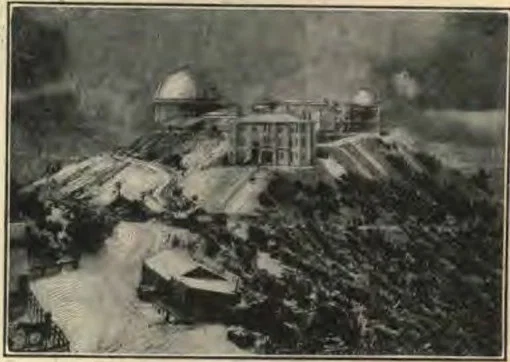
Out at an inconceivable distance beyond our solar system there is the stellar system. On a clear winter night nearly a thousand of these stars can be seen with the naked eye; and as each one of these stars is a great sun like our own, undoubtedly surrounded as ours is with planets controlled by this central luminary, there lies before us a mass of matter equal to one thousand solar systems, or to 1,500,000,000 globes of the size of the earth. But when we realize that the stars which can be perceived by the eye do not compose one one-hundred-thousandth of those which can be seen through a large telescope, some idea can be faintly grasped of the length of the journey before us. In parts of the sky where the eye cannot discern more than twenty stars, the telescope will reveal thousands. Dr. Herschel, the noted astronomer, says that a view of the Milky Way through his telescope revealed no less than 588 stars in his field of vision, and that “in one quarter of an hour’s time there passed no less than one hundred and sixteen thousand stars through the field of his telescope.”
And out beyond the uttermost reaches of human vision, aided as it is by powerful glasses, undoubtedly there are myriads of vast orbs rushing through space, unknown to man. With each new telescope that is stronger than those which have preceded it, new vistas are being opened up, and new stars are found far beyond those which have previously been discovered.