J. S. YATES
When visiting the ancient Hindu temple ruins in central Java a few weeks ago, we saw thousands of gods, telling of a dead past. These ruins represent more than five hundred temples, monasteries, and mausoleums; all in such a small district that by using a motor car one might well visit each group in a single day.
For centuries these chاندis, or temples, were buried beneath ashes from some of the nine neighboring volcanoes, and also further hidden by luxuriant tropical vegetation. Of late, considerable excavating has been done and some efforts made at restoration.
Near a group of ruins an inscription was discovered which tells with perfect exactness the age of the Tara Temple. As deciphered by the Dutch scholar, Dr. J. Brandis, and the Indian, Dr. R. G. Bhandarkar, a part seems to read, “The great king built the Tara Temple in honor of the guru [teacher] when seven hundred years of the Sakai era were past.” That would make it the seven hundred and seventy-ninth year of our era. It is assumed that all of the ruins belong to the same period.
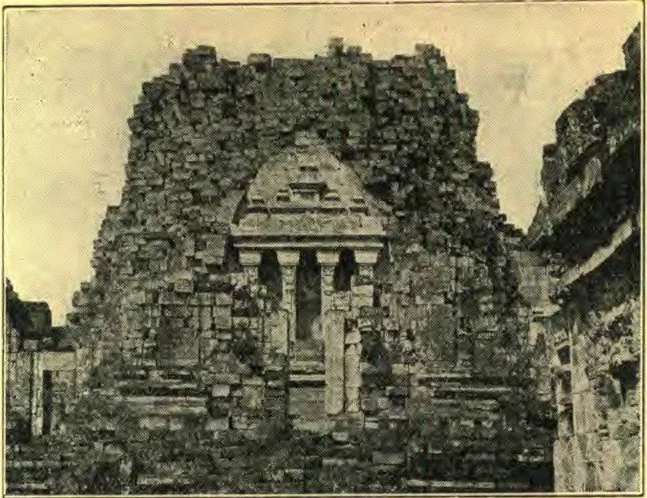
These structures were “built without the aid of line or mortar, the stones being joined by means of tenons and mortises, and dovetails; which bind them solidly together. The material is volcanic lava, whose grayish tint enhances the imposing and melancholy effect, . . . a melancholy hardly enlivened by the most fantastic virtuosity of the chisel.” It is evident that many of the colossal images were placed on their pedestal and the temples built over them.
The largest single structure is Boro Budur, being five hundred and thirty-one feet on either of its four sides. Here are a thousand images of Buddha alone, which if placed in a single line would extend for three miles.
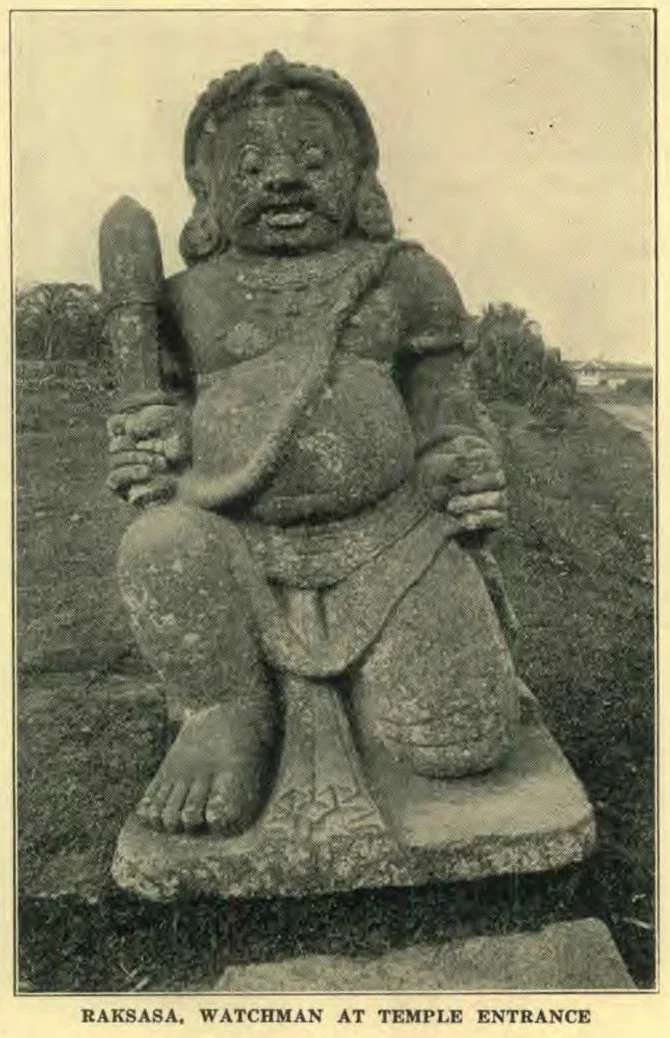
Notwithstanding the Buddhistic character of these ruins as a whole, a group near the villages of Prambanan has not one Buddha figure, but many Brahmanic gods. Of these temples the learned Dr. J. Groneman says: “They are the most interesting in the country. . . . In beauty, exquisite workmanship, and imposing majesty the sculpture works of Prambanan are not surpassed by those on any other monument of an extinct civilization.” To this group we will now give our attention.
Leading to the eight large temples were one hundred and fifty-seven smaller ones arranged in terraces. Inscriptions show that at one time a mighty Hindu empire existed in ruins in these parts, so it is thought that the main buildings contained the ashes of the leading rulers, while the lesser ones were mausoleums for monks and minor dignitaries, being built as the need demanded through a long period of time.
In the year 1890 the basements of the greatest temples were laid bare. Some of the wells beneath the images were relieved of their treasures before the archeologists got to them. However, we are told that in one they found a cinerary urn of stone holding imperfectly burned ashes, some flat pieces of gold and silver wrapped in copperplate, disintegrated, yet still showing old Javanese characters; seven oblong gold plates; five figures cut out of gold leaf, symbolizing a dragon, a tortoise, a lotus, a rosette, an altar, and ellipse; thirty-two globular Hindu coins; some garnets, etc. In others they found a gold coin, a gold nail, a tortoise, a cross, a fish from agate, and some rubies. These treasures buried with the ashes represented what loved ones wished the dead might have in a life hereafter.
On these temples epics pertaining to the gods of the Hindu Pantheon have been wrought in bas- and high-relief sculptures; but to the one who has not time to study them they represent merely a lot of rabbits, rams, deer, tigers, parrots, peacocks, geese, trees, bells, melons, and a profusion of demons, dancing musicians, heavenly nymphs, birds with human faces and breasts, etc.
Among the gods that can still be seen here are:
Agni, the god of fire. Here out of a flower arise flames which are pointed and serpentine.
Ravana, which has ten heads and twenty armed hands, riding a winged giant.
Kala, killer, and to the Buddhists this god of death is no enemy, so he is represented with a noble, mild countenance instead of the horrifying tusked-mouthed monster with a collar of skulls seen in other heathen temples.
Siva, god of destruction, has three eyes, wears a crown with a skull over a lunar crescent, a cobra across his shoulder, and a panther skin, the head of which hangs down on his thigh.
Ganesa, god of prudence, is shaped like an elephant, has four hands, also has three eyes and the divine decorations about his head as his father, Siva. One of his hands wields an ax, in another is a rosary, the third holds a little vase from which the trunk takes some food, the fourth lies half open on his knee.
Brahma has four headsp. 9 and eight arms; however, another Brahmanistic image has only six arms, and still another of the same deity has but four.
Vishnu, preserver, is a lion-man. It was thought that the demons could not resist the god in whom was both human and brute force.
Nandi is Siva’s sacred humped Indian bull. “It is told that among the Javanese and Mongolians, . . . and even among Europeans, there are some who believe that a man who, mounted on the Nandi’s back, wishes to become rich, stands a fair chance of having his wish fulfilled some day.”
Durga, protectress, consort of Siva, is no doubt the most popular image now. When we entered her chamber we were impressed with the fragrance of the flowers that had been piled in heaps at the foot of this beautiful image. She is standing on a bull she has killed, wielding with some ten hands weapons, among them a bow and arrow. Her lowest hand holds the tail of the bull, and another is fastened in the hair of a demon. From a Dutch work translated by a Mr. A. Dolk, we learn that “from far and near Javanese and Chinese come to offer her incense and flowers and ask favors of her, or fulfil a vow pledged in times of illness or adversity. Even hadjis, pilgrims to Mecca, conform to this heathenish custom. Stranger still, there are Europeans and half-castes who apply to the image for protection, prosperity, a high prize at a lottery, . . . a husband, etc.”
Of these ruins Mr. A. Cabaton, in his book, “Java, Sumatra, and Other Islands of the Dutch East Indies,” says of these temples: “To judge by their numbers, the powers of conception which they reveal, the boldness of execution, and the perfect art of their decorations, all these monuments prove that here at one time existed a great and flourishing empire; extremely populous, to judge by the swarms of artisans and laborers who must have been employed in the construction of these gigantic buildings . . . whose remains compel the admiration of all after centuries have elapsed.”