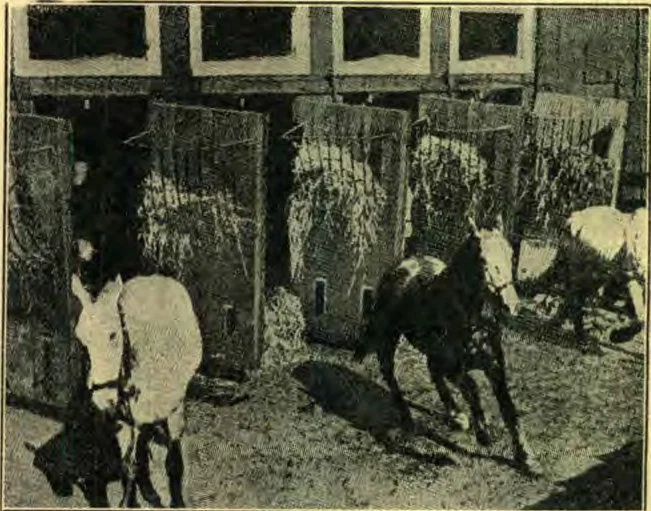
If the stable should burn, don't worry about the horses; the heat of the fire will set them free—that is, if the structure is equipped with the device of a Los Angeles inventor, which has been given a thorough test in his own city. In a large stable there, ten horses were placed in stalls furnished with the automatic equine release, and the heat from a single burning match was applied to the control. The fusible link melted in this trifling rise of temperature with the following results: a gate fell behind each horse, so that it could not back into the stable and get caught in the burning structure (supposing it had been a real conflagration); a door in front of each horse flew open by gravity, allowing a way of escape into the courtyard; the manger, which was built upon the door, collapsed, and in so doing released the rope which held the horse.
Thus the animal was released within five seconds of the time the test began, and the noise made by the moving gates and doors was sufficiently startling to send it scurrying into the open. As ten stalls were thus equipped, and as the opening of each door took place at the same time, there was quite a stampede of horses at this fire-escape test.
The operation of the entire system is by gravity, and the control may be by a single motion of the watchman's hand, or, if he happens to be away or asleep, the heat of the fire will do his work. A cord is extended throughout the structure with links at frequent intervals. Any of these links will melt rapidly under moderate heat, severing the cord, and when that is parted at any point, the automatic release becomes operative.—C. L. Edholm, in St. Nicholas.