THE BLUE JAY

7%

Review and Herald Publishing Company · Battle Creek, Mich. · Apr 11, 1901

FromThe Youth’s Instructor, Vol. 49, No. 15.

Read the full edition

THE BLUE JAY

Although familiar with the bird from boyhood, no other creature has given me more surprises than the Blue Jay. He is as full of antics as a clown, and far more original; and the different notes and noises he can make is something remarkable.
He puts himself in one posture when he sings; another when he is on the lookout for danger; and when he squawks, his attitude is absolutely ridiculous. As another has said, he “humps himself up, drops his tail as if he was falling apart, and then squawks!”
He seems much of the time in a scolding mood, and yet appears thoroughly to enjoy being fretful and saucy. He is very suspicious, always restless and on guard, not only as if fearing mischief from others, but plainly to find opportunity for some of his own.
He never sulks nor pouts; he is above such methods of showing ill will. He prefers to fly into a furious passion, and be done with it, or at any rate with the most of it. It has been said that on such occasions he swears; and Bradford Torrey affirms he has seen him when it was plain that nothing except a natural impossibility kept him from tearing his hair.
“His larynx would make him a singer, and his mental capacity is far above the average; but he has perverted his gifts till his music is nothing but noise, and his talent nothing but smartness. A like result the world has before now witnessed in political life, when a man of brilliant natural endowments has yielded to low ambitions and stooped to unworthy means, till what was meant to be a statesman turns out to be a demagogue.”
“It is a point in the bird’s favor that he still has, what is rare with birds, a sense of humor, albeit it is humor of a rather grim sort,—the sort which expends itself in practical jokes and uncivil epithets. He has discovered the schoolboys’ secret—that for the expression of unadulterated derision there is nothing like the short sound of a, prolonged into a drawl. Yah! yah! he cries; and sometimes, as you enter the woods, you may hear him shouting so as to be heard for half a mile, ‘Here comes a fool with a gun; look out for him!’”
THE BLUE JAY
THE BLUE JAY
There is, in fact, more truth than fancy about the matter of the Jay and a hunter. The Jay is naturally so inquisitive and suspicious that he never fails to give the alarm as soon as he sees a sportsman among the trees. “Many a deer,” says Professor Wood, “has been lost to the anxious hunter through the warning cry of the Jay; for the deer understand bird language quite well enough to know what is meant when a Jay sets up its loud dissonant scream; and many a Jay falls a victim to the bullet that had been intended for the heart of the escaped deer. Indeed, some hunters have taken so rooted a dislike to this bird that they always shoot it whenever they see it.”
I shall not soon forget the first time I heard the song of the Blue Jay. I had, from earliest recollections, been familiar with its dissonant screams and squawks, and supposed these to be the full limit of its vocal powers. But one day in early summer I heard a beautiful, flute-like song. I was at once on guard to discover, as I supposed, a “new bird.” Drawing a trifle nearer the tree from which the notes came, I discovered a Blue Jay. Once more he sang his flute-like song; and then, noticing my attentive attitude, he flew swiftly and silently away. It was a marvel to me that a bird with such a voice, capable of singing such a song, should generally so far forget himself as to deprave his powers by uttering shrieks that sound for all the world like the piercing creaks of an ungreased wheel.
Sometimes we are told that spring is here, “for Blue Jays have come.” Spring makes some difference in the number of the Jays, but in Illinois, Michigan, and neighboring States they are with us all winter. I saw one this winter about the middle of December. He flew into an alley near my office, alighted in a small tree, and screamed at a furious rate.
It has been held by many that the Jay is an inveterate murderer of young birds and a destroyer of eggs; but out of two hundred and eighty stomachs that were examined, remains of birds’ eggs were found in only three, and young birds in only two. This would seem to show that this bird is not so black as he is painted. As long as anything better offers, he never eats corn.
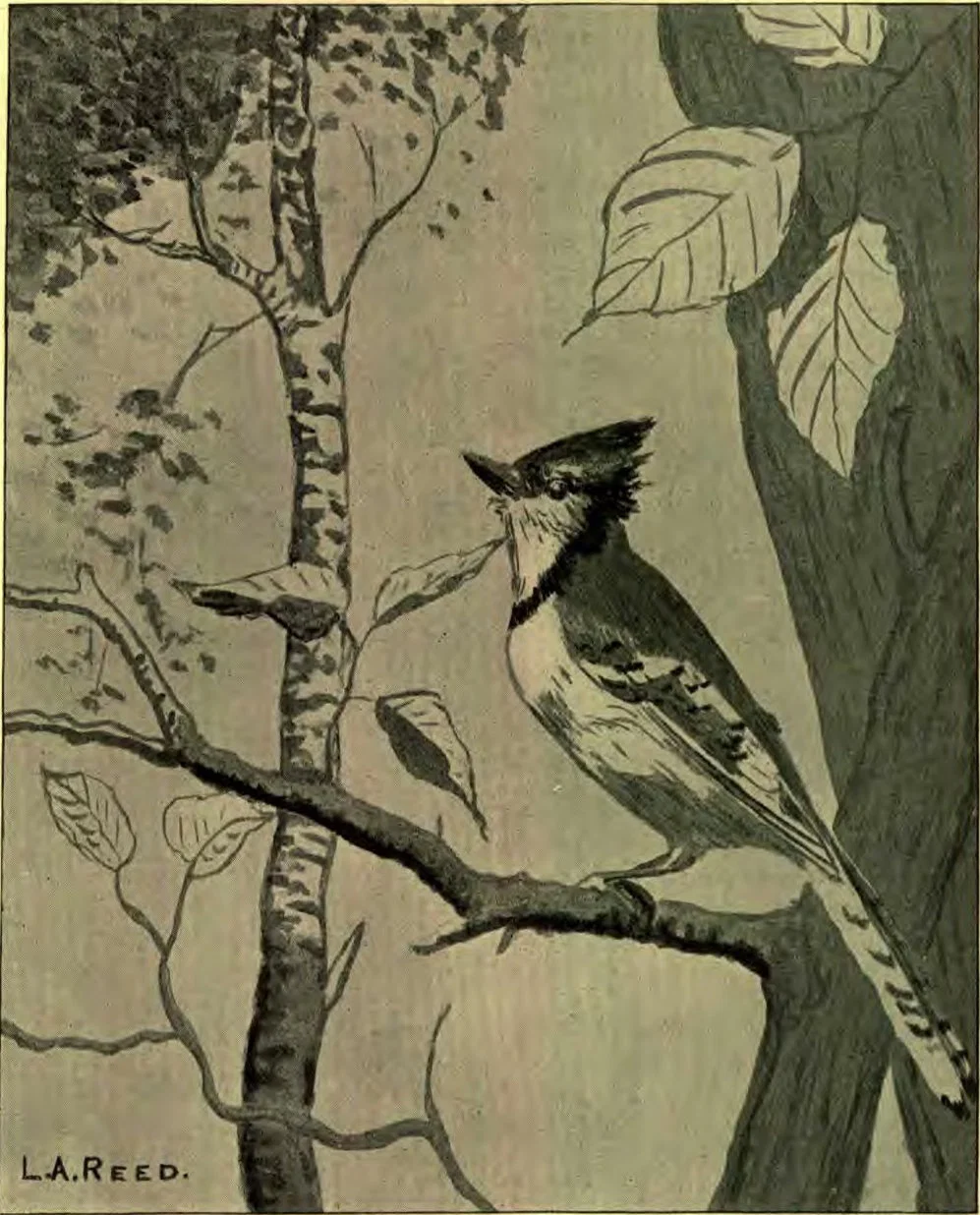
The crest and upper parts of the Blue Jay are purplish; the wings and tail blue, marked with black and white; and the under parts gray. A black collar completes his dress. He is a very pretty bird, and, despite his bad traits, is well worthy of study.
L. A. REED.