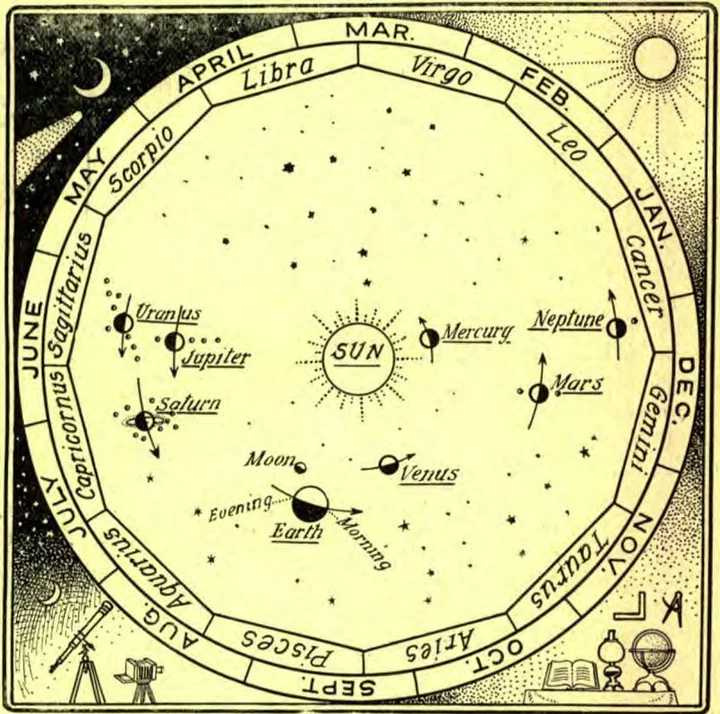
In our last study of astronomy, which appeared in the INSTRUCTOR of Aug. 23, 1900, we presented a diagram of the solar system showing the positions of the sun and accompanying planets as they would appear during the first part of the following month, with the promise that if time permitted, we would follow the different worlds in their God-given courses about the sun, noticing their positions from month to month. Sickness cut our work short, but while we are sorry to have lost so much valuable time, we are thankful to our Heavenly Father for his restoring hand that has been over us for good, and we gladly take up once more with the readers of the INSTRUCTOR the beautiful study of his great workshop.
In order to obtain something of an idea of what has been going on in our solar system since last we met for study, and also to gather up the threads of our work where we left it some time ago, we present, with this, two diagrams, the first, Fig. 1, being a reprint of the one that appeared seven months ago, showing the positions of the planets as they were Sept. 1, 1900; while the second, Fig. 2, shows them as they were the first of the present month—April. By comparing the two we see at a glance just what onward progress each world has made during the time that has elapsed since our last study.
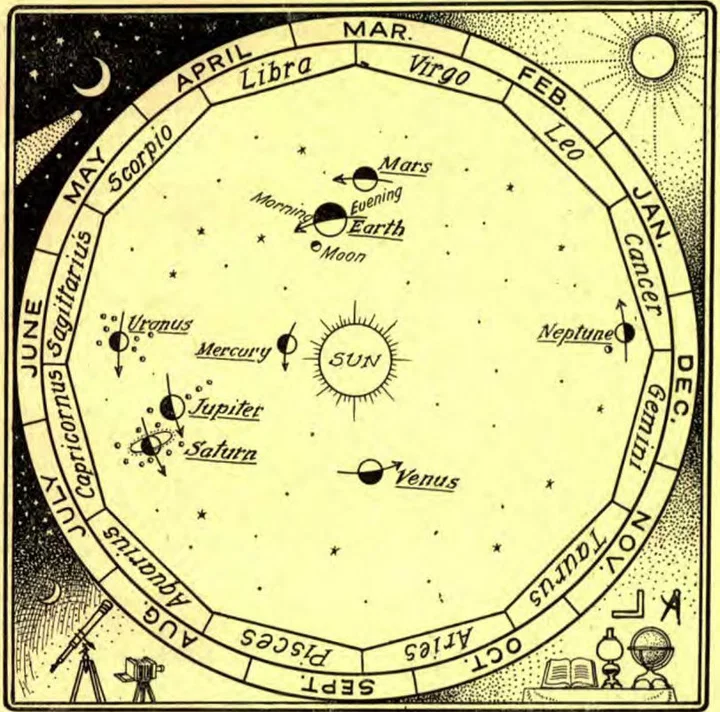
Mercury, as you will notice, was then passing rapidly along his path between the sun and the sign Cancer; to-day, April 1, we find him hurriedly passing between the sun and the sign Sagittarius. But remember that it takes Mercury only about eighty-eight days of our time to complete one whole year of his time; consequently, during the last seven months he has passed completely around the sun two and about one-half times, so that a child born upon that planet at the time of our last study would now be two and one-half years old, according to their time.
Venus, the next farther planet from the sun, having a larger circle in which to travel, has not made the seeming progress that Mercury has.
The yearly circle of Venus being two hundred and twenty-four days of our time, we find the planet within two-days’ travel of the exact point in the heavens where we last saw it, in the sign Aries.
Our own earth has passed from Pisces nearly around to Scorpio, and we all well know of the climatic changes that have taken place upon it during this time.
Mars we left in Gemini, but now we find him just passing from Virgo into Libra. We wonder how many of our INSTRUCTOR class are following this “ruddy god of war” in his apparent westward course among the stars that bedeck our evening skies? In our next study we shall learn many interesting facts regarding this near neighbor of ours.
Jupiter has passed from Sagittarius into Capricornus; while Saturn, with his rings and moons, has seemingly not done so well, remaining still in that part of the heavens known as Capricornus. Jupiter, it will be seen, has been slowly gaining on Saturn, while the two have been leaving the more tardy Uranus in the rear. You remember with what interest we watched the planets Jupiter and Saturn in their movements among the stars last summer? Well, this coming summer and fall, when they again appear, they will be much nearer together than they were last season; and we hope that by that time all our readers will have become so familiar with these planets that they can point them out, and be able to tell many interesting things concerning them.
The next planet is Uranus, and we can scarcely pass this interesting and unique planet without stopping for more than a mere mention. Uranus is very different from the other planets, away off there by itself, rolling and tumbling along in a manner peculiarly its own. It does not stand up and simply turn around, as do all the others, giving their inhabitants a comparatively equal day and night, but appears to lie down and roll over. In other words, its poles are not perpendicular to the plane of its ecliptic, or nearly so, but they are almost horizontal. At a certain season of its year its north pole points almost directly toward the sun; and at that season the sun does not rise and set, as it does with us, but merely describes a small circle in the northern heavens each day, which is about ten hours of our time. As the season progresses, this circle in the northern heavens becomes larger and larger, till soon the sun sets in the northwest and rises in the northeast. As the weeks and months go by, the sun keeps working farther to the south, setting in thep. 116 west and rising in the east. As this southern movement of the sun progresses, the nights grow longer (Uranus had no night at all to start with), and the days become shorter until at last the sun appears for a short time each day above the southern hillsides, and finally disappears altogether, leaving the inhabitants who live near its north pole, if such there be, to either move to the southern part of their globe or else remain in the darkness of constant night for at least forty years of our time.
These are interesting thoughts. Why did the Creator so make this wonderful world? Why is it so different from all the rest of our family? Praise his holy name, we soon, if faithful, shall have the privilege of visiting these noble worlds that he has created, and then we shall know. We hope, before long, to spend a whole evening studying the planet Uranus.
Although Neptune, the farthest away from the sun of any of the planets with which we are acquainted, has been during the last seven months plunging along at the enormous rate of eleven thousand miles each hour, its circuit is so great, requiring one hundred and sixty-six years of our time to complete one year of its time, that neither in the heavens nor on our small chart can we notice a very perceptible change in its position.
When we realize that eye hath not seen, nor ear heard, neither have entered into the heart of man, the things that God has prepared for them that love him, and contemplate the reward that awaits the faithful of earth, so soon now to be realized, how careful ought we to be in all holy conversation and godliness, looking for and hastening unto the day of God!
DR. O. C. GODSMARK.