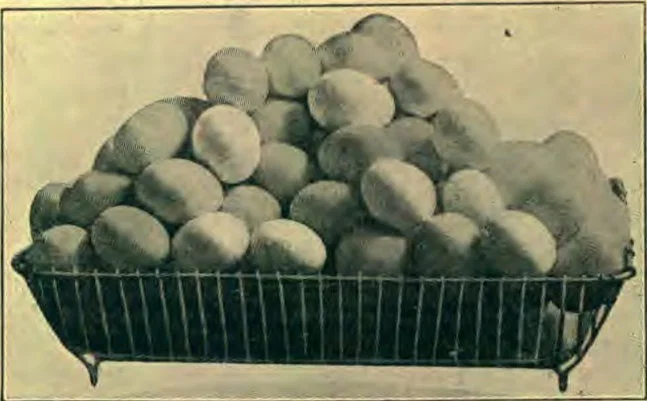
A RECENT bulletin of the Department of Agriculture gives the results of five years of careful study of methods of putting up frozen canned eggs for the market. The experts of the Department found that it is just as possible to make good canned eggs as it is to make good canned milk or good canned baked beans. And there is a good deal more of an economic reason for canning eggs than canning beans, for on account of their fragility, eggs cannot be kept and transported so easily as beans. Eggs are produced principally in the spring and summer, and there is practically no production in the winter. Unless the oversupply of eggs in summer can be kept in some way for winter use, there must be a shortage.
Of course, some of the summer eggs are kept in the shell in cold storage, but there are many perfectly good fresh eggs which are small or slightly cracked, or soiled, and which cannot therefore be kept in the shell, or which it would not pay to ship in summer from the corn belt to the egg-consuming markets. These eggs, the Department of Agriculture has found, can be broken and canned and kept in excellent condition for winter cooking. You may buy the whites separately in one can and the yolks in another, or you may buy whites and yolks mixed together in a single can. They are not yet put up in packages small enough for the average householder. The smallest commercial package is five pounds, and this would not be practicable for ordinary home consumption, because the eggs have to be used practically as soon as they are thawed out. They can be kept only two or three days at a temperature of 45° to 50°, which is the temperature of the average household refrigerator.
These hard frozen eggs, however, are already used by most bakers and manufacturers of macaroni, and they are practical for use in hotels, boarding houses, restaurants, and large families. In fact, some hotels with progressive chefs are already using them. They cannot, of course, be used for poaching, but they can be used for all cooking purposes in which eggs are required. They are excellent for pies, puddings, and custards, far cheaper than fancy shell eggs, and far better than seconds or storage eggs. They are cheaper because they are put up largely in the egg-producing belt of the Middle West, at the time when hens are laying best, and because they can be shipped closely packed in refrigerator cars, so that there is no waste space and so that the usual ten-per-cent loss from egg-breakage is saved. They are fresh because only fresh eggs are allowed to go into the cans, and after they are frozen, they are kept in absolutely air-tight tins, without deterioration either in quality or in freshness until they are used.
As soon as the eggs are received at the examining house they are sent to a chilling room and kept for about twenty-four hours at a temperature between 35° and 38° F., which removes all heat from them. They are then candled and recandled in another chilled room, and all eggs which the candling shows to be other than good are discarded. These graded eggs are then broken in refrigerated rooms, which are so constructed that they are as aseptic and as light as it is possible to make them. No dust or flies can get into these rooms, and the temperature in them never rises beyond 65° F. These rooms, moreover, are absolutely water-tight and steam-proof, so that they can be thoroughly cleaned.
Owing to the perishable nature of eggs, their canning under the method developed by the specialists of the Department of Agriculture calls for even greater cleanliness than is considered necessary in canning other products. In fact, the egg-canning rooms which the Department is striving to get egg handlers in the egg-producing centers to establish, look more like the operating rooms of modern hospitals than commercial factory plants, and represent the acme of scientific sanitation. The utensils used for breaking the eggs are all of metal, so that they can be steam sterilized, which is necessary in order that the work of breaking and canning the eggs can be done with bacteriological cleanliness. The operatives clean their hands much as a surgeon does before beginning an operation, and they dress in clean caps and gowns, such as are used by trained nurses.
Each egg is broken into a separate glass cup and carefully inspected before it is poured into a sterile container. Wherever a doubtful egg is broken, it is at once cast aside and all the utensils used in connection with it are cleaned and sterilized, and the operative cleans her hands. All the traces of the bad egg must be removed before work can be continued. In order to make certain that the egg breakers will give sufficient attention to each egg, a definite speed of breaking is set and maintained. Girls who attempt to work too rapidly and carelessly are checked. As soon as a can is filled with broken eggs, the contents are mechanically churned to a cream, and the can is then taken to the “freezer,” which maintains a temperature of 10° F., and sometimes much lower.
The freezer is an immaculately clean room, filled with row on row of shelves formed by pipes covered with thick hoar frost. Inside the pipes there is a flow of brine or other chemical solution which is kept far below the freezing point, so that the heat in the roomp. 10 is absorbed by the pipes, in exactly the opposite manner from the way in which steam radiator pipes throw heat out into a room. The can of frozen eggs is placed on one of these shelves and in twenty-four to thirty-six hours the eggs in the can are hard frozen. They are then carefully covered and kept until required for use. Until the canned eggs are actually opened and melted for use in cooking, they are kept hard frozen. The exceedingly low temperature which is maintained prevents the multiplication of bacteria, and when the eggs come out of this storage, if proper conditions have been maintained, they are just as sweet and fresh as the day they went in.
Such is the process which makes fresh laid eggs in winter a staple instead of a luxury. Hard frozen eggs cannot now ordinarily be bought at retail because they would have to come to the housewife absolutely hard frozen, and very few retailers are equipped with sufficient cold storage facilities to keep any hard frozen articles. The eggs have to be kept at a temperature of 32° or below, and most refrigerators in retail stores are from ten to fifteen degrees warmer. The possibilities of refrigeration are still in their infancy, and some day, if there is the right kind of refrigeration all along the line, it will be possible for the egg dealer to deliver to the housewife a two-pound box of frozen eggs on baking day, much as the milk dealer now delivers his standing order of milk. In this way the housewife would be getting her eggs at the equivalent of twenty-two cents a dozen instead of fifty cents or more in the middle of winter.
Until that happy time comes, however, the possibilities of the wider use of frozen eggs in restaurants, hotels, first-class baking establishments, and by manufacturers of commercially prepared food products, should be known and appreciated. Frozen eggs are a boon in that they offer a means of raising the standard of life at the same time that they decrease the cost of living. The years of careful study which the Department of Agriculture has devoted to the matter and the resulting wise direction which has revolutionized and standardized the frozen egg business, represent a service of inestimable value to the people of the country. — The Forecast.