AMONG Europe’s small kingdoms is that of Roumania, which is about one fifth the size of Texas, with a population one-half million less than that of Pennsylvania, or less than 8,000,000. Roumania is bordered on the south by Bulgaria, on the west by Serbia and Austria-Hungary, and on the north and east by Russia. The Black Sea also touches it on the east. These countries contain a large number of Roumanians, enough to give a “restored” Roumania a population of 12,000,000. And the hope of a “reunited” Roumania was one of the elements entering into this country’s decision to cast in her lot with the belligerents.
“Few states in history have been called to such momentous decisions as Roumania faced when it plunged boldly into the Niagara of blood and carnage that has rolled down over Europe for these two long years. But both hope and fear beckoned the Roumanians—the hope of a greater Roumania and the fear of a strangled homeland.”
“If the Central Powers won with Roumania on their side, they might, they felt, get something out of Russia; but Transylvania and Bukowina would still be beyond their grasp. On the other hand, they believed Russia would give them the beautiful Bessarabia, an adjoining Russian province which once belonged to Roumania, as a prize for participation on her side, and the Allies Bukowina and Transylvania on condition of an allied victory.”
So Roumania is in the war, “led by hope and impelled by fear;” and whatever the outcome, it will mean much to her.
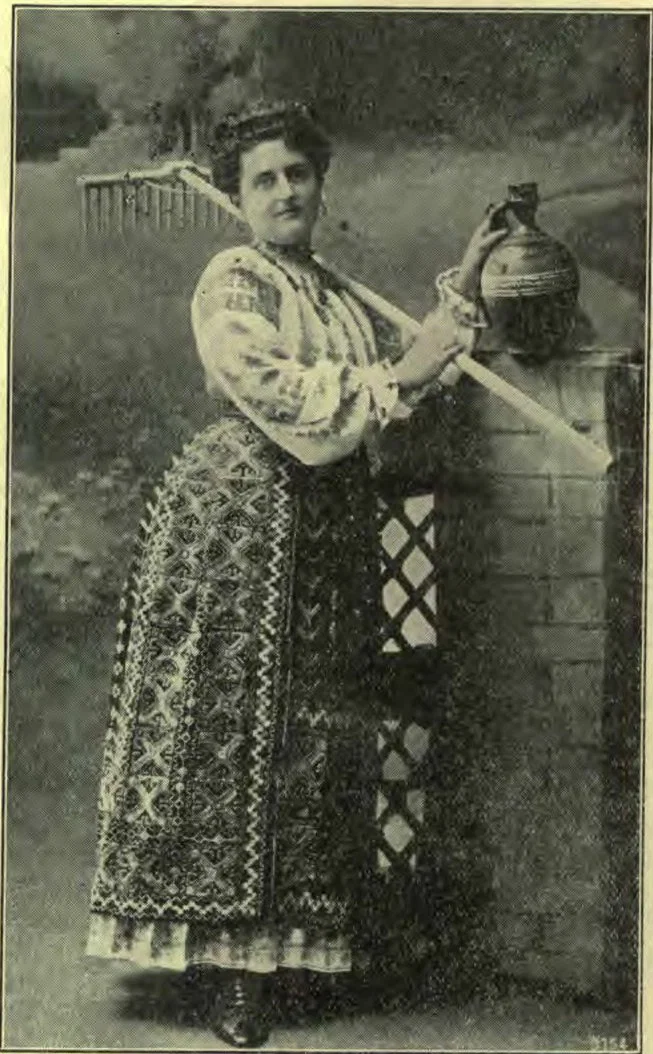
The Roumanians are proud of their Latin descent . There are comparatively few cities, so the peasant class greatly predominates, and these, with their peculiar customs, their striking superstitions, and their primitive views of things in general, make an interesting people. Large families are a mark of honor. “Inside the homes, poverty is everywhere manifest. The floors are of earth, on which the family go about barefoot, in order to save the costly shoes. The oven is of earth; the bed is a plank, set against the wall; and the artistic is supplied by a single cheap icon. Opulent peasants may go so far as to cover their walls with a cheap cloth, which gives a decidedly pretty effect; but they are the exceptions. For food on their table, there is one dish that is common to all, and that is a soft meal of maize. In addition, there will be mangoes, the poor man’s friend in the Balkans, either stuffed with cabbage, roasted, or boiled, and, possibly, that of a potato. Sheep’s cheese is also served; but bread is a rarity, and then it is of the black variety always. Meat, of course, is to be had on great occasions only.”
“At one end of the village stands the symbol of their wrongs—the home of the landed proprietor, to whom the adjoining thousand-odd hectares of land belong. Seldom, if ever, is the noble here. He lives in Vienna or Paris, and leaves the place in charge of some Greek or Macedonian, who has the stewardship for a term of five years, with the intent of making all he can, first for himself, and then for the proprietor.”
“The peasant woman usually grows some silk. She buys the silkworm eggs, and uses the spare bed, if there be one in the house, as a hatchery. She feeds the worms on mulberry leaves, and if the ants do not invade the place and destroy the worms, she soon has enough fiber for a veil or a waist. She spins and weaves it herself.”
“The average Roumanian peasant is not given to the kind of thrift that leads him often to a savings bank. The patrimony of his sons and daughters is more often good will, good health, and an honest mind, than it is land, or money, or houses. So narrow is the margin upon which a young couple starts out in life that it has come to be a proverb among them, ‘Married today and out at the elbows tomorrow.’ For children come apace, and the prices of the things the peasant has to sell are even lower than the prices of those he has to buy, and not until his own labors are supplemented by those of sons and daughters has he much chance to prepare for even the shortest of rainy days.”
The queen of Roumania would not change places with any monarch in the world. She loves her tiny kingdom, and wants every one else to love it too.
“Twenty-three years I now have spent in this country,” she says in the Chicago Tribune. “I have moved about among its humble citizens; have freely entered cottages, and taken the newborn babes in my arms.”
“Many a hearty welcome has been given me, the peasants receiving me with flower-filled hands. As the rustic riders gallop out to meet me, the bells ring and gayly clad women and children flock out of the houses to strew flowers.”
“On a burning summer’s day I came to a tiny town that was almost entirely of Turks. They became excited at sight of a woman in strange attire, called me sultana, and wanted to touch my fingers and my clothes. They patted my back, and even chucked my chin, andp. 8 jabbered and fought over me, overwhelming me with kind wishes.”
When Love Triumphs
“When a young Roumanian peasant lad’s thoughts turn to love and his mind begins to incline toward marriage, he goes to his mother, rather than to his sweetheart, with his tale. He tells her all about it, but rarely thinks of confiding the happy secret to his father; for Roumanian peasant fathers have faced the stern realities of life so long that they are apt to forget that they were once boys, and therefore have little sympathy with lovelorn tales.”
“But the mother acts as ambassador to the father, and if he can be induced to look with favor upon the lover’s choice, he calls in two of his best friends in the village, tells them of the son’s dreams, and asks them to accompany the said son to the house of the object of love’s young dream. Mayhap the girl herself has not yet received from the youth a single hint of his love; but even so, as he and his spokesmen approach the house, she suspects the object of his visit, and peeps through any crack or cranny that is convenient.”
“If it happens to be winter, the father of the girl invites the company in, and, surmising their mission, gives some hint as to his attitude by the way he looks after the fire. If he keeps it burning brightly, they know he is favorable. If he lets it die down a little, they understand he is only of an open mind on the subject. But if he lets it go out entirely, there is no use arguing the question.”
“It usually happens that the father of the girl is of an open mind, and the boy’s spokesmen tell what a fine, husky young fellow he is, what a good brother he is to his sisters, what a good son to his mother, what his patrimony is, and how industrious he is.”
The National Dance
“The Roumanian peasants have a saying that they must dance on Sunday to keep the creak out of their bones on Monday. Most of the dances are at the public houses,—dance halls under the blue sky, as it were,—and young and old gather there. The old folk spend the day with the tipple, while the young ones dance. There is very little drinking on any other day of the week, and a tipsy man, except on Sunday, is seldom seen.”
“The national dance is a sort of cross between a jig and the game of ring-around-the-rosie. All the dancers clasp hands and form a ring. They then begin a stepping, swaying motion that never moves them out of their original tracks, and to the music of the Tsigana band they keep it up for hours.”
“The dances are organized by the boys of the community. They arrange for the music, provide the refreshments, and preside as masters of ceremonies. When the girls reach marriageable age and have been sufficiently instructed in the household arts, they are allowed to attend these dances as participants. ‘She dances at the dance,’ is the peasant way of saying that a girl has made her début, and is eligible for matrimonial attentions.”
Community Service
“‘Many hands make light work,’ is another proverb of the Roumanian peasant, often put into practice. Almost every night there is a neighborhood gathering like the old-fashioned apple cutting or apple-butter boiling in early American rural history. The houses have their turns at these parties, and there is always a kettle of cornmeal mush and baked pumpkin and potatoes and popcorn ready for the occasion. All hands join in the evening program of combing, carding, and spinning the household supply of wool or flax, the while neighborhood gossip passes current among the elders, and occasional words of love or childish jest among the more youthful members of the party.”
Signs and Portents Govern Peasant Life
“The Roumanian peasant is much given to superstition, and he has a sign for everything. If shingles are not nailed on a roof in the proper sign, they will turn up at the ends; if potatoes are not planted in the proper sign, they will grow on top of the soil and be a failure; if you have money in your pocket when you see the new moon, you will not ‘go broke,’ at least not until another new moon comes. On the other hand, it is held to be dangerous to announce to those in the house that the new moon has appeared, for in that case all the pots and pans in the kitchen will be broken before the waning moon passes.”
“When a peasant child is christened, all of those present assume the relation of godparents, and it is a superstition that there must be no intermarriages between godfathers and godmothers. The result is that christenings are not widely attended, and those with matrimonial ambitions eschew them entirely.”
“The utmost care is taken by some to prevent a child from seeing its image in a mirror before it is three years old; for if it does, it will become a victim of the ‘falling sickness,’ which will send it stumbling through life.”
“The girls of Roumanian country districts take great pride in a clear, healthy complexion. . . . They take red and white threads, twist them into cords, from which they suspend coins around their necks. These talismans they wear from the dead of winter to the moment they see the first blossom of spring, feeling sure that thereby they will guarantee themselves a milk-white complexion, rosy cheeks, and ruby lips.”
Bukharest, the capital of Roumania, presents a very different picture to the one just drawn of the peasant life. They call their national capital “The Paris of the East,” and “in the character of its architecture, the ways of its people, the prices in force at its hotels, it justly deserves the title it has vauntingly assumed.” Nobody but the poorest thinks of walking in Bukharest. “Nearly all the ‘cabbies’ own their own teams of long-maned, flowing-tailed Russian horses. They are Russian exiles of the Skoptzy sect.”
“They wear great blue-black velvet coats, the skirts of which reach the ground. Their waists are bound about with multihued sashes, the flowing ends of which drop back over the seat, and one can guide his driver by pulling one end or the other of this sash when language difficulties stand in the way.”
Prince Charles the Miracle Worker
“Forty years ago Roumania was, both as to country and as to capital, one of the most backward nations of Europe; and then it called Prince Charles of Prussia to its throne. Although he had to travel to Bukharest incognito in order to escape the secret service of Austria, which was determined to keep him out, he immediately set to work to bring the country up to a higher standard. The story of his reign, which closed with his death soon after the European war began, is largely the same sort of story of development as that of Germany during the reign of his Hohenzollern kinsman. King Carol, as he was called, had for hisp. 9 queen Elizabeth, a German princess, better known by her pen name of Carmen Sylva. She, too, was spared the sorrows of Roumania’s hour of decision, having died a few months ago. They had one child, but it died in infancy, and Carmen Sylva turned her interest to the poor of the country and to letters and music. It is said that she was perhaps the most talented queen of her generation. She could converse in six languages; she wrote some thirty books; she composed an opera that was staged and praised on the continent, and her symphonies and songs have won a place in the world of music. Likewise she was no mean wielder of the brush, and was an expert needlewoman. Her pride was her work for the blind, for whom she founded an institution in Bukharest.”
“The present king is a nephew of King Carol. His wife is a granddaughter of Queen Victoria, and therefore a first cousin of most of the reigning heads of Europe.”
“Under the new era initiated and carried down to the present by the Hohenzollern dynasty, Roumania has gone far ahead of her neighbors of the Balkan region, and the visitor to Bukharest early finds that its people resent the idea of being classed with the Balkan States. They feel that they are the superiors of the Serbs, the Bulgars, the Montenegrins, and the modern Greeks.”
“It is true that their country is far in advance of other Balkan countries. Fast express trains run daily the length and breadth of the state; ports on the Danube collect and ship the produce of the country to various parts of the world; a fast Roumanian steamship line carries European mails from Kustendje, on the Black Sea, to Constantinople and other eastern centers of commerce; and several cities, both in size and style, resemble more closely the cities of Europe than do the other Balkan capitals.”
When King Carol assumed the throne, it became one of his principal aims to free his country from the suzerainty of Turkey; so one of the first acts of Roumania after the war between Russia and Turkey began in 1875, was to declare her independence of Turkey. In 1881 the Roumanians decided that they were entitled to the rank of a full-fledged kingdom, and so made proclamation to that effect, and crowned their ruler with a crown of steel made from a cannon captured by himself in the battle of Plevna.
The Persecuted Becomes the Persecutor
“Always bitterly resentful of ill treatment toward any of her race by other countries, she has forgotten to show that charity toward others under her power that she asks for her people from other nations. Her treatment of the Jew has been almost as harsh as that patient race has experienced at the hand of any oppressor.”
“It is hard to conceive in our own great land of liberty and equality how any nation could make such proscriptions against a race as Roumania has made against the Jew. No one is allowed to employ a Jew who does not also employ two Roumanians, and that means nonemployment for the sons of Israel. Jews are not allowed to be bankers, druggists, tobacconists; they have no standing in court, no right to employ counsel, no right to send their children to school except they pay for the privilege, which is free to all others. They cannot own farm land, are denied the right of holding government positions, and are prohibited from organizing or controlling stock companies or corporations. Furthermore, although some of them for forty generations have lived in Roumania, they are aliens still, under Roumanian law.”
“When the Powers assented to the creation of Roumania, one of the terms of the agreement was that all of her subjects should stand equal before the law. But later, Roumania decided that she would consider the Jew an alien, and so the agreement was nullified, with no hand raised in an effective protest.”
“The persecution, however, is economic rather than religious, for the experience of all eastern Europe has been that the Jew, under a free competition, manages to prosper where others barely exist, and so the attempt is made to handicap him as an equalizing process. Yet in spite of all his tribulations, in spite of governmental processes which would seem to leave nothing to the Jew but to emigrate, he manages to keep the noose from strangling him and to survive the fierce struggle.”
“While Roumania thus makes the Jew an alien, she does not regard him so when she needs men for her army. Then he is Roumanian from the crown of his head to the sole of his foot, although even in the army he cannot become an officer or escape the menial jobs that military operations always involve.”
“The water passeth and the stones remain,” so say the people of this doughty kingdom, referring to their own persistence as a people in spite of the floods of humanity that have swept over their territory. May it be so in this time, the most critical of their experience.