In the twenty years or so that I have spent as a guide in the city of Washington I have never known a dull day. I suppose one reason is that I am really interested in the work that goes on in the various government offices and buildings, and that I feel I’m doing my bit in explaining to sight-seers how the machinery of their government is kept running. Besides, I meet all kinds of people, and get a lot of pleasure out of them. First and last, I’ve picked up some interesting stories from the people I’ve guided.
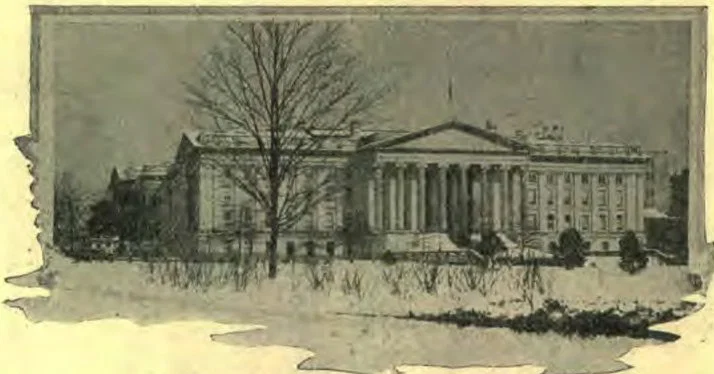
Last year in the spring a high school class from one of the northernmost counties of New Hampshire was visiting Washington, and I took them through the national Treasury. I had shown them the strong steel vaults that contain millions of dollars in gold and silver and untold more millions in bulky bales of greenbacks and yellowbacks. I showed them also the money-laundry machines that wash soiled bills, and the macerater that destroys old bills that have been redeemed.
Altogether, it was an impressive hour for the young people, yet I noticed that one of the younger boys of the class—Reddy Hosmer I think the others called him—still cast inquiring glances round him, as if he were not quite satisfied with what he had seen. As we started to leave, he rather bashfully said that he wanted to see Amanda Brown.
“She is the woman who saved Grandfather Hosmer’s eight hundred and thirty dollars that Butterball ate up,” he explained diffidently.
His classmates seemed to know the joke, whatever it was, for they at once began to laugh uproariously.
“Certainly, you shall see Mrs. Brown,” I said, and led them back to the door of a little room.
There, before a table by a great window, sat an elderly lady, with a calm, thoughtful face. Ready at her hand stood various magnifying glasses, together with certain other instruments of her own devising. She was deftly spreading out on cards the size of bank notes some fragments of mutilated bills.
Mrs. Amanda Brown is the most skilful expert in the world in identifying defaced, burned, shredded, or otherwise mutilated bank bills. Numbers of them come almost constantly to the Treasury, with requests, sometimes piteous, that the money be refunded.
Something much like awe was in Reddy Hosmer’s face—awe and a vast respect. The incident of his grandfather’s eight hundred and thirty dollars plainly had been a tragic one in the Hosmer household. I inquired about it, and when he had got over his first bashfulness he told the story.
“Grandfather sold his wood lot last year,” he began. “The big paper company that runs the mills over at Berlin Falls, New Hampshire, had been trying to buy that wood lot for four or five years, but he wouldn’t sell it. First they offered him four hundred dollars for it, and a while afterward five hundred, and then six; but grandfather hung on to it, till finally they offered him eight hundred and thirty, and he took it.
“The company’s agent came and brought a lawyer with him to have the writings done, and to pay for it. When the deed was made out and grandfather had signed it, the agent started to hand him a check for the eight hundred and thirty dollars; but grandfather had kept one hand on the deed.
“‘No, siree,’ he said to the agent, ‘I don’t want none of your little pieces of paper. When I sell ye a wood lot, I’m going to get my money for it. I want to see the color of your money, sir.’”
“The agent laughed and looked at the lawyer, and he laughed, too.
“‘All right, Mr. Hosmer,’ the lawyer said. ‘We can’t object to that. You keep your deed till tomorrow. We will bring your money tomorrow noon.’”
“And they drove off, still laughing.
“‘They can’t come any of their games on me,’ said grandfather.”},{
“Anyhow, they came back the next day and paid grandfather the eight hundred and thirty dollars in new bills. There were sixteen fifty-dollar bills and three tens. Grandfather counted the money over twice.
“‘That’s right, gentlemen,’ he said, and then handed them the deed.”},{
“They took it, and the lawyer said, ‘You are as smart as the best of them yet, Mr. Hosmer, if you are eighty years old. I shall know better next time than to try to get the start of you.’ They both shook hands with him, very friendly, and then went away, still smiling, but at what we could not guess.
“After they had gone, grandfather counted his money again, and after that he sat and fingered those new fifty-dollar bills for a long time. But at length he strapped them all up in the little old leather pocketbook that he generally keeps in a drawer of his writing desk in his own room, which is on the ground floor just behind the sitting-room.
“At supper time he said to father that he meant to put that money as soon as he could into a mortgage, where it would be drawing interest; and he thought he knew a man over at Colebrook who wanted to hire some money. He told father he wanted him to take him over to Colebrook the next day to see this man.
“The desk in grandfather’s room stands close by the window; and almost always, mornings, when it is fair, after grandfather comes out to breakfast, mother slips in and opens the window to air the bed and freshen the room. She did that the next morning, but did not stop to tidy up. Grandfather had counted his money again after he got up that morning, but instead of putting his pocketbook back in the drawer had left it on the leaf of the desk, as he often did; and that was how Butterball came to get hold of it.”
“Tell him who Butterball was!” several of Reddy’s classmates exclaimed.
“Oh, yes!” said Reddy, blushing. “Of course you wouldn’t know. Butterball was a little Jersey heifer; we called her that because the skin under her hair was just the color of butter. She was a year old, and had always come to the house when she got loose at the barn, for mother had made a kind of cosset of12her. Butterball would come on the run to the kitchen door or windows and put her head in, for mother to give her apples or potatoes or brown crusts of bread. If she didn’t get some sort of titbit, she would bawl and go lowing round the house just like a spoiled child. She’d got to be such a nuisance to every one that father was constantly threatening to turn her into veal.
“That morning it was rather chilly, and we had the kitchen door and windows closed. While we were at the breakfast table we heard Butterball low outside, but did not pay any attention to her. After a while grandfather finished his breakfast and went to his room. Then suddenly we heard him shouting. Oh, what a noise he made! Before any of us could get to the door of his room he rushed out, bareheaded, shouting:
“‘Stop her! Catch her! Make her drop it! She’s got my pocketbook in her mouth! If you don’t catch her soon, she’ll swallow it.’”
“We all ran out and round the house—and there stood Butterball by grandfather’s window, chewing something! Maybe she had mistaken grandfather’s little fat old pocketbook for a potato or a crust of bread. At any rate, she had it in her mouth and was munching away at it.
“Father tried to get hold of her horns, but we were making such an outcry that I suppose we scared her, for she turned and ran for the barn.”
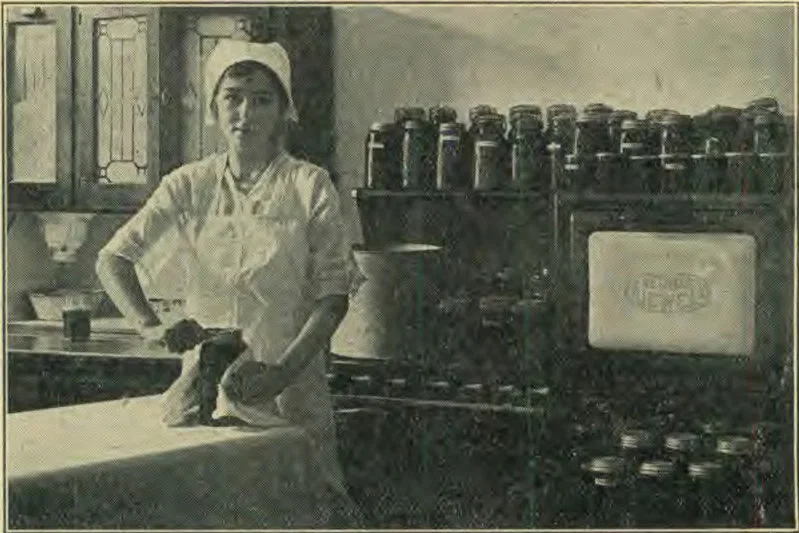
Miss Ethel Longacre, Takoma Park, D. C., is the first person to express to the editor of the "Instructor," by word or deed, any interest in the "Instructor" Canning Club, and though she is just past the age indicated for membership in the club, her picture, showing forty-five cans of fruit and vegetables, the results of her work as far as quantity is concerned, is herewith shown. We are sorry the picture does not reveal the excellent quality of her work. Miss Ethel was given first prize in a canning exhibition when only thirteen years of age, by the Takoma Park Canning Club, which is conducted under the auspices of government experts. We hope there are many others who will express in so admirable a way their interest and knowledge of the art of canning fruits and vegetables. Who will be the second to meet the requirements of the "Instructor" Canning Club? See "Instructor" of July 3.
“Grandfather made a grab for her tail and just managed to catch hold of it.
“‘Head her off!’ he cried, as he struggled in vain to bring her to a standstill. ‘Get her by the throat, some one! Don’t let her swallow!’”
“But Butterball ran, dragging grandfather after her, and reached the barn in spite of us. There we closed round her, and father seized her by the head and wrenched her mouth open, but it was empty. She had swallowed the pocketbook!
“Oh, what a rumpus grandfather made! I’m sure you could have heard him a mile!”
“‘Eight hundred dollars gone down that pesky critter’s gullet!’ he cried over and over again. ‘Eight hundred and thirty dollars!’”
“Five minutes later poor Butterball was veal. In her stomach was found a slimy wad that you hardly would have recognized as grandfather’s pocketbook. Evidently the heifer had been munching on it a long time before grandfather caught sight of her. We opened the purse a little, and could see that the bills were all chewed into pulp together, and the drier the wad got, the worse it looked.
“‘It’s a dead loss!’ said grandfather, with a groan. ‘My wood lot’s gone!’”
“But father had heard that the government sometimes redeemed mutilated money, and so the next day we put the wad into a little box and sent it on here by express, with a letter telling what bills there were and what had happened to them.
“Grandfather declared a dozen times, if he did once, that no one could make anything out of it; he was all cast down at having lost the money. But, to his great astonishment, three weeks later he received a letter in a big official envelope of the Treasury Department, which contained sixteen new fifty-dollar bills and three tens! The letter said that Mrs. Amanda Brown, the government expert, had been able to identify each one of the bills, and that the government took great pleasure in refunding them.”—Robert Yocum, in Youth’s Companion.