An Optical Illusion

5%

Review and Herald Publishing Assn. · Takoma Park Station, Washington, D. C. · Sep 14, 1915

FromThe Youth’s Instructor, Vol. 63, No. 37.

Read the full edition

An Optical Illusion

W. S. CHAPMAN
It was a drowsy day in midsummer. Uncle Joe sat at the window, alternately nodding and reading.
“What is that child doing that keeps him so quiet?” called Aunt Mary from the kitchen.
The child was busy playing in the sandy earth of the garden, and as Aunt Mary reached the door, was very quietly lifting sand in its chubby hand and, apparently, slowly pouring it back again without any particular object in view.
“What are you doing, honey?”
“Tum see, mamma.”
Aunt Mary discovered that the little one was endeavoring to force sand into what seemed to be a large ant hole, and so reported to her husband.
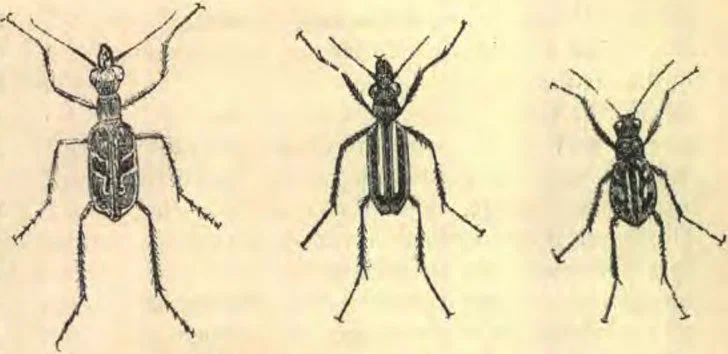
THREE VARIETIES OF THE TIGER BEETLE
“That is not an ant hole, Mary, but is the dwelling place of the larva of the Cicindela, or tiger beetle. These insects belong to the Coleoptera, or those whose hinder wings fold together both ways, and are hid, when not in use, under the forewings, which are made of harder material to form a case, or sheath, for the others. The hinder wings, when spread for flying, are several times larger than the body of the insect. That hole is the opening to the home of the larva of a tiger beetle.”
“If you can keep the baby quiet for ten minutes, or, better still, come into the room and watch from the window where noise will not disturb the grub, you will, possibly, witness something interesting.”
So Aunt Mary brought the little one indoors and sat down in a rocker close to Uncle Joe and where she had a full view of the garden from the window. For some time nothing occurred, then, suddenly, a large grain of sand or a pebble appeared at the mouth of the hole and was lifted above it, then quickly thrown several inches distant. Soon other pebbles came to the surface, and were treated in the same way. Evidently the little inhabitant was cleaning house after the disturbing attack of the baby. This kept up for some time, when a season of quiet followed; then, while both were intently watching in pleasurable anticipation, something happened—the hole disappeared from sight!
So astonished was Aunt Mary that she impulsively handed the baby to Uncle Joe and ran out into the garden, against his protest, for a closer examination. Sure enough, the hole was gone, not a trace remaining except a little surrounding depression, like a saucer, which always surrounds these tiger beetle holes.
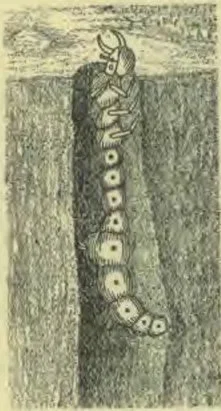
When Aunt Mary returned, Uncle Joe explained that the disappearance of the hole was an optical illusion. The larva, or grub, had ascended to the top of the ground; being head first, his little round head, the color of the sand, exactly fitted the opening, and by a circular movement the insect caused the surrounding sand to fall over him, not only completely concealing his head, but filling the opening level with the surrounding earth, covering it from sight. All that remained above-ground were two strong mandibles, looking like little dry twigs. “In this manner,” Uncle Joe explained, “the tiger beetle waits for his prey. A passing fly or bug ventures upon the inclined sand surrounding the opening, and naturally slides to the center with the intention of ascending the opposite side, but as he starts to pass between the cruel, innocent-looking mandibles, they close upon him, and down into the hole he disappears to his death. In this way, ants, flies, and other small insects and creeping things become victims of this cruel creature.”
LARVA OF THE
TIGER BEETLE
LARVA OF THE TIGER BEETLE
“Are all the holes which we see in the ground made by this grub?”
“No, indeed. A few are made by the ants, but the greater part are the work of wasps and other insects, and are veritable tombs where they store little creatures they capture, to become food for their larvae. This tiger beetle grub is a very pugnacious creature. In China they are so savage that men collect them and arrange regular combats, often betting large sums on the result. Come out into the garden and I will fish for this one, and draw him out of his cave, as the Chinaman does. The holes vary from six inches to a foot in depth. I will take this stray stalk of timothy growing here by the path, and pass it down into the hole until it reaches the bottom, which will be, of course, the head of the grub. At once the savage little grub, you see, seizes it in his strong mandibles and holds on tightly, even while being drawn to the surface. He is like a bulldog, and never lets go his hold even if cut in two. There he lies before you.”
“Notice the fierce expression of his face. His little round head is in two halves. See how the mandibles are depressed into the soft timothy stalk. His white-colored body, so soft, is not intended for life above-ground, and you see by his squirming that he already is beginning to feel uncomfortable.”
“In a few days he will pass through the change from a grub to one of the most active and beautiful of beetles, swift both of foot and wing, and fiercely predatory, attacking every small creature in the way of a grub or insect that crosses his path. This is what gives him the name of tiger beetle.”