G. B. THOMPSON
TO the ordinary student in school, New Zealand is but a dot on the map, an island, or islands, in the southern hemisphere, little thought of and little studied. Like other parts of the world, one really needs to visit the country to fully appreciate its extent, resources, and people.
The dominion of New Zealand consists of a group of islands. There are three main islands, known as North Island, Middle Island, and Stewart Island. There are also some islands to the east, of which the Chatham group is the most important.
The southern extremity of New Zealand is about the same distance south of the equator as the northern boundary of the United States is north of the equatorial line, though it is not so cold.
North Island is divided from Middle Island by Cook Strait, twenty miles wide at the narrowest point. Stewart Island is separated from Middle Island by Foveaux Strait, eighteen miles wide.
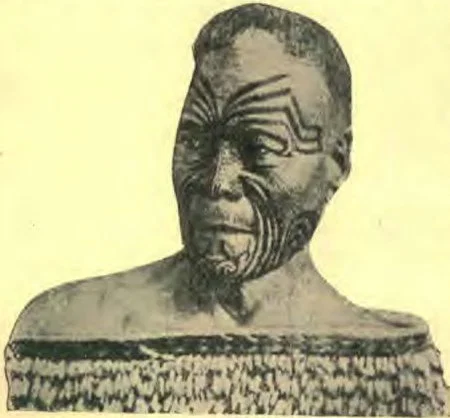
The three islands are eleven hundred twenty miles long, and one hundred ninety miles at the greatest breadth. The total area is given at 103,658 square miles, or a territory as large as the States of New York, Vermont, New Hampshire, Massachusetts, Connecticut, Rhode Island, New Jersey, Maryland, and the District of Columbia. The population at the present time is about one million. In addition to this there is a Maori population, which in 1906 was 47,731.
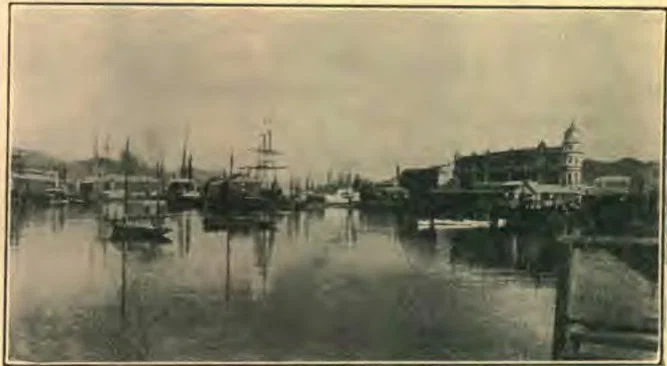
Since 1840 New Zealand has been a colony of Great Britain, with a parliament; the members of the house are elected by the people. In 1907 it was declared a dominion. The capital city is Wellington. The largest city is Auckland, which has a population, including the suburbs, of more than one hundred thousand; it also has a most excellent and beautiful harbor. Christchurch and Dunedin are large and important cities. Nearly all the towns, lakes, mountains, and rivers bear Maori names, which to the traveler making his first trip through the island, are quite unpronounceable. As a sample I submit the following: Whakarewarewa, Ngongotaha, Waikorowhite, Pipiriki, Taumarunui, Waikaremoana, etc. Imagine yourself trying to purchase transportation to some of these places! The best the ordinary stranger can do is to point at the place on the map, and tell the agent to give him a ticket to that city or town.

The following facts, gleaned from what I deem a reliable source, will give some idea of the resources of this far-away country:—
It has a coast line of 4,330 miles; the highest mountain peak is Mount Cook, 12,349 feet high; the largest lake is Taupo, covering 238 square miles; the deepest lake is Manapouri, which has a depth of 1,458 feet, the bottom being 861 feet below sea-level; the highest waterfall is 1,904 feet. The longest navigable river is the Wauganni, which is ascended by steamers and launches for a distance of 140 miles. This beautiful river is called the “Rhine of New Zealand.”
In 1907 there were more than twenty-two million sheep in the country, from which more than thirty-five million dollars in wool was realized. There are also large numbers of horses and cattle of a superior quality.
In 1908 there were 2,471 miles of government railway. This is all narrow-gage, but the road-bed, as a rule, is good, and traveling is comfortable. About ten million passengers were carried during the past year. There are excellent coal mines, nearly two million tons of coal being mined in 1907. There are also some gold and silver mines. There are extensive forests, from which valuable timber is secured and exported. The educational system is good, primary education being free, secular, and compulsory. There are two hundred thirty-six registered newspapers, sixty-sixp. 4 being dailies. The climate is excellent, resembling that of Italy. The south and middle islands are quite cold in the winter, snow being frequently seen.
New Zealand is indeed a beautiful country. Numerous scenic views greet the eye of the traveler. One writer thus describes the island:—
“Unequaled fjords, Awe-inspiring geysers; Forests filled with deer; Unrivaled Alpine scenery; Matchless lake country,— Boiling lakes in the north, Ice-cold lakes in the south; Hundreds of trout streams; The home of the Maori; The anglers’ and deer stalkers’ paradise.”
Flowering shrubs and beautiful flowers adorn the hills and the homes. There are beautiful lakes, girt about with bush-clad hills, and filled with the most lovely fish. There are mountains which frown down from the clouds, whose peaks are capped with eternal snow. The eye is charmed with fertile fields, on the bosom of which feed large flocks and herds. There are gorgeous landscapes, nooks in secluded beauty, inspiring views of mountain, lake, river, and volcano.
Among the most interesting places to visit is the thermal spring at Rotorua. To the writer this place seemed one of the wonders of the world. Hot sulphurous springs of water over an extended area boil from the earth in quantities beyond computation, varying in temperature from 110° to 212° F. From rocks gurgling water and steam hiss. Geysers of boiling water shoot into the air, sometimes to a great height and in tremendous quantity, and one is awed by the terrific forces at work beneath one’s very feet as one walks about to view the scene. Great pools of gurgling hot mud, like vast caldrons of porridge, bubble and sputter here and there. Mud volcanoes are constructed before your eyes, down the cones of which slides the lava-like hot mud in splashes perhaps an inch in diameter. The whole vast region steams and boils as if an angry volcano slumbered beneath your feet, ready, at any moment and without warning, to break forth and spread ruin and death in its wake. This place is called the “Safety-valve of New Zealand,” and to me it seemed well named. The region is volcanic, and the puffs of steam, and the hoarse sound of bubbling water deep below, betray a fierce, tempestuous energy of imprisoned forces, which some day will produce an eruption. Having viewed the sight, I was ready to depart without delay to a spot where the evidences of coming destruction were not so manifest.