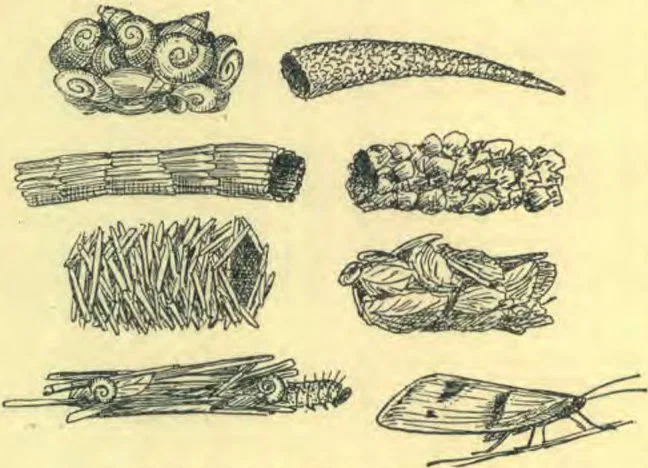
The young naturalist who lies face downward at the brookside, and with shaded eyes watches the busy life that there has its being, will see, in many places, little masses of small stones or bundles of small sticks, moving on the bottom of quiet pools as if they were alive. When out of the water they seem to be only groups of stones or clusters of sticks, motionless and dead. But they are the homes of living larvæ. By putting them in water or by pulling them apart, a whitish habitant is discovered—a larvæ which is a dainty morsel much relished by fish. Nature has provided it with an ingenious means of protection. The little caddis fly larva is an exemplification of the old saying that “necessity is the mother of invention,” since the little animal does not always build as his ancestors built, but adapts himself to the circumstances of a new environment and utilizes whatever material may be available. In some localities the cases are made of stones; in others, of short twigs; in still others, some of the little builders and mechanics bore out the interior of a slender twig or straw, and use the hollow as a protection against the enemy fish.
INSECTS THAT BUILD SUBMARINES
When caddis flies are placed in small aquariums, they extend the body out of the front of the protecting case and carry it as they crawl. But jar the receptacle, and the larva instantly retreats into its house. It is hardly possible to pull the little creature out of its case, except possibly from the smooth straw. It clings to its covering with peculiar tenacity by means of two hooks at the rear extremity of the body. So firmly is it anchored to the sticks, that violence will not dislodge it, unless the force is sufficiently great to pull the insect in two.
But the larva may be driven out by using a tiny toothpick with a blunt end, or by anything else of the kind that does not terminate in a sharp point. Push this into the rear of the case, and the little animal at once unhooks himself and hastens out to find a new home.
Usually the cases are straight, but sometimes they are curved, and a few spiral forms have been found, which closely resemble minute snail shells. The dweller in this rude retreat is a fisherman who not only builds a home of sand, but uses the sand to make a funnel-shaped trap faced by a silken net. The funnel is directed upstream. At the entrance the net has almost rectangular meshes, often in beautiful regularity, and appears much like a delicate spider web in the water. These ingenious contrivances are placed in the swiftest current, and in rapids between stones. Sometimes they are found in great numbers along the brink of a waterfall. The observer must look carefully to see the net, as it is usually obscured by the dirt that collects and adheres there in little masses. But if he is so fortunate as to find one recently completed, the netlike formation is clear and beautiful.
In some places, empty cases may be seen at the edge of the brook. Often they almost completely cover the rocks and the earth between them. In such instances the insects have emerged at the time of a freshet and the retreating water has left the cases stranded high and dry.—Edward F. Bigelow.