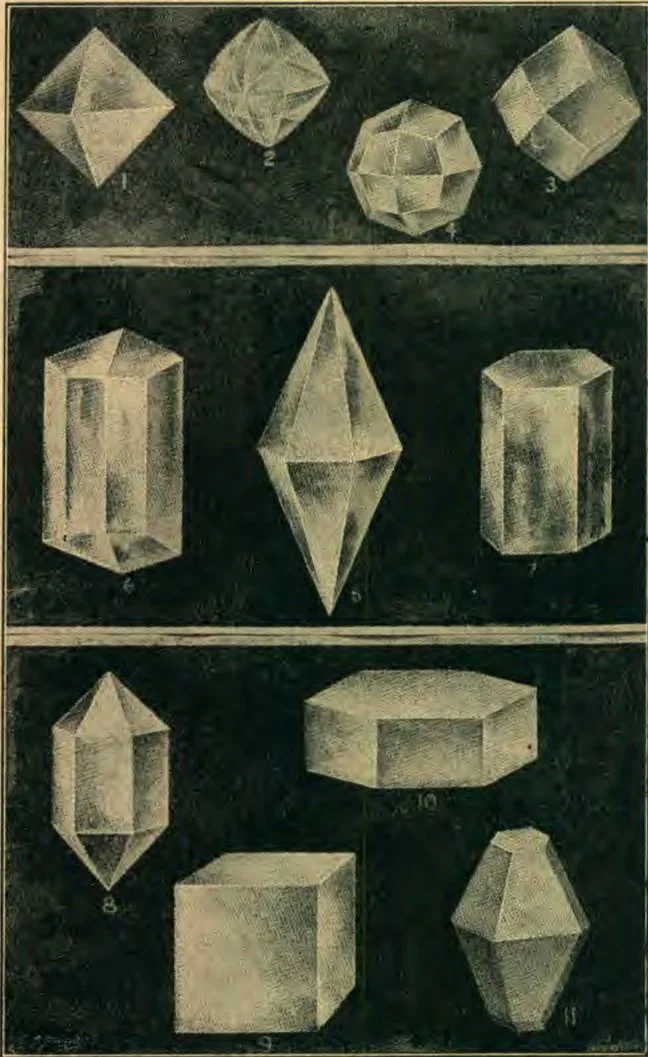
The eye has become so accustomed to the gem as it is seen mounted in jewelry, with its many little facets given it by the lapidary, that the fact is quite forgotten that practically every gem once possessed its own beautifully symmetrical shape when it left the hands of nature.
1, 2, Diamond Crystals; 3, 4, Garnet Crystals; 5, Ruby or Sapphire; 6, Topaz; 7, Emerald; 8, Rock Crystal; 9, Rock Salt; 10, Mica; 11, Sulphur
These shapes are known as crystals, and are of the greatest importance, because by them the gem may be recognized; for the same gem will always appear in the same shapes, which are peculiar to itself alone, and quite different from the shapes of all other gems. For example, the diamond occurs in a crystal like that shown in Figure 1, which is like two four-sided pyramids with their bases set together; or, again, in a shape like that of Figure 2, where the faces of the crystal are slightly curved. The most characteristic shapes of the garnet crystals are seen in Figures 3 and 4, in twelve- and twenty-four-sided figures. This gem, particularly, occurs in well-defined and beautiful little crystals. Again, we have crystals of ruby or sapphire occurring in a form like that shown in Figure 5, a six-sided double pyramid; but these crystals are apt to be rougher in outline, and without natural polish. The natural polish that many of the gem stones possess on their faces is finer than any that the skilled jeweler can produce.
Figure 6 shows a simple crystal of topaz. This stone is often very rich in crystal faces; frequently no fewer8than thirty or forty may be counted on the top alone. A typical crystal of emerald is shown in Figure 7, a simple six-sided prism; and Figure 8 shows that of a rock crystal. Rock crystal was the first among all crystals to be written about, and as long ago as 2,200 years an ancient historian described its shape. Both this stone and the emerald in their natural crystal shapes were made into necklaces by the Egyptians. Because rock crystal is so clear and colorless, the ancients, for many hundreds of years, believed that it was only a form of ice so hardened that it could never melt.
From what has been already said about gems and their natural shapes, it might be inferred that every gem, as it comes from the mine or river bed or from wherever it may have been discovered, is found in its exact crystal form. However, this is not always the case: sometimes it may lose its beautiful shape from being rolled and tumbled in river beds and streams, or again it may be found in a very imperfect condition, perhaps only one half, or less, of the faces being present. But even when many of these are absent, or perhaps only traces of them left, the crystallographer will be able to recognize the gem.
Color Not Reliable Test
Now the shapes of the crystals of semiprecious or precious stones are particularly important, because some of their other properties are of little use to us in the recognition of the gem. Take, for example, color; it might be supposed that this would be of great help, but this has not always been found to be true, and, in fact, it is very often most misleading. Topaz (Fig. 6) will illustrate this point. This stone is commonly yellow or brown, or a yellowish-brown color; but it is often found perfectly colorless, also pale blue and deep wine color.
Again, the garnet may be of every shade of red, of several very beautiful shades of green, also orange color, brown, and even black.
These differently colored varieties sometimes have different names, such as “evening emerald,” for one of the green kinds, and “cinnamon stone,” for the orange-colored stone; but they are all garnets, having their characteristic chemical composition and crystalline form. The giving of these different names to stones of the same family is most confusing, especially so in the case of the ruby and sapphire, for these two stones are only two varieties of the same mineral, corundum, the only difference being that of color. They are alike in all their important properties. The coloring matter in most gem stones is present in so small a quantity that it is often difficult to discover to what it may be due.
Known by Its Hardness
There is, however, another simple property that is of great service in determining a gem, that is its hardness. Thus, diamond can always be recognized, as it is the hardest of all minerals, and will, therefore, scratch any of them. Next in order come the ruby and the sapphire, which may be scratched by the diamond, and in turn will scratch any of the other gems, such as the topaz, emerald, or garnet.
Each gem has its own particular degree of hardness, which is always the same.
A good deal has already been said about crystals of gem stones, and perhaps it should be added here that these are not the only kinds of crystals. Nearly all minerals (which include precious and semiprecious stones) occur in crystals, each one having a form peculiar to itself. Thus we have crystals of rock salt in the form of simple cubes (see Fig. 9); crystals of mica (Fig. 10) — that shiny black or brownish mineral, occurring in little hexagonal-shaped plates, which split into the finest, thinnest leaves imaginable, and which is used for making lamp chimneys, as well as for other commercial purposes; and crystals of sulphur (Fig. 11). There are also sugar crystals, like those of rock candy; and, perhaps most beautiful of all, snow crystals, which occur in an infinite number of lovely forms.
The growth of a crystal resembles, in a way, that of a living being, for it grows out of a solution as if it were alive; and if injured, it repairs itself, replacing any missing parts; or, if it is delayed in the course of its growth by some impediment, when this is removed, it will continue to grow as if there had been no interruption.
Finally, does it not seem a pity that these exquisite little objects, often brilliant with faces of nature’s making, are never made use of in their natural forms? — Mary Winearls Porter, in St. Nicholas.