LEONA BURMAN
“The individual who can do something that the world wants done, will, in the end, make his way, regardless of his race.”
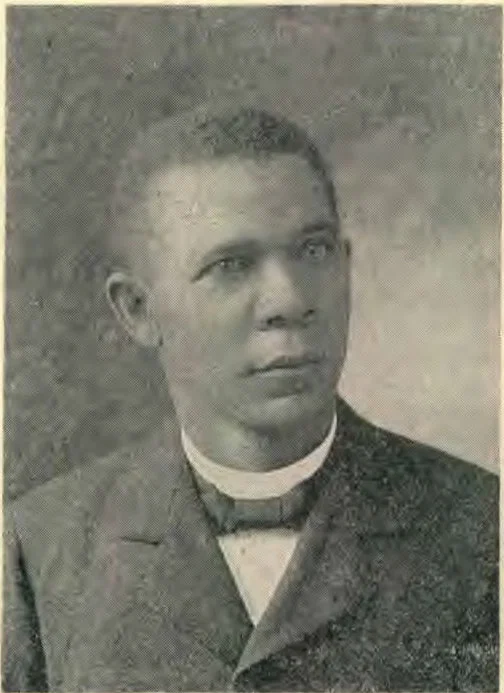
ABOUT fifty-seven years ago, in a typical log cabin in Virginia, there was born a black baby boy. As he grew up, he was valued for what he would bring in the market, for he was born a slave. His mother, being the plantation cook, had very little time to devote to her children; but she must have spent that little well, for with no attention or thought from his father, who was a white man on a near-by plantation, he developed into a remarkable boy. Though only seven years old when set free by the Emancipation Proclamation, he had already borne his share of burdens on the plantation, and he said he could remember no period of his life that had been devoted to play.
Soon after the close of the war he went with his mother and stepfather to the new State of West Virginia. They settled in Malden, a small town about five miles from Charleston. The boy was put to work in a salt mine, and there he learned his first figures from the salt barrels filled by his father.
He had a most earnest longing for an education. In some way his mother got a copy of Webster’s “blue-back” speller, and as he had been told that the way to learn to read was to learn the alphabet, he began to try to understand it. There was no one to help him, for none of the colored people could read, and he was afraid of the white people. Though his mother was totally ignorant of books, she sympathized with her son in all his efforts, and to her influence he attributed the success of his life.
Finally a school for colored children was started in the valley, and the lad’s hopes rose high, only to be dashed to the ground when his father said he could not spare him from work in the mine. By dint of persevering and planning, however, he at last secured permission to attend for a few months.
His first day at school brought him face to face with a new difficulty. He had only one name, whereas all the rest responded to the roll call by at least two. His mind was quick, and when the teacher reached him he announced his name as “Booker Washington,” a name that has stayed by him all these years. He afterwards learned that the name Booker Taliaferro had been given him in infancy by his mother, and so he signed himself Booker Taliaferro Washington. Such is the early history of one of the noblest men our country has produced. We may now follow him in his efforts to secure the education for which his whole being hungered. When about thirteen years old he overheard two miners talking of a great school for colored people that had been started somewhere in Virginia. Silently the boy crept up where he could hear more, and as they talked, he learned that poor students were to be allowed to work a part or all of their way. The more he heard, the more it seemed to him that Hampton would be heaven on earth, and he decided that he would attend that school, though he had no idea where it was, or how he was to get there.
About this time he went to work for Mrs. Viola Ruffner, who had the reputation of being very strict with her servants, so much so that one rarely stayed with her longer than two or three weeks. Booker made up his mind to please her, and hired out for five dollars a month. He found her a woman who demanded absolute honesty and frankness in her servants, and when she found these, she was a friend. She was thoroughly systematic in everything, and the lessons he learned in her home made a valuable part of his education, and, no doubt, contributed largely to the success of his later life.
In the fall of 1872, he decided to start on his five-hundred-mile journey to Hampton. After traveling a part of the way by train and stage, he found that all his money was gone. Nothing daunted, he set out to walk. When he reached Richmond, he found himself alone in a strange city with no money. He went without supper and slept under the sidewalk. The next morning he secured work on a ship in the harbor, but in order to save every cent for school he continued to sleep under the sidewalk. Many years later, he was given a reception near that spot, but his mind was more upon the sidewalk and what it suggested than upon the reception.
When he at last reached Hampton he was tired, hungry, and unkempt; but as soon as he could, he applied to the head teacher for admission. Evidently she was not favorably impressed, for she made no decision in his case, though she admitted several others. He did not become discouraged, but continued to linger near her. Finally she told him to sweep a classroom. Feeling that it was his entrance examination, he did his best, sweeping three times and dustingp. 4 four times. When he had finished, Miss Mackie examined the room, testing for dust with her handkerchief. She was satisfied, and admitted him to the school, giving him the position of janitor. Though the work necessitated long hours and little sleep, he was happy, for he was able to earn a large part of his expenses. The thoroughness of that first sweeping characterized his subsequent life.
After finishing his course at Hampton in 1875, he taught for two years in his home town. He then spent eight months in study in Washington, D. C. While there, he had an excellent opportunity of witnessing the superficiality of a large class of colored young people whose only ambition seemed to be to learn a little Latin or Greek and hold a government position. He decided that true success consisted in laying a foundation for the betterment of the masses of his own race, and that a practical education that would teach them how to perform life’s duties in a better way was of more value to the colored people than Latin and Greek or music.
During the summer of 1879, Mr. Washington was asked to connect with the Hampton Institute as preceptor and teacher. This gave him the opportunity of carrying his own education farther.
His life work began in 1881, when, by the recommendation of General Armstrong, he was selected to start a school for colored people, at Tuskegee, Alabama.
He found no buildings, no equipment—in fact, nothing with which to begin work. After spending a month in visiting the colored people in their homes, he was almost discouraged as he thought of their great needs. But more than ever he was convinced that the education to be given them must take hold of their everyday lives, and make them valuable in the community where they lived. This, however, was not the ideal of the Negro. He wanted an education that would enable him to live by his wits rather than by work; that would make it possible for him to wear a high hat, kid gloves, and fancy boots. Many expected to get a diploma in two or three months. Booker Washington, therefore, had to overcome the prejudices of the white people and the wrong ideals of the Negroes.
The school was started in temporary quarters, with thirty students and one teacher. A little later, an old abandoned plantation, one mile from Tuskegee, was offered for sale for five hundred dollars. Only two hundred and fifty dollars was required as a first payment, but this amount was much more than Mr. Washington had ever had at one time. Greatly perplexed, he wrote to his former teacher, General Marshall, who at once offered to lend him the money from his personal funds. The mansion having burned, the only buildings on the plantation were an old cabin, a kitchen, a stable, and a henhouse, all in a dilapidated condition. The stable and henhouse were repaired, and used as recitation rooms. Convinced that farming should be an important part of a young man’s education, Booker Washington next cleared, with the aid of the students, twenty acres, and put in a crop.
As soon as it was evident that the school was being conducted on right principles, and that the education given at Tuskegee was not spoiling the Negro, but was making him a useful citizen, gifts began to be made for the erection of permanent buildings. But this success did not come without hard work, sleepless nights, and some dismal failures on the part of the leader. He determined not to run into debt for luxuries and to have the students build their own institution. In speaking of the beginning of the dining room service, he says, “Had we started in with a fine, attractive, convenient room, I fear we should have ‘lost our heads’ and become ‘stuck-up.’ It means a great deal to start off on a foundation which one has made for oneself.” In harmony with this idea, Booker Washington rose from the plantation slave to a man honored by many of earth’s great men and women. From a poor colored boy struggling by himself to master the alphabet, he progressed till Harvard University, in 1896, conferred on him the degree of master of arts.
The institution at Tuskegee, begun in poverty and without equipment of any sort, has grown till it owns twenty-three hundred acres of land, one thousand being cultivated by the students each year. The old stable and the henhouse, with one teacher and thirty students, have been replaced by eighty-three buildings, with one hundred and ten instructors and fifteen hundred students. The school provides thorough academic and religious training, besides conducting thirty-seven industrial departments. Every student is required to master at least one trade. Although started without resources, the institution now owns over eight hundred thousand dollars’ worth of property, besides having an endowment fund of more than a million dollars. All this is free from mortgage. The yearly expenses are about one hundred and fifty thousand dollars. Most of the money invested in Tuskegee, Mr. Washington raised by going from door to door, explaining the work.
On November 15, death took from the Negro race, Mr. Washington, its foremost teacher and leader. In summing up the life of this great man,—for a great man he surely was,—I can do no better than to give a few quotations, which make clear the principles on which his life was conducted.
In speaking of a large gift received from the late C. P. Huntington, Mr. Washington said: “Some people may say it was Tuskegee’s good luck that brought to us this gift of fifty thousand dollars. No, it was not luck. It was hard work. Nothing ever comes to one that is worth having, except as a result of hard work. When Mr. Huntington gave me the first two dollars, I did not blame him for not giving me more, but made up my mind that I was going to convince him by tangible results that we were worthy of larger gifts.”
“From General Armstrong,” he says, “I learned that great men cultivate love, and that only little men cherish a spirit of hatred. I learned that assistance given to the weak makes the one who gives it strong; and that oppression of the unfortunate makes one weak. It is now long ago that I learned this lesson from General Armstrong, and resolved that I would permit no man, no matter what his color might be, to narrow and degrade my soul by making me hate him.”
If we desire success in our work as missionaries for Jesus, we can do no better than to follow the advice he gives. “In order to be successful in any kind of undertaking, I think the main thing is to grow to the point where one completely forgets himself; that is, to lose himself in a great cause. In proportion as one loses himself in this way, in the same degree does he get the highest happiness out of his work.”