Carbon: Its Allotropic Forms and Compounds—No. 13
YOU may not have been accustomed to thinking of the glittering, costly diamond as a near relative of the coal you shovel into your furnace by the ton. It may be, too, that you have not thought of that black, greasy powder you use for oiling your bicycle as even more nearly related to the diamond than the coal. But the diamond and the graphite powder are almost pure forms of carbon. Charcoal, coke, coal, and lampblack are slightly more impure forms of the same element. “Things are not always what they seem,” you know.
In a previous article it was stated that one of the most interesting of problems to the student of nature is the fact that some substances of very different natures are composed of precisely the same kind and of the same number of atoms in a molecule, but that the atoms are supposed to be arranged differently in their respective molecules. The varying forms of elements are said to be allotropic forms; so diamond and graphite are allotropic forms of carbon. Essentially, they contain carbon and only carbon. Charcoal is regarded as another allotropic form by some chemists. The first two are crystalline in their structure, and the latter amorphous; that is, without any definite form.
Carbon is an extremely important and very abundant element. The compounds containing this substance are far more numerous than those of all the other elements put together. All organic substances—that is, all things that have or have had life—contain it. Therefore, most all food products and vegetable drugs contain it. It forms a part of chalk, marble, limestone, coral, and many other minerals. It appears in the air in the form of carbon dioxide gas (CO₂). It is to the compounds of carbon we are indebted for our raiment, and for many of our dwellings. Its abundance is indicated from the world’s yield of coal, more than six hundred million tons being mined yearly, and it is estimated that there is still enough left in the crust of the earth to make a layer three feet thick over the entire land surface.
Five thousand billion tons of the carbon dioxide gas, it is estimated, exist in the atmosphere; “enough to keep a forest, which would cover the whole earth, land and water, growing for eight years, or ordinary crops for twenty-two years.” If we place beside these two items all the organic and mineral substances containing carbon, we must conclude that this element should claim some attention from its abundance, if for no other reason. But its utility is as marked as its quantity.
While diamond, graphite, and charcoal differ among themselves in color, hardness, luster, weight, power of conducting heat and electricity, and chemical affinity, yet they all agree in one particular,—if heated strongly in the presence of oxygen, they unite with it, and form carbon dioxide gas (CO₂). If a diamond is “heated white-hot between the charcoal poles of a powerful galvanic battery in a vacuum, it softens, and swells up, forming a black, brittle mass like coke.”
Crystal Carbon-Diamond
Crystals are the elite, the aristocracy, of the mineral world. Their beauty of form, delicacy of coloring, and durability make specimens not larger than a thimble cost thousands of dollars.
The word crystal comes from a Greek word meaning ice, as it was anciently thought that crystals could be produced only in the extreme cold of lofty mountain passes. One learned man of the early centuries described their formation by saying that “cold in mountain heights made the ice so dry that it congealed, or hardened, into crystals.” It is now known that intense cold is not at all necessary to their production, and that they have no connection whatever with ice. Nearly all varieties of minerals have their permanent crystalline forms, as well as the amorphous.
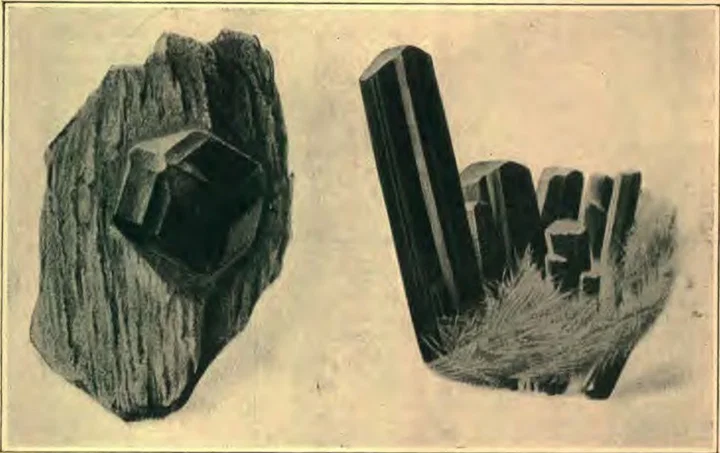
Some crystals are perfect cubes, prisms, pyramids, or hexagons, with surfaces as exquisitely polished, when taken from the ground, as our handsome plate-glass mirrors. Ten thousand different forms of crystals have been found and classified, but all have been reduced to two orders, consisting of six systems.
Crystals are of almost every size, varying from the microscopic to gigantic ones nearly ten feet in circumference. Beryls have been found more than four feet in length, two and one-half feet thick, and weighing nearly six thousand pounds. Equally large crystals of apatite have been discovered in Canada. The highest perfection of form and beauty, however, is found in crystals of moderate or small size.
The same mineral may occur in different places, and sometimes in the same place, exhibiting a variety of forms; its crystals may be plates as thin as paper, prisms, pyramids, dodecahedrons, and a hundred other forms; but however great the numbers, they may all be reduced to a single type. A thousand varieties of snow crystals have been observed; but when not injured by wind or other casualties, they all show their relation to the hexagonal system.
To get from a solution a perfectly formed and handsomely polished cube or prism implies a definite arrangement of each particle with reference to every other particle and to the whole, else the exact geometrical figure could not result. Of course each molecule does not intelligently choose its place, but the particles of a given substance never fail to arrange themselvesp. 7 in the way peculiar to that substance. The perfect cubes of iron pyrites, or fool’s gold, if dissolved and allowed to crystallize again, would never take the form of the quartz crystal, but would assume their own natural form. The confused arrangement or general mix-up observed in a group of schoolchildren at recess, and their orderly arrangement in the schoolroom at the ringing of the bell, illustrates fairly well the process of crystallization, or the change in the particles from the solution to the perfect crystal. Mr. Ruskin says that if from a pile of bricks to be used in building a tower, the various bricks should suddenly of themselves get up from the pile, and walk over to the place where the tower was to be located, and each place itself in just the position necessary for the formation of the perfect tower, this action would illustrate what takes place in the process of crystallization.
This mysterious mathematical arrangement of molecules is still an unsolved problem, though various theories have been proposed. Scientists can no more tell why all that army of particles in solution move steadily to the nucleus of crystallization, and why each arranges itself about it in just the place that is necessary in order that a perfect, polished cube or prism may result, than they can explain how a pretty pansy face is made by absorption and arrangement of mineral particles from the earth; or how apple, pear, and plum trees, growing side by side, always produce their own kind of fruit.
No matter how much of a hurry the salt molecules, or particles, may be in, they never forget that they must have six square faces, twelve edges, and eight angles. So a peach never forgets the peculiar characteristics that make it a peach; and it is all because the Lord “putteth forth his hand upon the rock,” and because he said, “Let the earth bring forth . . . the fruit-tree yielding fruit after his kind.”
The diamond is the crystal form of carbon. Its crystals are pure, transparent, glittering, and octahedral; that is, having eight plane faces, or sides. The diamond is unaffected by any liquid reagent, as acids or alkalies. It is the hardest substance known, this property making its dust useful in polishing hard and refractory substances. Drills armed with diamond points are used by miners. The glass-cutter has a diamond wheel.
“Diamonds are among the purchases made periodically by the automobile manufacturers, though it is not generally known that the precious stones are required in the making of motor cars. The diamonds are used in the truing of emery-wheels, and in most of the large factories several of them are destroyed each month in this service. The stones used are large, but of an inferior quality, known as ‘bort’ diamonds. They are usually imported from Asia. Nothing else has been found of a cheaper material to do the work.”
The diamond has been obtained artificially by a French chemist. He made the real substance. Imitation diamonds consist merely of heavy flint glass. One “interesting way of distinguishing real from imitation diamonds is to bring them close to a little radium salt in a dark room; under this stimulus the real diamond phosphoresces, but the imitation article makes no response.”
Graphite, or Plumbago
Graphite is favored with several names. It is sometimes called black lead, as well as plumbago, because of its use in common lead-pencils. There is no lead about a “lead”-pencil. The lead of a pencil consists of powdered graphite mixed with clay and water. This dough is pressed into molds and dried, or, while soft, is forced through plates with apertures the size of the lead in the pencil.
Graphite is often found in hexagonal prisms, is steel-gray in color, has a greasy feeling, and, as a mass, is quite soft, though the particles are so hard that saws used for cutting graphite are soon worn out. It also, when burned in the presence of oxygen, unites with that gas to form carbon dioxide (CO₂), the gas we exhale.
Graphite is used as a lubricant for machinery; and since it resists heat up to more than a thousand degrees, it is used for making crucibles in which to melt steel and other metals. It is also used for coating shot and gunpowder. Its friability makes it of use in writing.
When any other form of carbon, as the diamond, is heated to an extreme temperature, it is transformed into graphite.
“By virtue of its greasy, adhesive, or sticking quality, it is easy to cover iron, which is so easily affected by the weather, with a thin, lustrous layer, or varnish, of graphite; the common stove-polishes, for example, are composed of powdered graphite. This mineral is a good conductor of electricity, and is used for coating wood, plaster, and wax, and other non-conducting materials, so as to make them capable of conducting the electric current, and so receiving a metallic film in the process of electrotyping.” F. D. C.
(To be concluded)