Curiosities in figures are fascinating to many. If the reader of this article will take paper and pencil and perform a few simple operations in multiplication and addition, he will be surprised at the results arising from a certain number. If you are able to remember that the number we shall use is 142,857, you can present the following peculiarities later on to others. Any one forgetting the number can readily derive it by changing the fraction one seventh to a decimal of six places. At the seventh place the figures begin to repeat themselves, so our number is a circulating, or repeating, decimal.
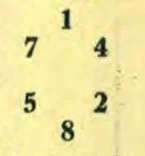
Let us begin by writing the figures of 142,857 in the form of a circle or, as we might say, in cyclic order. Multiply the number by 2. Now look at the cycle of figures and you will find that your answer can be read from the cycle by starting with 2 and reading in clockwise order 285,714. Multiply the original number by 3 and you will find the answer in the same cycle of figures as 428,571. The products by 4, 5, and 6 can likewise be read from the same cycle, as you will find if you multiply correctly. Only a very few numbers have this striking property, and all others are much larger than the one given. Multiplying by 8 you should get 1,142,856, which consists of more than the six figures in the cycle, but add the first digit 1 to the last digit 6, making 7, and you can read again from the cycle of figures 142,857. The same thing can be done with all possible multipliers in the hundreds and thousands, with a single exception. Going back and multiplying by 7 you will get another peculiar result, for it consists entirely of nines,—999,999. Multiply by any multiple of 7 and you will find that the product can always be changed to the same form—999,999. For instance, the product by 329 is 46,999,953. If you write the number of millions beneath the hundreds and add, you will get, as I before suggested, 999,999. Try a few other multipliers and see whether you can obtain similar results.
For a little variation, try another method. Start with 142,857, or any other number from your cycle of figures, and multiply by 77; then multiply the product by 13. Suppose that you begin with 571,428, your final result should be 571,999,428. You see that the result can be obtained by simply splitting the multiplicand and writing 999 between. If you wish to pose before your friends as a “lightning calculator,” you can easily achieve success with a little practice.
As a final example of curious products, start with 142,857 and as you continue to subtract 15,873, successively multiply the difference by 7. The results will then appear as follows:—
142857 × 7 = 999,999 126984 × 7 = 888,888 111111 × 7 = 777,777 95238 × 7 = 666,666 79365 × 7 = 555,555 63492 × 7 = 444,444 47619 × 7 = 333,333 31746 × 7 = 222,222 15873 × 7 = 111,111
LAWRENCE D. RHOADS.