On the Boundless Deep—No. 11
MRS. C. M. SNOW
Since snapshots are not allowed at Pago Pago, we filmed as many mental pictures of this peaceful little world as memory could retain. Some one described it as a world of peace that passeth the understanding of any one not born a Samoan. At least their wants seem few and easily supplied, as their food needs little cultivation or preparation, and their costumes are largely born, not made. But though they go hatless, shoeless, coatless, and often with but one piece of raiment, yet they seem to possess a love for adornment and a certain refinement and grace, a naïve coquettishness and picturesque simplicity not tinctured with coarse bravado. Living as they do, on a narrow shelf of beach, between the sea and the sky, and under great tropical trees that toss the air breathed by a thousand glowing blossoms, they are still nature’s children, and not yet contaminated by the rapid stride of civilization.
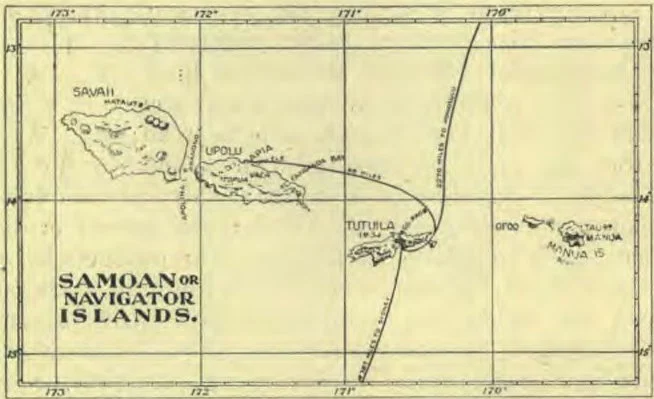
The sister steamer of the “Sierra,” the “Sonoma,” was met at Pago Pago by four thousand Samoans, who came from a radius of five hundred miles, wearing full war paint and feathers, and for three hours entertained the passengers with native songs and dances. Following the dance, a big native feast was held, winding up with the passing of a huge bowl of kava, the native drink, of which all partook.
As we sailed out of the harbor, which is an ancient crater, very deep, and completely landlocked, the natives who assembled to greet the ship, quietly glided away, by shore and by sea, to their various little homes that polkadot the sugar cane and coconut groves. The rowers kept time with their oars to a native chant that floated to us on the breeze.
On the maps a little dot is placed and called Tutuila. To us it now represents much more,—the last landmark of our voyage, the last bit of American soil on which we may, perhaps, ever tread, the last place where we may greet the Stars and Stripes, and the last point where we may trust our letters to the care of a United States postage stamp. It also represents to us an interesting people, whose eyes have a pathos that haunts us, and in whose honest hearts we feel are deep places where the seeds of truth should be planted. Our hearts thrill with a new desire that the gospel torch shall be lighted and burn brightly, so that the people of this winsome little out-of-the-way islet may see the way to Jesus. To some it might seem a drowsy old place and slow, but I can well imagine that a native once lured away could not get back fast enough. And this was proved by the one who returned home with us on the “Sierra.”
When fluttering handkerchiefs and waving flags became indistinguishable by the fast-widening distance, we viewed again the contour of the island, with its bold coast line and the sharp-peaked, highly picturesque mountains by which it is traversed. Tutuila is about seventeen miles long and five miles wide, and is said to contain over five thousand inhabitants. There was no diving or swimming exhibition here. Doubtless the swimmers fear too close companionship with the sharks which infest these waters.
Later we passed in sight of Vatoa, or Turtle Island, where Captain Cook once essayed to land, but the natives were so forbidding that he decided not to do so. This was the last land we saw, although the water was at one time covered with dirt from Fiji, and occasionally that from some other island floated on the waves. We strained our eyes in vain in the direction where our own island, Pitcairn, lies.
On an outbound trip from Pago Pago, the “Sonoma” sighted a volcano in full eruption on a barren Tongan island, making a glorious spectacle at night. They also saw Norfolk Island and Lord Howe Island.
When the wooded heights of Tutuila were left behind, there was some change in the temperature and in the water. This was our most uncomfortable time after the first two or three days of the voyage. We had struck the trade winds, and the sea was choppy. The waves were running high, and flew over the deck. The stateroom portholes were closed, and we could get no ventilation down below. We could not sleep in the cabin, and spent the night in the social hall. We could get some air there, although the water dashed through if the window was open but a little. The room looked like a very active morgue, whose occupants often sought for a softer spot and a breath of air.
The sun was now directly overhead, and we crossed the date line just south of the Fiji group, in south latitude 19. Had we crossed the equator at the Gilbert Islands, we would have had zero latitude and maximum longitude. Now the longitude began to decrease, and the latitude was already increasing. We were indeed lost, for we were in a new latitude and a new longitude, and the sun was traveling north instead of south. People were speaking of our destination as “over here,” not “over there.”
Knowing our predicament, the erstwhile generous captain turned robber and took from us one entire day. Not satisfied with that, he took a night also, and even tried to beguile us into believing that when we went to sleep Tuesday night we woke on Thursday morningp. 11 . Of course he explained it all to his own satisfaction, that each degree of longitude we had passed represented a gain of four minutes’ time, and that we really were in debt for the greater part of the day and night he had taken from us. But I doubt not that on his return he will hunt up and take possession of that lost twenty-four hours, while we are forever deprived of it.
On nearing Tutuila, the ship’s force had resumed their dark woolen garments, and, notwithstanding the heat, continued to wear them. So inflexible are seagoing rules and etiquette.
A pleasing diversion occurred one morning when we sighted a four-masted American schooner loaded with lumber. She was the only vessel we had seen on the high seas in all this voyage, and we were glad to run across her. We had seen the smoke of the “Great Northern,” about three days from San Francisco, and met one of the Oceanic vessels one night too far away to see. The vessels were in wireless communication, or we should not have known that we met her, although we were on the lookout for her.
We sighted the schooner about half-past six, passed her about eight, and by nine-thirty she was out of sight, far back in our wake. We watched her with our opera glasses until there was not a speck of her to be seen. That incident gave us a better appreciation than anything else of how fast we were going and how far we had gone. The schooner signaled that they were from Puget Sound, had been out seventy-eight days, and were going to Melbourne. We reckoned that it would be one hundred days from the time they left port until they arrived. It had taken us about three hours to pick them up, pass them, and lose them in the distance.