Visiting Solusi Mission’s Outschools — No. 2
WE left Gilbert’s school at ten-thirty Wednesday morning and soon reached the Zuzumba River, down which we traveled several hours. Along this river we saw much small game, such as wild guinea fowl, pheasant, stembuck, and ducker (a larger buck). A little late in the afternoon we camped for dinner, just before leaving the river. After crossing a stony ridge, our road to Samuel’s school took us down into the Godzo River valley. Soon after sundown we camped for the night on the bank of this river. In a short time we had a large pile of wood near the wagon for our night’s camp fire. There are no lions in this part of the country, except as two or three sometimes pass through; but the native keeps his camp fire burning all night, especially if it is the least bit cold.
At this particular place where we camped there were no native kraals near, so this was the first, and, in fact, the only night of the ten we were out that we were left entirely to ourselves. While I did not realize that it interfered with my pleasure or efficiency in the least to have from five to twenty natives and several of their dogs around when I was preparing and eating my meals, yet somehow I believe my supper and breakfast tasted a little better in the absence of thin dogs and extremely dirty babies and children.
One of the accompanying pictures * shows half of a group of twelve little girls who came down to our wagon one morning to watch the white man. We were outspanned for breakfast, and they stood near watching my breakfast from the time it came in sight for preparation till it went out of sight for assimilation. It happened to be my morning to shave, and they watched that process with great interest until I suddenly reflected the sunlight into their faces with the mirror, when they scattered like a flock of quail into which a shot had been fired. But most of them soon learned that it was not anything that would hurt them, so they returned. Two, however, I drove all the way home by occasionally throwing the light at them, when they would run a little farther.
Thursday we broke camp at 8:30 A. M., and began the remainder of our journey to Samuel’s, still traveling away from home. We reached there soon after one o’clock. This gave me nearly the entire afternoon to visit with Samuel, and learn what he was doing, and the general facts concerning the people of his community.
At that time Samuel had no school because of the busy harvesting time, when the children are taken from school to help gather the harvest. Yet he was not idle. He puts in full time every Sabbath going round to the kraals, holding meetings and reading his Bible to the people. He takes time during the week to visit the sick and minister to the needy. Hep. 7 told me how he helped a little boy who was bitten by a snake. He was down at the river getting water when he saw a boy running and crying loudly. As soon as he learned that the boy was bitten by a snake, he ran to a store some distance away, where he got some medicine from a white man who told him how to use it. He applied the medicine according to instruction, then carried the boy home on his back. He went to see him every day till he was well.
Samuel is a man who has implicit faith in the promises of God, and he goes forward in his work with a childlike confidence and trust that is in advance of that of many of his white brethren. He told me what he did in another experience he had, and it helped me to realize as never before that if more of the same spirit characterized my own work I should see greater results in my efforts. He was called to see a sick woman whose condition was critical. Because of the nature of her illness there was nothing whatever he could do for her, so he knelt down and prayed for her. He went every day after that to see her, and all he did for her was to pray. He said she was well in a few days.
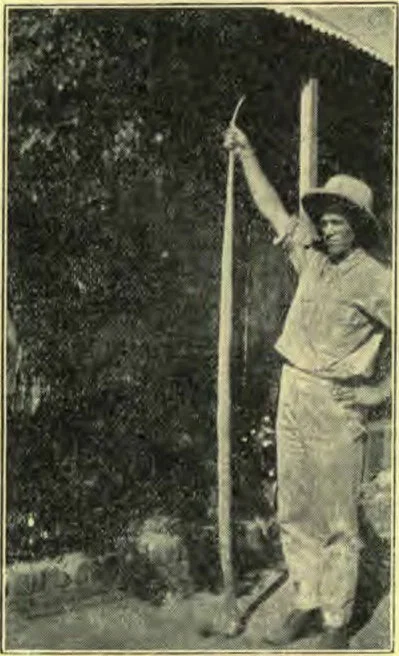
I asked Samuel something of his earlier life, and he told me he had been over nearly all of South Africa. He served during the last two years of the Boer War, most of the time driving the mules of a Maxim gun for the English artillery. He speaks English quite well. He came to the mission ten years ago, where he attended school several years and learned the truth. He was baptized, and because of his simplicity of life and earnest Christian experience, he was sent out as an outschool teacher, in which work he has since remained. Today he is one of our most trusted and faithful teachers.
Because of his earnest efforts in his community he has recently sent three girls to school here at the main station, and two of them are members of our large baptismal class. Other girls say they are going to come to the mission. Two did start, but were overtaken on the road and compelled to return. There are even married women who desire to come here to school, but are held back because of the cruelty of their husbands. The two girls who are members of the baptismal class are quiet and faithful in their work, and manifest every indication of true conversion.
During the evening we spent at Samuel’s, a company of twenty gathered around our camp fire. Samuel read a chapter from the Bible, explaining it as he proceeded; then we had prayer, after which a half hour or more was spent singing our good songs. This company seemed to be those of Samuel’s nearest neighbors, who not only were his intimate friends, but were interested in the truth.
Thursday afternoon Samuel had sent word to everybody to come to the meeting Friday morning. At half past nine we opened the meeting in his front yard, with but thirty persons present from the many kraals around. Human nature seems to be the same in every country and among every people — satisfaction, contentment, and indifference. Samuel said many of the people around him did not care to hear the Bible. But we had a good meeting with those who came.
After the meeting and the usual dispensary work which followed, we were off for Henry’s school at 11 A. M.
RALEIGH P. ROBINSON.