[The following papers on “The Hills and Mountains of God” were given at a program in the Pacific Union College chapel, and were submitted to the INSTRUCTOR by the senior class editorial committee.—Ed.]
Introduction
A FEW summers since, it was my pleasure to canvass on horseback through central Oregon; and I think I have never more thoroughly enjoyed a summer. At least I remember no other with so much pleasure.
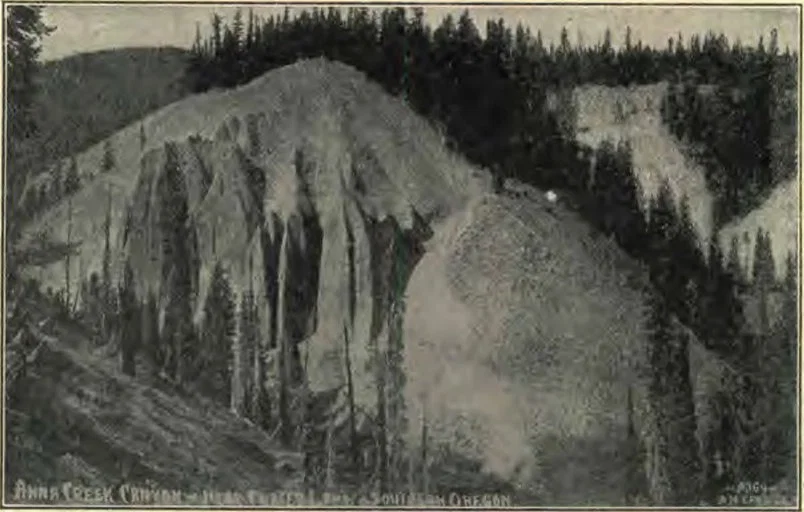
ANNA CREEK CANYON, NEAR CRATER LAKE, SOUTHERN OREGON
The experience is still so fresh and vivid in my mind that I can easily imagine myself mounted on my buckskin pony galloping over those barren hills; inflating my lungs with the pure ozone spiced with the sage and an occasional breath of the juniper; casting my eyes over the broad and rolling expanse of that land of far distances,—and fairly feel my soul expand. Here it is that one feels the freedom of room; here it is, to quote an expressive phrase, that one has “sweep and swing and amplitude.” The very bigness of the country is deeply impressive.
But especially inspiring is a view to the westward, across the intervening plain, waving in golden grain, or across hills as barren as those over which one rides, to the mountains beyond. The dark green of the Cascades, deepening almost to a purple as the sun slips down behind the wooded ridge or behind some icy peak, is a welcome and refreshing barrier to the vision. How restful to the eyes and the heart are those sylvan slopes! How productive of thought are those venerable peaks! Away to the northwestward on the Washington side of the Columbia is Mt. Adams; then the majestic Hood, the Fujiyama of us Portlanders; Mt. Jefferson, the sentinel to the west; and the Three Sisters clustered in the southwest,—a chain of lofty peaks all wrinkled with age and hoary with the snows of unnumbered winters.
It was here, I think, in the freedom of the great outdoors and under the spell of these mighty mountains, that I first began to muse upon the philosophy of the “everlasting hills,” and where I first conceived the idea that we have endeavored to work out in this program, “The Hills and Mountains of God,” those great landmarks towering above the plain of history, each one vastly significant and clothed in majesty and immortal glory,—the stately stepping-stones of Jehovah,—Ararat, Sinai, Golgotha, the Alps, and eternal Mount Zion. L. LAMBERT MOFFITT.
Mount Zion
YOU have gone forth in the silent flush of morning, before the world has awakened to its weary routine of toil, and have seen the sunlit mountains flooded with radiant, golden light; and they have spoken to you—strength.
And yet again you have gone out in the tranquil hush of evening, after the turmoil of the day was ended, and have turned your face, yet burning with the fever of care, toward the peaceful and glorified hills; and they have spoken to you—rest.
They were barren and cold during the day, in the valley where I lived, but in the crimson and orange and gold of sunrise and sunset, they were tinged with the translucent splendor of heaven. And as I have watched them, rising so majestic, so bold, so firm, so calm, roseate with softening, mellow light, I have had almost a vision of the eternal mountains over there where the sun goes not down, and the light does not fade. And then I have remembered that upon a summit like these, the city, the beautiful city, the hope of the ages, the joy of the eternities, shall come down and forever abide,—even upon that hill whose name is so precious, so sweet, to the Christian’s ear, so sacred to the Christian’s heart—Mt. Olivet.
So I have been lost in contemplation and wonder at how unspeakably grand, how supremely beautiful, how awfully sublime, shall be the lofty peaks in that other, brighter world. I hope that the mysterious whispers of the oracular hills of this sphere shall be made plain in the heavenly summits, when all the mists of perplexity have vanished, and the shadows cleared away. And oh, if there is courage and strength and triumph upon these sylvan terraces that climb toward the immeasurable arches of the azure, how infinitely truer shall be their thrill and grasp upon us, when we see them in an earth made new.
I know not half of the supernal excellencies of that Elysium, but herein is my hope, my trust, and my prayer, that amid the towering grandeur of its ineffable heights, I too may roam, among the redeemed who walk there, and “the ransomed of the Lord,” who shall “return, and come to Zion with songs and everlasting joy upon their heads,” who shall “obtain joy and gladness, and sorrow and sighing shall flee away.”
Then, for all we have suffered here, for all we have endured and passed through, it were enough reward.4it seems to me, just to catch, afar off, one vision of that joy of the whole earth, even Mount Zion; and upon it, shining like a crown of unutterable glory, the glittering New Jerusalem, scintillating, flashing, blazing, with the immaculate whiteness of spacious palaces, magnificent pavilions, immortal towers, and avenues of light, where walks the Divinity who made the hills, and in imperishable purity, the blessed host of the sanctified, purified, glorified ones, bathed in the perpetual radiance of God!
In that illimitable realm of peace, we shall ascend to worship on that holy hill within the awful presence of the throne. And every mountain, resplendent with the shining of the angels, shall burst forth into celestial music, too sweet for mortal ears, till all the environing hills are as the choir lofts of heaven, vibrant with the life of melody because the children have come home.
What infinite wonder! What incomparable joy! “Oh, the latitude, and longitude, and sublimity, and profundity, both of the word and works of God!”
I love the strength of these rugged hills that seem like shrines to the invisible Omnipotence. But, above and beyond all beautified inspiration in this transient, ephemeral world—higher and deeper and nobler and grander shall be my inspiration in the everlasting hills of paradise!
LLEWELLYN WILCOX.
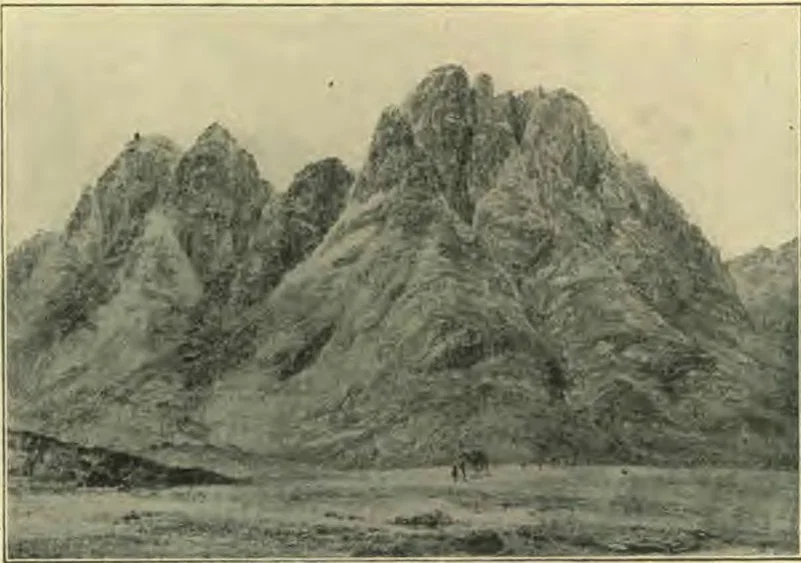
SINAI GROUP OF MOUNTAINS
Sinai
THE three grand features of earth—the sea, the desert, the mountains—combine in the peninsula of Mt. Sinai. It is between two gulfs, Suez and Akabah; two tides never flowing together, one falling as the other rises, but imparting to each of the barren valleys through which they flow a life and activity hardly less than that which has animated the Nile.
White shells strew their shores. A forest of submarine vegetation gives the whole sea its Hebrew appellation of the “Sea of Weeds.” Trees of coral may be seen even on the dry shores with the red rocks and the red sand.
In contrast with the deep waters, and in harmony with the red coral fields, mighty masses of crimson rock stand out alone against the crimson sky. “It is as if Arabia Petraea were an ocean of lava, which while its waves were running mountains high, had suddenly stood still.” It is the sandstone and granite alike that lend this rich red hue which is so wholly unknown to the gray and brown suits of our northern hills. It is the wild rents, the fantastic forms, the grotesque rocks, that have shaped these three groups—Mt. Serbal, Mt. Catherine, and Omm Shomar, the traditional Sinai.
Beyond the range lies the third grand feature—the desert. Blanched sand, with a few scattered palms, stretches for miles beneath the burning Arabian sun, which when like ruddy ore it lies sinking in the barren skies, seems to burn the entire heavens with its blazing rays. Then the shadows, to be in harmony with the constant quietude, stealthily creep across the plain—and night with her thousand eyes keeps vigil until again the sun bursts in upon her.
Mt. Sinai combines the three grand features of earth—the sea, the mountains, the desert. Thus her union of grandeur with desolation makes her scenery absolutely unrivaled. “The entire range is the ‘Alps of Arabia’—but the Alps planted in the desert, and therefore stripped of the variegated drapery of oak and birch and pine, of moss and grass and fern. The very things that impress the traveler when viewing the European Alps are in the Arabian Alps wholly unknown,” yet the impression is no less wonderful.
History was born that night when Moses led forth his children from Goshen. Through these waters, across this desert, around these mountains, wandered the people whose days and experiences are parallel with our days and experiences. As the green fields of Egypt receded from their view, and while advancing farther and farther into the desert—into the great sweep of burning sands and toward flaming mountains—the monotonous expanse of wilderness laid its depressing grip upon them, and they murmured. Doubt filled their minds. Under each morning sun, the desert stretched away before them, a distasteful barren solitude. They forgot the marvelous deliverance through the Red Sea, when all before them was terror and all behind them death; forgot the sweetening of the bitter waters of Marah; forgot whence came their daily food. The scenery around them was bare, dreary, desolate. For they had not learned that—
“Christ alone can satisfy the soul,
And those who walk with him from day to day
Can never have a solitary way.”
And thus they came to Sinai.
“The dawn gilded dark ridges of the mountain, and the sun’s golden rays pierced the deep gorges; on every hand vast rugged heights seemed in their solitary grandeur to speak of eternal endurance and majesty.” But slowly “a dense cloud wrapped the entire mountain in blackness, from out the thick darkness vivid lightnings flashed, while peals of thunder echoed and reechoed among the surrounding heights. The whole mount quaked violently, Sinai was altogether a smoke, the Lord descended upon it in fire. Now the thunder ceased, the trumpet no longer sounded, the earth was still, there was a period of solemn silence, and the voice of God was heard. Speaking from out the thick darkness that enshrouded him as he stood upon the mount surrounded by a retinue of holy angels, the Lord made known his law.” A law which has molded individuals, has molded tribes, has molded nations—yea, has molded the universe!5
In influence Sinai is enhanced by the fact that there she stands alone. “Over all the other great scenes of human history—Palestine itself, Egypt, Greece, and Italy—successive tides of great recollections have rolled, each to a certain extent obliterating the traces of the former. But in the peninsula of Sinai there is nothing to interfere with the effect of that single event. The exodus is the only stream of history that has passed through this wonderful region,—a history which has for its background the whole magnificence of Egypt, and for its distant horizon, the forms, as yet unborn, of Judaism, of Mohammedanism, and of Christianity.”
DUFFIELD STURGES.
Ararat
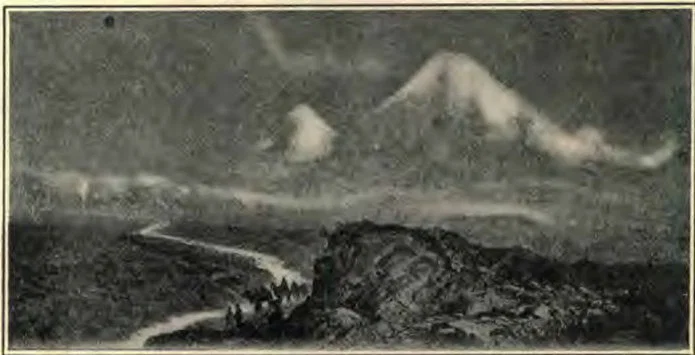
MT. ARARAT, BETWEEN CASPIAN AND BLACK SEAS, ASIA
ARARAT may be called the most venerable mountain in the world. It is the first to be associated with the story of the human race, and is earlier mentioned in sacred literature than any other. It looms on the border line between the antediluvian era and ours, and seems to shut our vision from that former age. This fact disposes us to feel that if we could retrace the steps of history to that mountain range, and from the vantage of its highest summit, could turn our vision backward over the span of twenty centuries, before our eyes would roll the lands and peoples of the world when it was young. What a picture we might look upon, if that were so!
If that were so, there would be opened to our sight a country more enchanting and enchanted than that of any story ever told! A land in which the first hearths and altars of the race were lighted, and where was committed the first black deed of malevolence and blood! A land of mighty giants, whose deeds were exploits, and whose dominion over the wild herds of the plains and the denizens of deep forest solitudes was but half questioned. A land almost as fair as Eden, where the sword of flaming light still guarded from its gate the touch of feet polluted, and whose flowers made all the air more fragrant than the plains of Sharon!
But that vision is denied us. We may continue long and frequently return to seek such a point of outlook, but in vain. The meager chapters of those days are written in the Book. There are tablets of them graved in all the penciled face of nature. They have memorials in the black remains of their ancient forests, and in the fossil bones of animals that roamed their glades. Indeed, the next skeleton you see may have come out of that distant past, and the next piece of coal you burn may once have been a bridal or a festal flower or a bough of shelter under which the children of that country played and sported long ago. Every chiseled hill that anywhere keeps vigil above the universal grave, and most of all Ararat, their headstone, the rock at the mouth of their sepulcher, on which a greater than the Roman seal is set, through some miracle in his heart of stone, seems always to mourn for them in tears, which, falling either side his feet, move in two great rivers to the Persian Gulf. But of that land and those centuries themselves, we may have no closer glimpse. There stands their monument, and in the impenetrable mysteries of its shadows, their countries lie and their figures move unreal and shadelike through the dusky solitudes.
Thus is Ararat a monument to the dwellers before the flood; but to us he stands in quite another relation. For when the ark rested upon the mountains of Ararat, it bore all the potentialities of the human race out of the wreck of the old world into the opportunity and promise of the new, and thereby committed to those mountains the first sponsorship of the new era. It was in the valleys of Ararat that, in its second infancy, the race was cradled and nurtured until it dared to walk abroad again; and from their sheltered defiles, issued the progenitors of every people under heaven.
Today the inhabitants of the world are divided and estranged by racial prejudices, and heavy upon the hearts of men is the accumulated heritage of centuries of hate. There is no race which has not suffered at the hands of a brother race, and neither is there one which shows a disposition to forgive or to forget its just or imaginary grievances. Furthermore, the tastes, temperaments, and standards of men, and even their mental processes, are so widely diverse that the human family is divided by them into uncongenial and incompatible groups. Indeed, it seems that races have been innately so constituted that in color, taste, and character they tend to repel each other, to disassociate, rather than to mingle and to fuse; as if, at the tower in the plain, God designedly exaggerated the most distasteful peculiarities of men, so that very dislike for each other would drive them as far apart as the boundaries of the world would permit.
But in the shadows of Ararat, this condition did not yet prevail. There the whole human family dwelt together in blood relationship. And thus it falls out, that Ararat, to us, stands for the original equality and brotherhood of man, and prophesies of that day when the animosities of mankind will be subdued, and their exaggerated characteristics sufficiently modified, so that the race may dwell together again in genuine congeniality and unfeigned devotion.
And Ararat has yet another meaning, not so profound as this perhaps, but sweeter because it touches more intimately upon our lives of every day.
Upon the floods that destroyed the old world, there was one voyager, the first sailor of a sea unknown. He felt his craft caught roughly to the breast of ocean, where hungry waves drove at it with their fangs, and wild tides reached for it out of the soundless depths. Day and night the din was in his ears of waters beating the deck overhead, and wind and water bellowing on every side; and not one light in all the heavens smiled courage to his anxious eye. But after forty days, he saw the elements break from the grip of storm. The lunging war horses of the deep tossed their foamy manes less and less high in air. The fury of the winds abated, and their wild yells died into low-voiced whisperings about his bark. And he saw the hours6begin to lengthen into days of endless unbroken tedium, when from sky to sky his eye was met by nothing but the long unvarying stretches of the deep, and no sound was on the stillness but the lap and wash of waters and the rustling flutter of light fingers of the wind at sport with this curious disturber of their solitudes. And then, when he was sick with longing for quietude and rest such as was nowhere in the floods, he found at last in the arms of Ararat, upthrust dripping with ocean ooze to receive his bark, the answer to his heart’s desire. And from that stable height he watched the toiling surge recede until the long green fingers of its foaming margin slipped, clawing at the sands, back and farther back till they were lost in the distance. And he turned to the interrupted duties of his life again, and came to forget the wrangling waters, locked within their rocky prison far away.
There are other hearts who on the troubled floods have sought, in passionate desire, a refuge from the wilful elements and fickle sea. And there is a mountain firm and steadfast whose towering majesty looks down unmoved on all the tumult of the world, and in whose high, pure atmosphere, the heart learns to forget its doubtings and unrest in the calm assurance of mastery and trust. And, if Ararat has for this day one message more than another, it seems to me it must be the blessedness of finding in uncertainty and discontent, a resting place upon that mountain crest, and drifting on the shifting floods no more.
CHESTER A. HOLT.
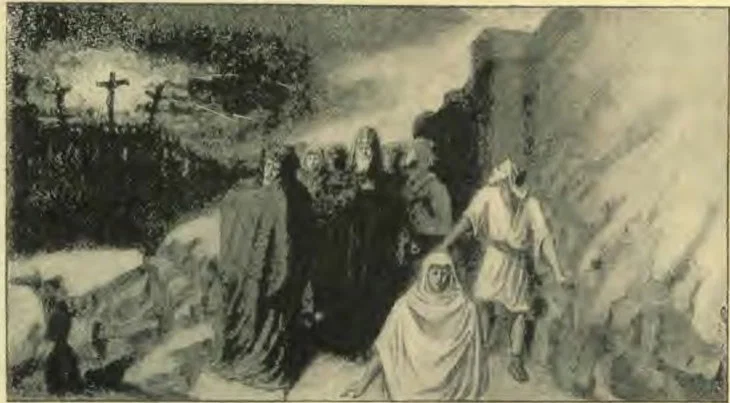
LEAVING CALVARY
Calvary
NORTH of Jerusalem, under the Damascus gate, through which pass now the Bedouin and the rabbi, even as they journeyed in the days of splendor long past, lies the road which since the city was first built has been the golden highway of the world.
Near this golden highway is the mound, so I read once in an ancient book, where our Lord was crucified. And as I read, I saw the eleven and their Teacher wind their way among the Passover tents to Olivet. I saw again Gethsemane, not as it is now in its artifice and false tradition, but as it was when the olive trees heard the wail of grief we cannot know, and witnessed the price of our redemption—and were silent. Over against it lay the guilty city clothed in night and its pride, the temple desolate, cold as the cold moon that cast its rays between the pillars and hastened before the coming dawn. In the shadows the forsaken Saviour wept and prayed alone; and the world slept on, unmindful that its destiny hung in the balance, and careless of its sins and of the weight of woe borne by the Son of man in the garden there. Round about him were the legions of darkness, and his heart was rent nigh to death; and there was none, none to comfort the Comforter, or even to watch beside him.
Ere the day broke, the Man of Sorrows felt the traitor’s kiss and stood condemned in his righteousness, the jest of his children, cursed of his sons, sentenced by power he had ordained. He saw his own deny him, his followers turn, and he suffered the lash of those who called themselves the sons of Abraham. When at last they drove him to the mound outside the city and shamed him with the cross, not knowing that they shed the blood of God, he saw them cast the dice for his garments, and—wonderful love—prayed for them, and those for whom he died jeered and scorned his perfect sacrifice.
Near him, mock courtiers, hung the thieves, their lawless deeds full written on their faces, black and pale in turn, felons in the felon’s dying place. But one of these had yet that grace of God left in his soul that he could see through dim eyes beyond the grave, and ask for pardon, and a diadem to wear within the kingdom of the Crucified. And mark the answer, proof of kingship true as any that ever gave mercy in the hour of death,—promise of a home in paradise. And then in that last hour, the faith of man almost quenched, see thou his own Father turn from the awful scene, and the earth all steeped in sin till the very air was heavy, and the elements, confused, knew not their places; and hear the cry of that worst agony, “My God, my God, why hast thou forsaken me?” And as the pall of death settled down upon Golgotha, and the broken heart of the Anointed, drained of all it held, rested and ceased to beat, far from the distant past rang the echo of a familiar tongue, and the voice that spoke the universe in place spoke again to his own creation, “It is finished!” “Father, into thy hands I commend my spirit.” Out across the valley rang the cry, out and far out, past Orion—till it reached the throne, and the weeping angels heard it, and so it went from eternity on to eternity.
On the mound day drew to a close, and before the Sabbath fell, Joseph came and tenderly laid the body of the King within his tomb, and there He waited, lying with the dead until his resurrection. And out on Calvary, when the stars came out, dimly against the sky three crosses stood, and the cold wind dried the blood that stained them, and now and then beyond the distant hills a solitary jackal called, and in his goat-hair tent the Arab drew closer about him his cloak to shield him from the wind.
Forty years went by, when Titus came and the mound saw the siege of Zion, the chosen city. Cæsar’s legions stood on Calvary whence they could see the temple in its magnificence, and the old men within the walls saw the glittering destroyer and knew that the promised desolation was at hand. Following this came many Gentiles, Crusader and Saracen, Moslem and Christian; and now today, were we to stand on Calvary, we should again see soldiers marching, marching, marching out of the North to seek the ancient battle field of God.
But on Golgotha, when the night is come the bare and lonely knoll revives again the scene, and Olivet, Zion, and Calvary remain, faith, hope, and love, and the greatest of these is love.