When to Use the 6-8-10 Rule
By Charles D. Myers
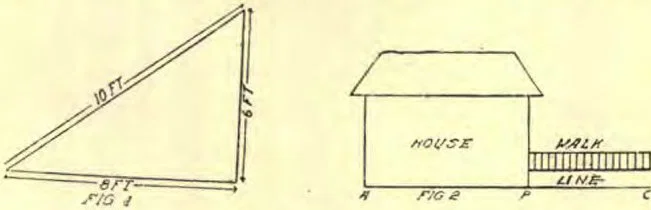
In laying out a rectangular plot of ground for any purpose—the foundations of a house, a tennis court, etc.—the beginner soon finds out that it is almost impossible to get it square by the use of the carpenter’s steel square. Carpenters, when confronted by a similar problem, proceed according to what is known as the “6-8-10 rule.” This rule is based on the fact that the sum of the squares of two sides of a right angle equals the square of the hypotenuse. In practice, the carpenter first determines the position of one of the corners, then measures six feet from it in one direction and eight feet in the other. Between these two points is, if the corner is square, just ten feet. (Figure 1.)
If you have no steel square and want to square a board, you can proceed in about the same way, only measuring inches instead of feet. Using your foot rule, draw a line across the board, making it as nearly square as you can. Then measure six inches along the board, and eight inches along the line. If the line is square, the distance between these two points should be ten inches. If the board is wide, instead of 6-8-10 inches, you may use 12-16-20 inches.
There is another problem that the amateur carpenter sometimes runs up against in laying out the lines for a fence or walk. Suppose you wish to build a walk to line up with a house, as shown in Fig. 2. Stretch a cord from A to C. Make sure, by moving it back and forth, that the line just touches the building at B. Fasten the line to a stake. Now if, at the point B, the distance from the corner of the building to the edge of the walk is two feet, make the distance between the line and the walk at C two feet, and your walk will line up with the building. Of course, you could get the same results by the use of the 6-8-10 rule, but this last method is often preferable.—Charles D. Myers.