[May be used as a reading if too long for recitation.]
IN the heart of China lies the quaint walled city of Kiu-kiang. There, in the year 1873, a black-eyed baby was born to a young couple named Shih, or Stone.
“We will call her Maiyü, for she is a beautiful gem,” decided the parents. Then, praying to the Great Father of all, they consecrated their daughter to his service.
Mr. and Mrs. Shih had been among the first in that part of China to give up their old faith and become Christians. Men and women from the Western world had come to Kiu-kiang, and told of the one true God and of the wise Brother of all men, and they had listened and believed. The father became a pastor and took charge of a Christian chapel. His wife taught a day school for girls.
One day, as Mrs. Shih was talking with the missionary, Miss Howe, she said earnestly, “If I ever have a daughter, I shall not bind her feet.”
This was a wonderful thing for a Chinese woman to say. For centuries past, every girl in the country, unless she was a slave, had her feet kept bandaged till the time was past when they might grow larger. The poor little crippled stumps were called “golden lilies;” the smaller they were, the prouder was the family, and the better chance there was of marrying the girl to a man of high position. Because of this custom Chinese girls had to suffer for years, and hobble about for the rest of their lives.
Mrs. Shih taught Maiyü faithfully whatever she thought a Christian girl should know. So, before Maiyü was eight years old, she had learned to recite the Gospel of Matthew and the Christian catechism, in addition to reading several of the Chinese classics.
Inside the home Maiyü knew only love. But when the usual time for foot-binding arrived, she met with trouble whenever she went outside her door. The passers-by jeered at her for not being brought up like other girls. One day a girl whom she met stood directly in her way, and said: “You can’t pass me till you get down on your knees and make reverence to my bound feet.”
Bow before those poor bandaged stumps! She, Maiyü, the descendant of one of the oldest families of China, ordered to do this! Indeed, she would not humble herself. But it was not till help came from her mother that she was allowed to go her way.
The friends and relatives of the Shihs urged them to have Maiyü’s feet bound. “Why,” they said, “you will never be able to get a mother-in-law for her.” As marriages in China are arranged by the parents, this was their way of saying that Maiyü would never have a husband.
When Maiyü was only eight years old her father took her to one of the missionaries, saying, “Here is my little girl. I want you to make a doctor of her.”
Astonishing words indeed! There was not a Chinese woman physician in the whole country. Such a thing had never been dreamed of before.
“It will take years for Maiyü to be educated,” the missionary doctor told Mr. Shih very seriously, “and after that she must have a course in medicine.”
But the little girl’s father was not discouraged at the thought of the long time of training that would be necessary, and Maiyü was soon busily studying in the girls’ boarding school, which was taught by Miss Howe. She stayed there nearly ten years, studying both Chinese and English.
Then she entered upon the great adventure, and under Miss Howe’s care she started for the United States to study medicine at the University of Michigan. Another girl, Ida Kahn, whom Miss Howe had adopted when a baby, went with her.
After a long voyage, followed by a railroad journey, the girls reached the city of Ann Arbor, Michigan, and gazed with wondering eyes upon the great university. Then came the meeting with new friends, and the entrance examinations, which they passed with such high marks that the professors were astonished. The other students at the university were also interested in these earnest, bright-eyed girls from China.
One day in class, Maiyü startled the professor who called on her to recite, by saying, “I have decided to change my name.” At these words the other students broke into a hearty laugh. Maiyü looked about in surprise. What could she have said wrong? When she came to understand that in America to change one’s name means to get married, she enjoyed the joke as well as the others, for she had simply meant that she wished hereafter to be called Mary Stone, the English for Shih Maiyü.
Four busy, happy years passed by. Mary and Ida won honors in their studies. They also found time to help in Sunday school and to interest many people in missionary work for China.
Graduation day came at last. They wore gowns of soft and beautiful China silk, sent to them from home. Maiyü’s dress and slippers were of pale pink; Ida’s were of blue. When they came out on the platform to receive their diplomas, the great hall rang with applause, for here stood two girls who would certainly bring honor to the university.
Dr. Mary Stone, as we must now call her, did not stop to rest, but went at once with her friend Dr. Kahn to Chicago to learn all she could in the hospital there.12
In the autumn of 1896 the young physicians reached their old home, to be greeted by thousands of eager people. They were borne through the streets to the noise of exploding firecrackers, while crowds closed in around them to peek curiously at the “women doctors.” The air was full of questions, such as, “Can they heal the sick?” “Is it true they have been studying for four years in a foreign land?” “Will they live here in Kiu-kiang?” And when the girls answered, “Yes, yes,” their friends nodded their heads and said, “Hao! Hao!” meaning, “Good! Good!”
“We will rest a little before beginning our work,” thought the women doctors. But this was not to be. On the third day after they reached home, four sick persons came to ask their help. The next day, others came. From that time on their practice grew so fast that they had to rent a place at once where they could treat the sick.
About one month after this remarkable start, they were asked to visit a very sick woman. When they reached her house, they met the Chinese physician, dressed in elegant robes of silk and satin. He had already said to the woman’s family, “I can do no more. You had better ask the help of the women doctors who have studied across the seas.”
The sick woman began to improve almost as soon as Dr. Stone and Dr. Kahn began to treat her. She was soon out of danger. Her relatives were so pleased that they prepared a feast for the young physicians, at which the grandmother honored them by winding red scarfs about them. Many gifts were also showered upon them, and firecrackers were set off in their honor.
One success followed another, until noted men throughout the country heard of the work of these young girls whose feet had never been bound and who did such remarkable things. At last some of the great men of China actually formed a society the members of which agreed to have their sons marry girls with unbound feet, and their daughters marry only into families where the girls had natural feet.
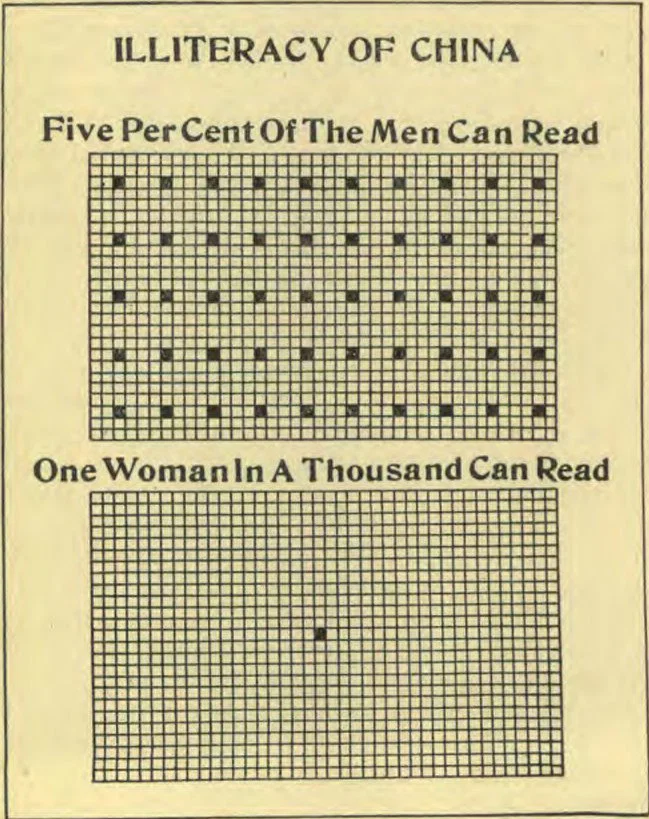
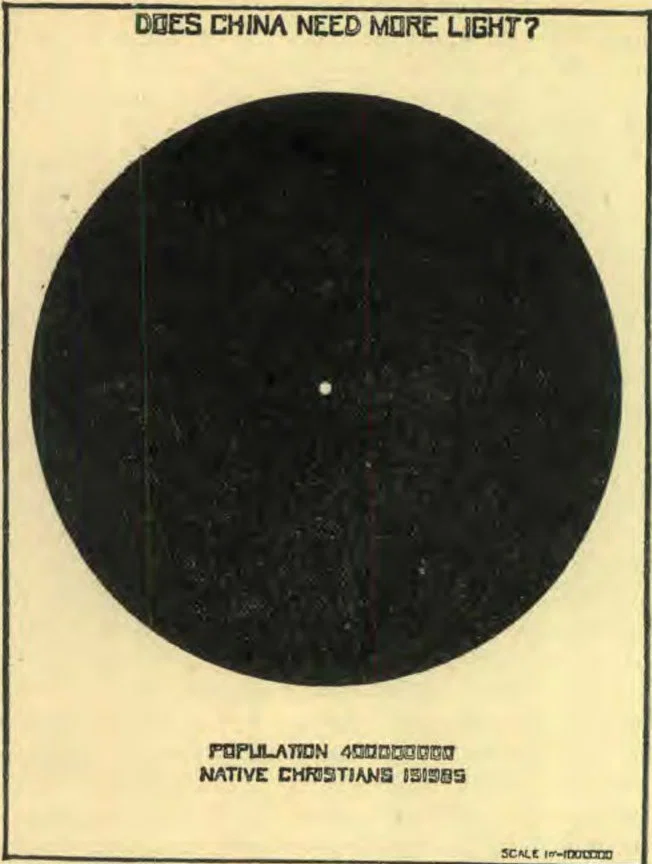
For the Illustrated Exercise, make two charts out of this one.
At the end of a few months Dr. Stone and Dr. Kahn had treated more than two thousand sick persons, had made over three hundred outside calls, and had thirteen patients in their tiny hospital. Wherever they went people treated them with honor, and they were often carried home in chairs decorated with red cloth, while admiring crowds exploded firecrackers.
Soon after the hospital was opened, a great flood swept over the near-by country, and the homes of tens of thousands of people were destroyed.
Since then this wonderful woman has been busy as ever, serving in his name the women and children of her country. Honored in both the East and the West, she proves to all who know her that the parents chose wisely in naming her “Beautiful Gem.”
They are still busy in hospital and school, in homes, and on the lecture platform, serving in Jesus’ name the women and children of their native land.—Adapted from Everyland.