The Earth's Atmosphere—No. 8
Weight, or Pressure, of the Air Illustrated
(Concluded)
The pressure of the air is the active principle in barometers. Otto Guericke (ga-rick-eh), of Magdeburg, Germany, a philosopher wiser than his generation, made the first barometer, not taking into consideration Torricelli's and Pascal's experiments. Guericke constructed in his own home a cistern which opened on the roof of his house. He floated on the water a wooden figure of a man. As the atmosphere decreased in pressure on the top of the water in the cistern, the old wooden fellow, which usually overlooked the roofs of the buildings, would go out of sight; and as the atmospheric pressure increased, the old man would be lifted up higher, so he could be seen from the street. Usually before a storm there is a decrease of pressure, so the old fellow would draw his head out of sight before a shower; but on pleasant days he would be quite sure to be out looking about. The people, being superstitious and ignorant, thought the owner of the curious figure was in league with the devil, so threatened his life. The philosopher, rather than further risk his safety, removed the old barometric gentleman to less conspicuous quarters.
Our present-day barometers are based upon the same principle as Guericke's; but mercury is substituted for water. Since it is more than thirteen times as heavy as water, a tube only one thirteenth as high is required. While the air at ordinary pressure will sustain a column of water about thirty-four feet high, it will sustain a column of mercury only thirty inches, as Torricelli showed.
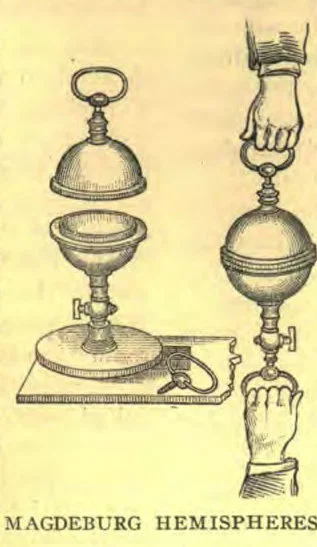
Otto Guericke made another interesting piece of apparatus that illustrated admirably the pressure of the air. This consisted of two large metal hemispheres that could be fitted tightly together. After putting them together and exhausting the air from them by means of the air-pump which he himself invented, eight strong horses, four at each end, were unable to pull them apart.
The air-brake used on trolley and steam cars is a very important invention, and depends upon compressed air for its utility. A powerful condenser worked by steam is attached to a locomotive. It is connected by pipes with a reservoir under each car, and fills these reservoirs with highly compressed air. When the engineer wishes to stop the train, he moves a lever, which allows the compressed air to rush into a cylinder, also under the car, and, by driving a piston along this cylinder, it presses the brake strongly against the wheels.
Winds are due to differences in the atmospheric pressure. Warm air is lighter than cold air; so wherever the earth for any cause becomes especially heated, the air over that place is thinner and lighter, so the cold air rushes in and lifts the warm air up and out. If the air everywhere was of equal temperature, there would be no winds. Cyclones are accompanied by a whirling, or rotation, of the wind around a heated area, or an area of low barometer, together with an onward movement of the storm over the country. The great weight, or pressure, of the air at such times is very apparent from the immense damage and curious freaks wrought by the cyclone. One storm that “started from the Barbados sunk an English fleet that anchored at St. Lucia, and then ravaged the entire island, blowing down houses and burying over six thousand persons in the ruins. Then, moving on to Martinique, it overtook a French transport fleet, sinking forty ships, with four hundred people, all of whom perished. Farther on to the north, the islands of San Domingo, St. Vincent, and St. Eustatius were devastated, and nearly all the vessels in the track of the cyclone were lost, with all on board.”
While winds at times prove very destructive to life and property, their work is usually of a beneficent character, purifying the air, equalizing temperatures, so modifying climate and distributing moisture.
To the air in its quiescent state we also owe much. It diffuses light, so that we can see all about us in the daytime. Were it not for the particles of the air reflecting and re-reflecting the light, we should need a lantern at noon even to find anything on the side of the house opposite the sun. The beautiful sunset colors are made possible by the air and the vapor it holds. So the northern lights, among the most impressive of atmospheric phenomena, are caused by discharges of electricity through the rarified air of the upper regions. Beauty and utility are wonderfully combined in the services our atmosphere renders us. Let us not forget that our Father's thought toward us when he said, “Let there be a firmament in the midst of the waters,” was a very generous one.
Liquid Air
It may be interesting, before leaving the study of the air in its natural or gaseous form, to study it in its liquidp. 8 state. Liquid air, according to one writer, is air so cold that it assumes the liquid form. The first ounce ever produced cost three thousand dollars, and the next pint, eighty dollars. With improved methods it may now be prepared for a few cents a gallon. A Mr. Trippler, of New York, has a private plant for liquefying air, and so economical are his methods that his prodigal use of the liquid is astonishing to all observers. He pours it out upon the floor by gallons, that visitors to his plant may see how rapidly it evaporates.
Mr. Trippler makes use of both pressure and cold in his plant. He subjects the air to a pressure of two thousand or two thousand five hundred pounds per square inch. The liquefied air occupies only about one eight hundredth of its former volume. It evaporates readily, drawing heat from whatever is in contact with it. Rubber, beefsteak, and eggs are made brittle like glass by being immersed in it, and will give forth a musical tone when struck. This is due to the intense cold, and not to any chemical action. Lead is made elastic, and mercury, the quicksilver of our thermometers, is frozen to a solid by it. Nails may be driven into wood by mercury hammers thus formed. If liquid air is poured into a glass of alcohol, the alcohol will quickly freeze solid. If a tin cup is immersed in liquid air, it becomes so brittle that when struck it breaks as does glass.
Owing to the rapid evaporation of liquid air, it will, in a few seconds, if confined in a tube closed with a wooden plug, drive out the plug with an explosive force and a loud report. Paper, or even the asbestos felt used in wrapping pipes, will, if saturated with it, burn brilliantly. The older the liquid air, the more brilliant the burning, since the nitrogen escapes more readily than does the oxygen, and leaves the residue richer in oxygen than the newly formed liquid.
Because of the concentrated oxygen in the liquefied air, steel pens, watch-springs, electric-light carbons, if heated to a red heat, burn rapidly when plunged beneath the liquid. The carbon dioxide gas formed by the combustion freezes at once, and drops to the bottom of the vessel as a white solid.
If a kettle of liquid air is placed on a cake of ice, the air boils vigorously, since the ice is very hot compared with the liquid air.
The suggested uses of liquefied air exceed its practical uses. While liquid air may have to wait long, as did electricity before coming fully into its own, it has already rendered service in purifying liquids by freezing them. For instance, as chloroform crystallizes, by subjection to great cold, into solid crystals, these can be removed and melted, and a pure product obtained. The cold of liquefied air in some instances may be used to produce chemical reactions, the same as heat. It has also served as an explosive in blasting, thirty tons of coal being loosened at times by one shot. It is also used as an energy producer, a refrigerant, a cauterizer in surgery, a smoke consumer, and for burning garbage in cities.
F. D. C.