THE raft has been used for centuries for carrying various cargoes. It carried Egyptian cotton on the Nile; it is in service on the Kongo River in Africa and the Ganges in India; but the raft which is its own cargo is that composed of logs—a method of water transportation that originated in Nova Scotia a half century ago.
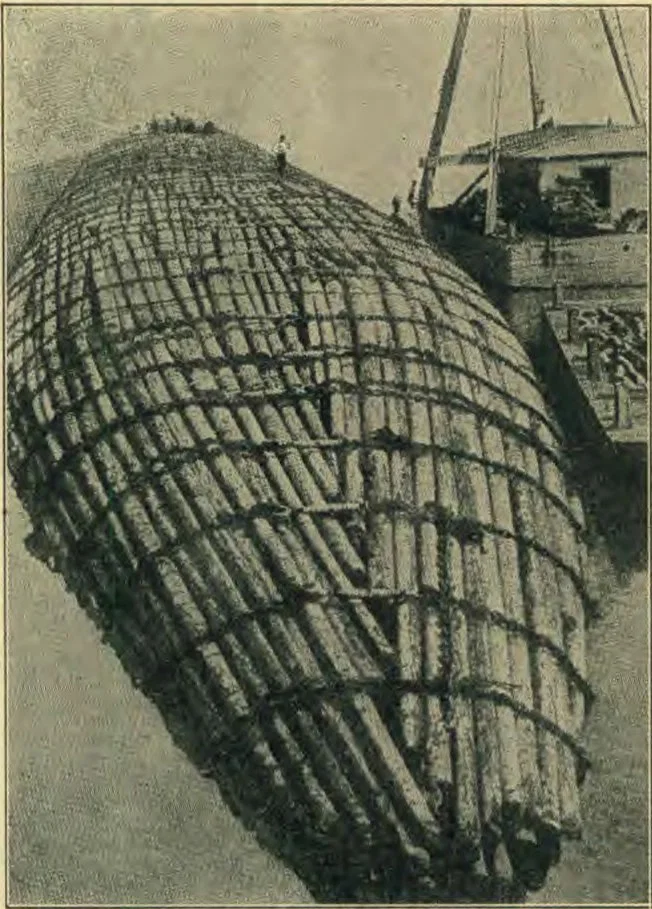
Tree trunks cut from Nova Scotia forests were moved on wooden rollers to one of the harbors, where the logs were piled in layers and bound together with twisted wire rope. The raft was to be taken to a lumber mill on New York Harbor, where the logs were to be cut into timber for building purposes. To haul the raft while on the sea, one end of a heavy wire rope was fastened to its bow, the other was secured to the rear deck of a steam tugboat. It started on its ocean journey, but never reached its destination, for a gale of wind sprang up, the towing rope parted, and the raft drifted out to sea. Later, some of the logs were washed ashore on the Norwegian Coast.
In the Northwest the transportation of lumber in rafts is very extensive. They are of enormous dimensions, in shape closely resembling a cigar, having its greatest diameter at the middle and tapering to a point at both ends. While these rafts are of varying sizes, the smallest usually contain at least five thousand pieces of timber ranging from eighty to one hundred and ten feet in length and from two feet to nearly five feet in diameter at the butt.
Consequently, some of the rafts made in this peculiar fashion are nearly as long as the largest transatlantic liners, measuring no less than six hundred and fifty feet from end to end. So compactly are the poles arranged, however, that the greatest diameter is not over sixty feet; but, as our picture shows, the great weight of the wood forces a raft down in the water until the highest portion is rarely over ten feet above the surface.
To bind together the logs on the raft so that it will withstand the force of the seas to which it is exposed in the trip down the coast from the Columbia River or Puget Sound to San Francisco and the southern California coast, is a difficult problem. As the cigar shape offers less resistance than any other to the force of the waves, this has been adopted.
In order to pile the timber into this form, a huge skeleton, or shipway, as it is called, is constructed. This is practically a cradle, moored in the water adjacent to the boom where the logs are confined.
By means of a boom derrick the tree trunks are lifted from the boom one by one, and placed in the cradle so as to overlap each other, the plan followed being somewhat similar to that used in laying a brick wall, the end of each log coming opposite the center of the one adjacent to it, although to a novice the raft looks as if it were made up of timber thrown in without any order. After completion the raft is wrapped with iron chains lashed around it at intervals ranging from twelve to twenty feet apart. The chains are composed of one and one-half inch links, and after the chains have been stretched taut by a hand or steam windlass the ends are clamped together by little steel wheels. To prevent the chains from slipping, iron staples are driven through the links into the outside poles. In addition to the chains, however, side lines, as they are called, consisting of wire ropes, are stretched around the raft between the chain sections, so that, when the wrapping is completed, the mass of logs is bound together very securely.
When the wrapping is finished, the raft is ready for launching. The cradle in which it has been formed consists of two sections held together at the bottom by bolts. To each bolt is attached a rope, and when the raft is ready to be floated, it is necessary only to pull on these ropes. The bolts then slip back in their sockets, the two sections of the cradle fall apart, and this curious sea craft is ready to be towed away by tugboats.
In building the raft two two-inch chains are stretched lengthwise from end to end through the center. One of these is bolted to a sort of bulkhead at one end, consisting of a band of iron which is fitted around the projecting ends of the outer pieces.
The other chain, called the towing chain, is connected at the forward end with the towing hawser, and secured inside the raft by lateral chains which extend also from side to side, being fastened to those which encircle the raft. In this way the towing strain is well distributed and is not borne merely by the bow end.
To move this unwieldy bulk, two powerful steamers are usually employed at sea, one for pulling directly ahead, and the other to aid in keeping the raft in the right course, especially in rough weather. But a comparatively small portion of the surface is exposed to the seas; otherwise it would be impossible to transport the timber in this form. The depth in the water allows only a very slow rate of speed to be maintained. The average time required between the Columbia River and San Francisco is from ten to fifteen days, according to the weather, although the distance is only about seven hundred fifty miles.
The Columbia River rafts are put together at ap. 11 town called Stella, which is located in the lumber country about forty miles from the mouth of the river. These rafts are the largest which have yet been transported down the coast.
While many of these rafts have been safely taken to their destinations, some have had their fastenings torn away by the force of the waves. Where such accidents have occurred, the scattered logs have spread over the ocean for a distance of many miles, and have formed a very serious danger to vessels.—Day Allen Willey.