Notes on Christmas

17%

Review and Herald Publishing Assn. · Takoma Park Station, Washington, D. C. · Dec 25, 1917

FromThe Youth’s Instructor, Vol. 65, No. 52.

Read the full edition

Notes on Christmas

We were once fined for keeping Christmas. Yes, in America! In 1659 the General Court of Massachusetts enacted that “anybody who is found observing, by abstinence from labor, feasting, or any other way, any such day as Christmas Day shall pay for every such offense five shillings.” This law held and was enforced for twenty-two years, and even when it was finally repealed in 1681 the Puritans grew bitter and for years never recognized the day.
Nobody knows when Christ was born, of course, and December 25 is simply an arbitrary date. The day has been variously fixed and celebrated on April 20, May 20, March 29, September 29, and quite generally on January 6.
“The Christmas tree was born in Egypt. There the tree used was the palm; and the ceremony was in full force long before the days of Anthony and Cleopatra. The palm puts forth a fresh shoot every month, and Old-Year parties were given with a palm spray, with twelve shoots, symbolizing the completion of another year. The custom passed into Italy, where the fir tree was employed for the purposes of celebration; and its pyramidal tips were decorated with burning candles, in honor of Saturn. This festival, the ‘Saturnalia,’ was observed at the winter solstice, ranging from the seventeenth to the twenty-first of December. Then came the ‘Sigillaria,’ days for interchanging presents of figures in wax, like those on the Christmas tree; and, finally, the ‘Juvenalia,’ when men became ‘boys with boys,’ matrons turned children once again, and young and old indulged in the solemn romps with which the festival closed, and which used to mark our own old-fashioned festivities at Christmastime. Then the Christmas tree passed into Germany, but there still may be seen the pyramids which sometimes are substituted for the tree.”
“Santa Claus is buried in Italy — that is, the man from whom we got Santa Claus. He was St. Nicholas — an archbishop of Myra, in Lycia, who passed away on Dec. 6, 342. He was supposed to be a holy personage of unusual attributes, with an especial love for children. In Russia, December 6 is a church day; in France it is the grand fête day of children; in many provinces of Germany it is celebrated as a preliminary to Christmas; in the Netherlands it is the real day for gifts, with December 25 as a church day; in South Austria it takes the place of our Christmas Day. Nicholas was abbreviated to ‘Klaas’ by the Dutch, and from this our ‘Claus’ is easily apparent. At Bari, on the southeastern coast of Italy, the bones of St. Nicholas are interred, and on every December 6, thousands of pilgrims visit the tomb and great ceremonies are held.”—The Ladies’ Home Journal.
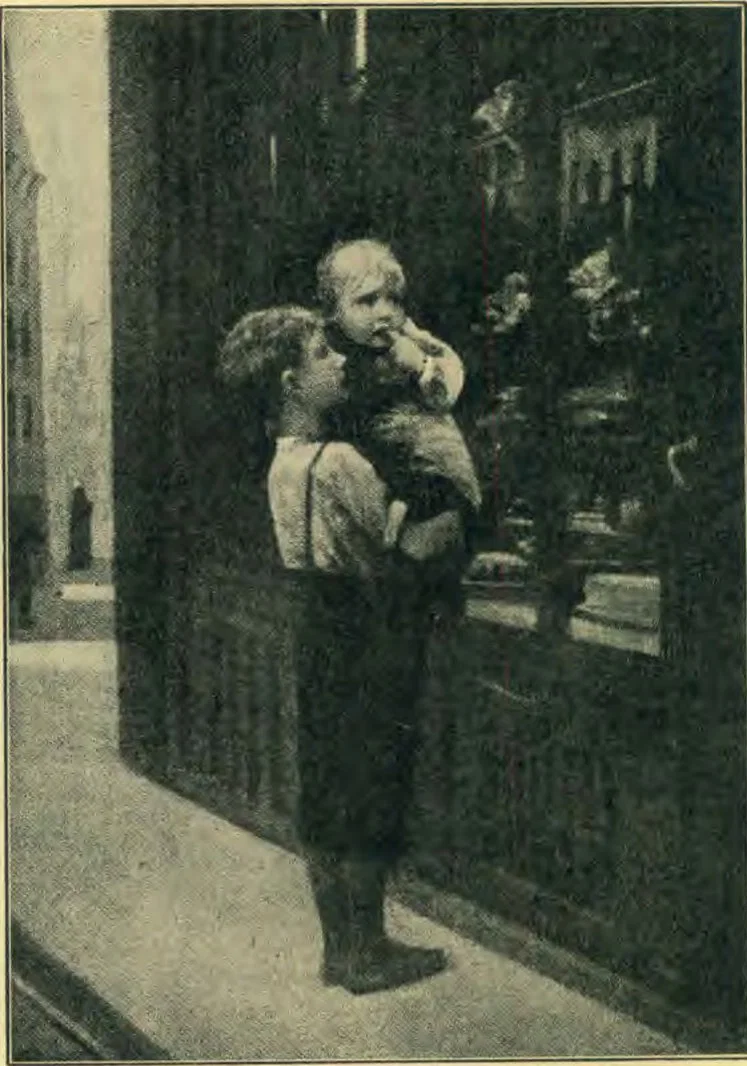
THE TEMPTING SHOP WINDOWS YIELD NOTHING TO THOUSANDS OF WISTFUL CHILDREN THIS CHRISTMASTIDE