Donald Hears About the Cleansing of the Heavenly Sanctuary
CARLYLE B. HAYNES
DONALD HUNTER reached the big tent on the baseball lot early on Tuesday night, and waited eagerly for the beginning of the meeting. He was much interested in the subject that night, for he wanted to learn what great event it was which God had predicted would take place in the year 1844.
When the electric lights flashed on, he saw hanging over the platform a chart more than twenty feet long on which was painted in beautiful colors a picture of the sanctuary the children of Israel built in their wilderness wanderings. All the furniture of the sanctuary was painted a golden color, and the chart made a very attractive background for the platform. Donald studied it with interest during the song service, and then, as Brother Harris began to speak, he settled into his seat prepared to listen carefully to every word.
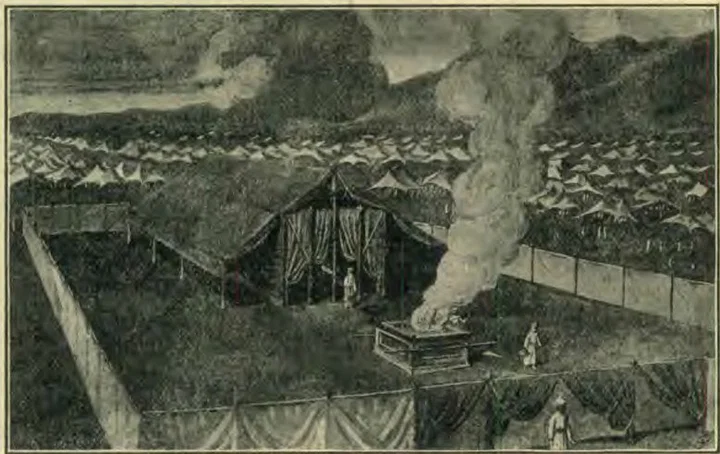
“This ancient sanctuary,” said the speaker, pointing to the chart, “was the dwelling place of God in the camp of the Israelites. During the time Moses spent forty days with God on Mt. Sinai, he received instructions to build the sanctuary. While he was there communing with God, the Lord said to him, ‘Let them make me a sanctuary; that I may dwell among them.’ Ex. 25:8.
“Then the Lord said: ‘According to all that I show thee, after the pattern of the tabernacle, and the pattern of all the instruments thereof, even so shall ye make it.’ Verse 9. From this it is plain that Moses not only received instruction to build this sanctuary, but he was shown a pattern of the sanctuary as a whole, as well as a pattern of every article of furniture to be placed in the sanctuary. This is evident from Ex. 25:40, in which the Lord, having described all the articles of furniture, said: ‘Look that thou make them after their pattern, which was showed thee in the mount.’”
“In obedience to this instruction, Moses had the children of Israel build the sanctuary. It was constructed in every detail just as the Lord commanded, and according to the pattern which Moses saw. This sanctuary is described fully in Exodus, chapters twenty-five to forty.
“The sanctuary was always pitched in the center of the encampment in the wilderness, three tribes of the children of Israel pitching to the north, three to the south, three to the east, and three to the west. In the court of the sanctuary, as you see here on the chart, there were but two articles of furniture, the brazen altar on which all the sacrifices were offered, and the brazen laver in which the priests washed before entering upon any of the services.
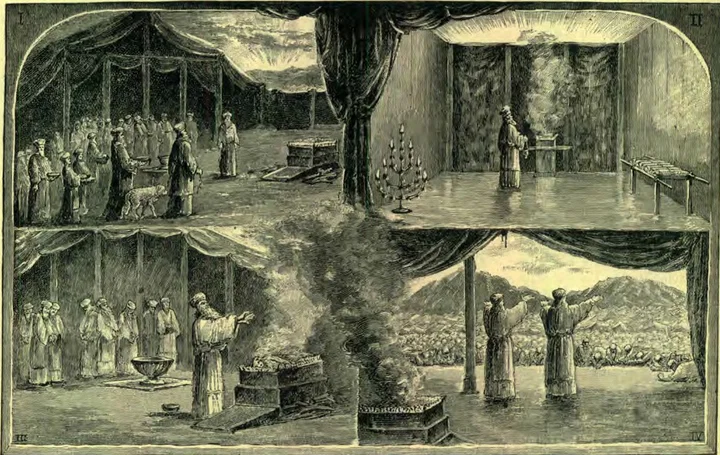
“The sanctuary itself was composed of two rooms, the holy place and the most holy place. In the first, the holy place, were three articles of furniture, the table of showbread, the seven-branched candlestick, and the altar of incense. All of these were made of gold or overlaid with gold. A veil, with the figures of angels embroidered with gold thread, separated the holy place from the most holy place.
There was but one article of furniture in the second apartment, the ark of the covenant. This was a chest of acacia wood, covered both inside and outside with gold, in which were the two tables of the ten-commandment law. The cover of this ark was solid gold, and was called the mercy-seat. On each end of this mercy-seat was the figure of an angel with outstretched wings. Between these angels there was always a bright light which had no human source, and this was the Shekinah, or the manifest presence of God among his people.”
“The services which were carried on in this sanctuary are fully described in Leviticus, and are as follows: When any person committed sin, he broke the law which was in the ark in the most holy place, for ‘sin is the transgression of the law.’ 1 John 3:4.
“When this law was broken, it condemned the sinner to die. It demanded his life. It sentenced him to death, for ‘the wages of sin is death.’ Rom. 6:23. And ‘without shedding of blood is no remission.’ Heb. 9:22.
“The broken law, therefore, demanded blood before the sin could be remitted. Hence the man who had sinned brought to the gate of the court an animal such as had been appointed for the sin offering. The sinner then confessed his transgression on the head of the animal, and, in type, his sin thus passed from himself to the lamb. It was now the lamb which the law condemned; it was now the blood of the lamb which it demanded. Then with his own hand the man killed the lamb, its blood was caught in a basin,p. 9 and taken in by the priest and sprinkled before the broken law. This was done to show that the demands of the law had been met, and that blood had been shed for the remission of man’s sin.
“Thus the man went free and the lamb suffered in his place. All this, of course, was typical of the vicarious atonement of Jesus Christ. And it was all meant to impart faith in the coming of ‘the Lamb of God, which taketh away the sin of the world.’”
Donald’s interest in this subject was greatly increased as it was explained. That part of the Old Testament which dealt with sacrifices and offerings had been very dry reading to him, and he could not understand why beasts had to be offered to God; but now he was beginning to see that they were only typical of the great sacrifice of Christ. Many things were made plain to him which before had perplexed him. Elder Harris continued:
“In this way the sins of the entire encampment accumulated day by day in the sanctuary, being brought in by the blood of the animals which died for their remission. And now it became necessary to cleanse away these sins from the sanctuary.
“This was done every year, on what was known as the day of atonement, which came on the tenth day of the seventh month. On this day the high priest himself had charge of the services. In the morning, two goats were brought to the gate of the court, and lots were cast on them, one being chosen as the Lord’s goat, the other becoming the scapegoat. Upon the Lord’s goat the high priest laid all the sins which had been accumulating in the sanctuary during the entire year. His blood was then taken and brought in directly before the law in the most holy place by the high priest, and there sprinkled for the remission of all the sins which had been confessed and brought into the sanctuary. Then, bearing the sins of all the people in his own body, having made an atonement for them, the high priest came out of the sanctuary, and laid these sins upon the scapegoat. The scapegoat was then led by the hand of a fit man into the wilderness and left there, where he died, and thus the sins of the encampment were separated forever from the people of God. Leviticus 16.
“This service was called the cleansing of the sanctuary. It was observed once a year, and was typical of the work Christ is now doing for us.
“In heaven there is a heavenly sanctuary. Heb. 8:1, 2. It has in it the same furniture which the earthly had. Heb. 9:1-5. The earthly sanctuary, which is shown on this chart, was but a type of that heavenly sanctuary where Christ ministers for us. This is the figure of the true. Heb. 9:8-12. When Christ ascended to heaven nineteen centuries ago he entered in the holy place of the heavenly sanctuary to offer his blood there for us. Heb. 9:12. Whenever we commit sin, and confess it to Christ, he offers his blood before the broken law for the remission of our sins, just as the blood of the Lamb was offered in the old earthly sanctuary for the remission of the sins of the people.
“Thus the sins of God’s people for nineteen centuries have been accumulating in the heavenly sanctuary. And the time must come when these sins will be forever blotted out by the final service of Christ’s ministry, the cleansing of the heavenly sanctuary. The time for the beginning of this service is very clearly pointed out in the prophecy we have been studying, ‘Unto two thousand and three hundred days; then shall the sanctuary be cleansed.’ Dan. 8:14.
“We have already seen that the 2300 years end in 1844. In 1844, then, Christ transferred his service in heaven from the holy place to the most holy place of the sanctuary above. In that year hep. 10 began the work revealed to the prophet, the cleansing of the sanctuary. This is the work to which the ancient day of atonement pointed forward. But it was not done yearly, as was that of the earthly tabernacle. Heb. 9:22-26. The heavenly sanctuary is cleansed but once. And the time for the beginning of this work is fixed in the Bible as the year 1844.
“It is undoubtedly this time to which Peter refers when he says, ‘Repent ye therefore, and be converted, that your sins may be blotted out, when the times of refreshing shall come from the presence of the Lord.’ Acts 3:19.
“The time of the final blotting out of sin, then, has actually been reached. It began in 1844, and has been going on ever since. This is the most solemn period in the history of God’s dealings with men. But much more than the cleansing of the sanctuary is involved in this closing work of the gospel. Tomorrow night we shall study the important work that is to be carried forward in heaven at this very time.”
Donald Hunter was greatly moved by this talk. It was almost like drawing aside the veil and permitting him to look into heaven, and observe the great movements which are now taking place there at the throne of God. This prophecy of the twenty-three hundred days was certainly the most wonderful of all, and he found it difficult to wait until the following night before continuing its study. He wanted to learn all about it at once. He lay in wakefulness a long time that night, thinking of the great work which was going on at that very time in heaven, and before falling asleep he did not neglect to thank God for the prophecies which throw such a flood of light on the pathway of those who serve the Lord.