EGYPT is a land of oddities and surprises, a land of wonders and long-forgotten greatness. It is peculiar in form, climate, soil, people, industry, and history.
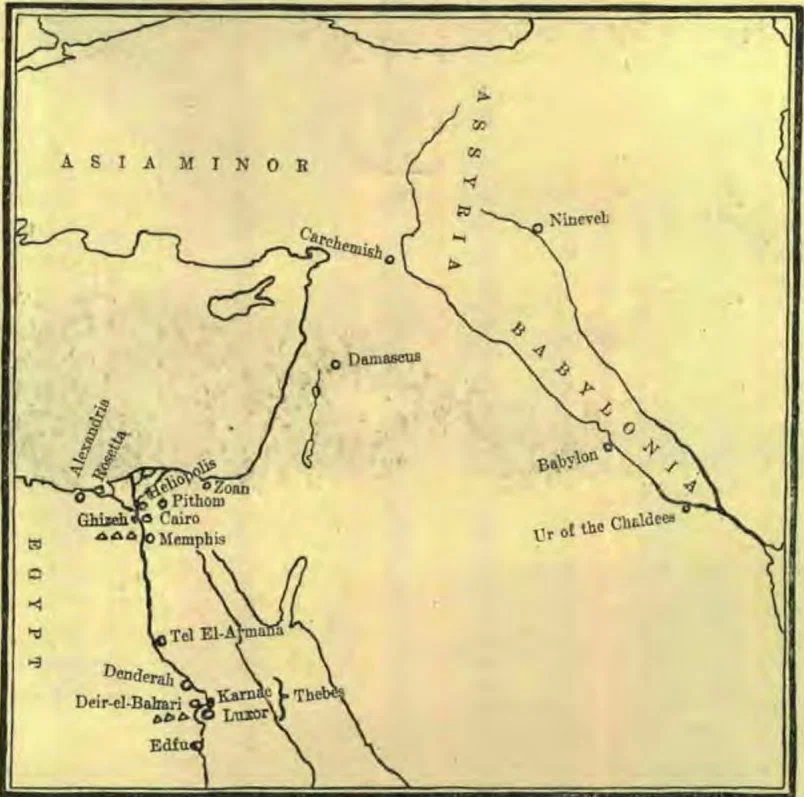
Egypt proper is a little more than 500 miles long and but from 12½ to 31 miles wide. If we include Nubia, which Egypt conquered, the length is more than 1,000 miles.
So near does the desert on either side hug the river that sometimes the green ribbon that fringes its banks is not more than a mile in width.
The Spade as Teacher — No. 2
Further Glimpses into Egypt’s Past
Were it not for the Nile there would be no Egypt. The Sahara would stretch from coast to coast. The river also forms the basis of division, the part between Cairo and the Mediterranean being Lower Egypt, or Bahari; the part between Cairo up to the First Cataract being Upper Egypt, or Said. These terms are confusing, as the term “upper” is usually applied to the northern portion of the country, and “lower” to the southern portion; but here it is not the points of the compass that name the divisions, but the low and the high land, the low land, of course, being at the mouth, or delta, of the Nile.
The kings of Egypt bore the title, “King of Upper and Lower Egypt.” The Hebrew name for Egypt, as used in the Old Testament, is usually regarded as a dual term, meaning “the two Egypts.”
How long Egypt has had a place among the nations cannot be told, but there is evidence that she came into prominence early after the flood, at least more than 3,500 years before Christ.
The very earliest history of Egypt shows that the country first consisted of forty-two districts, or nomes. Different tribes occupied the different districts, and each lived apart from the others. We are told that it was during this predynastic period that the Egyptians began to worship animals, maintaining this custom for centuries this side of Christ.
In time these nomes were united, twenty forming Lower Egypt, and twenty-two, Upper Egypt. The symbol of the former was the bee, and the crown was a diadem of open work; while the symbol of the latter was a papyrus plant, and the crown a kind of tall helmet.
About 3400 B. C., the two crowns were united under Menes, with his capital at Memphis, near Cairo; but the two parts of Egypt were still ruled as separate countries. This was the beginning of the first dynasty, and it may be interesting to note here that we now have “one piece of King Menes’ royal regalia—a golden bar, the oldest known piece of jewelry.”
It was during this early period of Egypt’s history that the peculiar picture writing of the Egyptians came into use.
The Pyramids
The words “Egypt” and “pyramids” are almost synonymous, for the thought of one always brings the thought or picture of the other. A beginning was made at pyramid building in the third dynasty; but the great pyramids were constructed during the fourth dynasty.
These great stone structures, of which there are more than seventy, are the tombs—the burial vaults of kings who reigned two thousand years before the days of Israel’s oppression in Egypt.
What pygmies are the most pretentious of present-day tombs and mausoleums beside these gigantic memorials in the cemeteries of Memphis and Thebes!
The pyramids “are the highest, costliest, cruelest tombs the world has ever seen.” One hundred thousand men are said to have labored twenty years to complete the Great Pyramid, that in it the body of Cheops might rest in security. The king’s tomb was usually hewn out of solid rock, and a pyramid built over it.
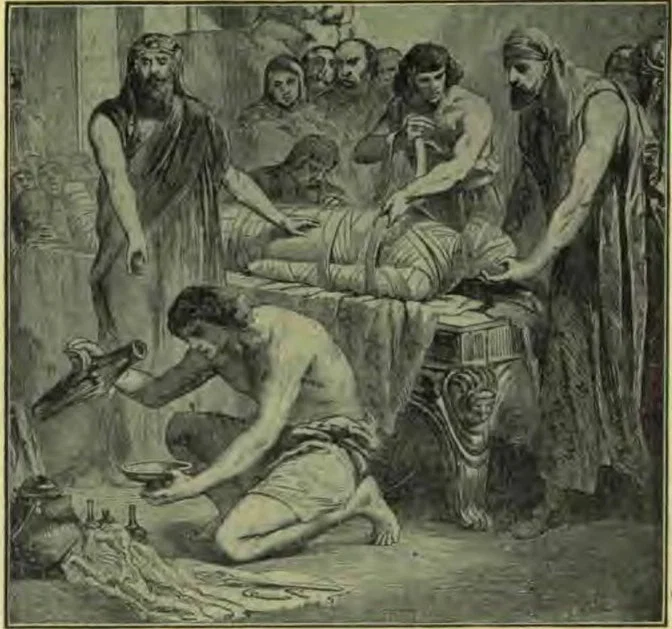
Ordinarily only the king found a resting place in the pyramid; sometimes a separate chamber was built for the queen. Why should not the kings of Egypt have built for themselves enduring monuments when they had the secret of embalming by which the dead were preserved through millenniums?
Dr. George A. Barton, in his work “Archeology6and the Bible,” briefly sketches the main pyramids, as follows:
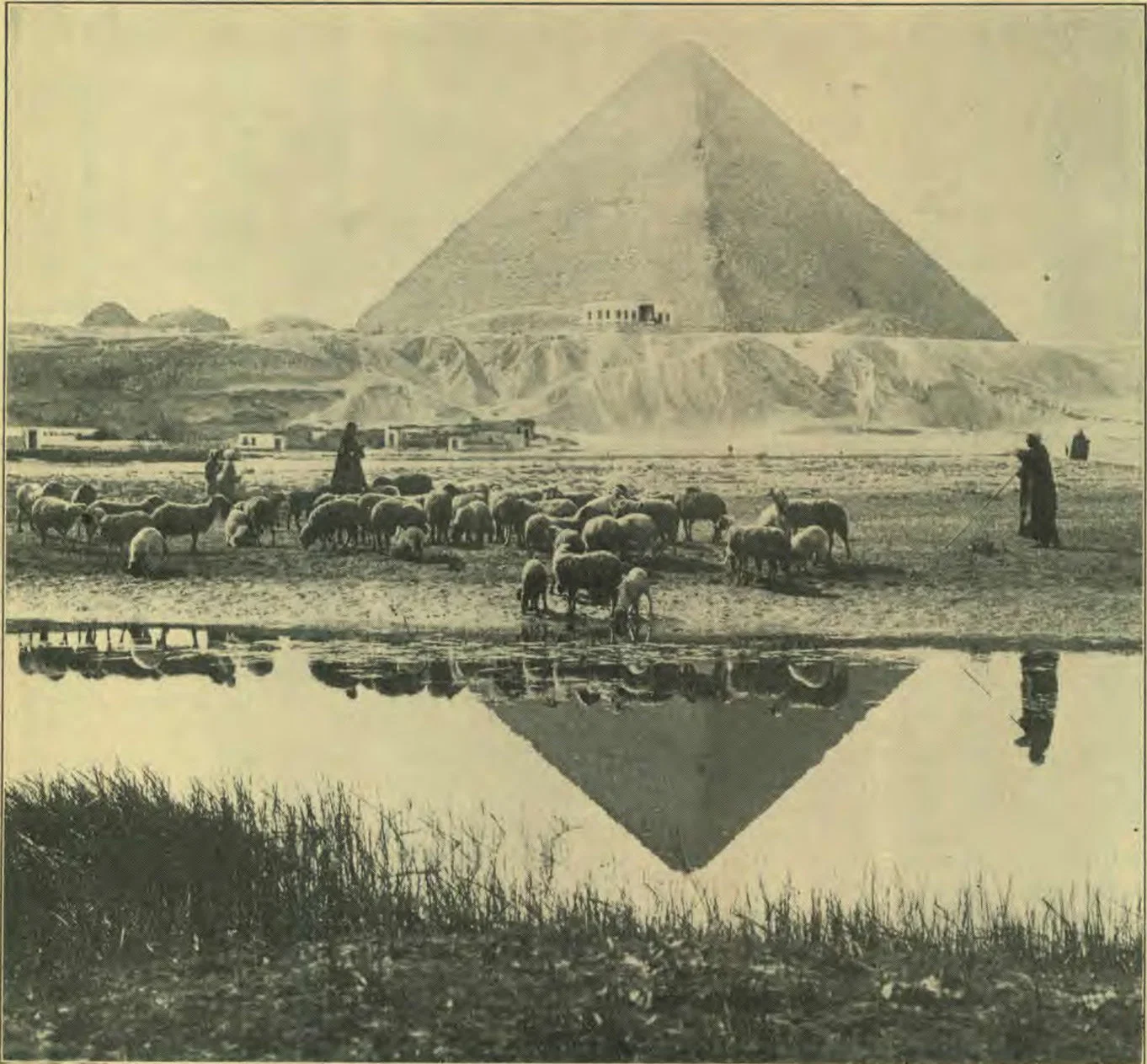
“Khufu, or Cheops, the founder of the fourth dynasty, improving upon the work of his predecessors, constructed the first real pyramid and the greatest of them all. The blocks with which he built were about three feet high, and he made a step with each course of stones. A covering, which has now been removed, was originally placed over the whole, thus securing a perfect pyramidal form. This pyramid is now 750 (originally 768) feet on each side, and 451 (originally 482) feet high. It contains some 2,300,000 blocks of stone, each weighing on the average two and a half tons. The stone was quarried from the Mokattam Hills on the other side of the Nile, more than twelve miles away.
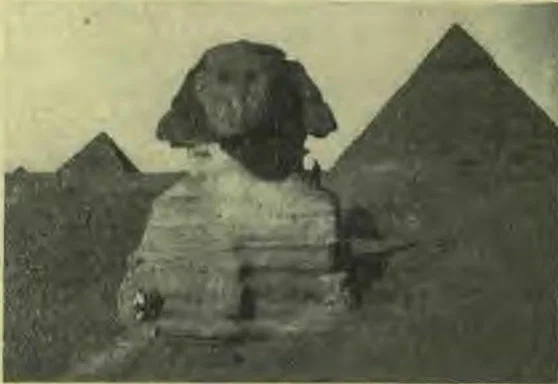
“Khafre, the next king but one after Khufu, built the second pyramid, which is almost as high as that of Khufu, being 447½ feet, but measures on the sides but 690½ feet. Within and under the pyramids are the tomb chambers. Khafre also carved out of the native rock, not far from these two pyramids, the great Sphinx, the head of which bore a portrait of himself. From the top of the head to the pavement under the paws is 66 feet; the breadth of the face is 13 feet 8 inches, and the other parts are in proportion. Near the Sphinx stands a temple, built of polished granite, which is connected by an underground passage with the pyramid of Khafre. All these are silent but eloquent witnesses of the skill of the Egyptians of this period in stone work, and to the absolute power of the Pharaoh.”
The Middle Kingdom Established
What is known as the Old Kingdom of Egypt, which had its capital at Memphis, gave place to the Middle Kingdom about 2160 B. C., with its capital at Thebes because the new ruler was from the nome, or district, of Thebes. This city, though of small importance hitherto, now came into the limelight, and for 1,500 years was one of the most important in the Nile kingdom. The ancient Egyptian name of the city was Net. The Greek rulers changed the name only a few centuries before Christ.
After a few centuries, rebellions broke up the kingdom, and Egypt once again was ruled by kinglets. This condition of division offered favorable opportunity for invasion. And Asia produced the invader, who conquered Egypt and ruled for many years. The kings of this dynasty were the Hyksos, or “Shepherd kings.”
They were of Asiatic origin, but it is not definitely known from what people they were descended. Some claim they were of Hittite origin, and some that they were Amorites. In either case they were foreigners to the Egyptians, and under their rule many people from Palestine, Syria, and Mesopotamia emigrated to Egypt. It is thought that it was during the reign of these Asiatics, or foreigners, in Egypt that Abraham, Joseph, and Jacob were in the country. If this be true it is not strange that these sojourners were so favorably treated by the ruling monarch.
But Egypt did not like her foreign rulers, and various attempts were made to dispossess them, but7not until the effort of Amosis I was the thing achieved. Egypt then became the invader, and in time conquered Palestine, Phenicia, Syria, and the Euphrates. She also extended her empire to the south, conquering Nubia.
The Tel-el-Amarna Tablets
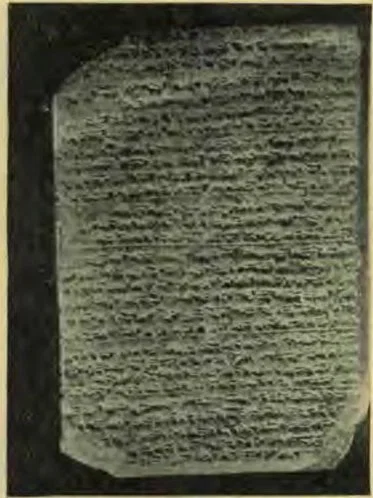
These conquests brought the Egyptians and Asiatics into close relationship. In 1887 a peasant woman found at Tel-el-Amarna, about two hundred miles south of Cairo, more than three hundred cuneiform tablets which proved to be letters, or dispatches, from kings and officials in Palestine, Phenicia, Assyria, and other Asiatic countries to Egyptian kings. They were written in the language of Babylonia. “They speak of political conditions, of social relations, of exchange of gifts, slaves, and proposals of various kinds, such as were made between different nations and subject nations. Their importance can be perceived when we think that they give us some of the real international life of Western Asia and Egypt before a single word of the Old Testament was written.”
PYRAMID OF CHEOPS
Friendly relationship between Egypt and the peoples of the East continued to increase until the kings of Egypt married Asiatic princesses and espoused the religion of Asiatics. Finally one of the Egyptian kings, Amenophis IV, attempted to introduce the worship of the sun god of Western Asia into the sacred precincts of Egypt. “This heresy in the king of the land could not be long endured, and finally, through the letters from Tel-el-Amarna, we learn that civil war was breaking out, that enemies from the north, the Hittites, were advancing, and that general dissolution of the empire was in progress. In the midst of this storm of protest, of secession, and of aggression, Amenophis IV, of Khu-n-Aten, died. But his sepulcher was profaned, his mummy rent in pieces, and his sacrilegious city was destroyed. Asiatics who were implicated in this heretical propagandism were forced to flee for their lives, or suffer the penalty by death. This chaotic condition of affairs ceased only at the rise of a new dynasty, the nineteenth.
“This new house adopted a new policy of exclusion in their motto, ‘Egypt for the Egyptians.’ The early kings were Rameses I and his son, Seti I. Their reigns were short and uneventful, except that Seti carried his arms into Asia and established his supremacy on the east coast of the Mediterranean Sea. But the accession of his son, Rameses II [the Pharaoh of the oppression] marked the beginning of a new era for this dynasty and for Egypt.”
Does not this history given us by the archeologist show why the tide turned so bitterly against the Israelites? for it was in this period of Egyptian history that the Israelites, who were Asiatics, were made to serve with rigor.
Rameses II
This is the Egyptian king who oppressed Israel. It was for him that Israel built the cities of Pithom and Raamses. Ex. 1:11. Within or near the old territory of Goshen, in 1883, Edouard Naville uncovered Pithom, and found colossal statues of this king. He also found the treasure chambers or granaries of this city. “They were strongly built and separated by brick partitions from eight to ten feet thick. The bricks, half sun-baked, were made, some with and some without straw. These storehouses were means adopted by the Pharaoh, Rameses II, to provide for his people in the event of foreign invasion, or of famine, such as had often visited this land. These precautions served to make Rameses’ kingdom independent of his neighbors. These cities of Pithom and Raamses accord with the demands of the Scripture narrative. The storehouses occupy in Pithom almost the whole area of the city, the walls of which are about 650 feet square and twenty-two feet thick. The strawless bricks in these walls almost re-echo the rigor of Pharaoh’s words, when he said, ‘Ye shall no more give the people straw’ (Ex. 5:7), but demanded the former tale of bricks. About these old walls we can see and handle some of the handiwork of the Hebrew slaves. Could these old ruins but speak, what tales of hard taskmasters, of bloody lashings, of exhaustion and distress would they reveal to us! The bondage of Israel, in all kinds of hard and bitter service, aroused even to a murderous deed the court-educated youth Moses.”
Embalming the Dead, Egypt
Rameses II is credited with being the vainest and most ostentatious of Egyptian rulers. He was the greatest of all builders, therefore the greatest of all self-advertisers; for all these great tombs and temples were built by the monarchs to bring glory to themselves. Rameses left his mark on almost everything from Memphis to Thebes. One writer says of him: “It is almost impossible to find in Egypt a ruin or ancient mound without reading his name.” “Of the thirty-two obelisks in Egypt he is said to have erected in whole or in part twenty-one. Of the eight ruined temples in Thebes, he built in whole or in part seven.”8
“For thus saith the Lord God,
My people went down aforetime into Egypt to sojourn there;
And the Assyrian oppressed them without cause.”
This text has presented a serious difficulty to Bible students, for how could it be said that the Assyrian oppressed Israel in Egypt? Commentators invariably sought to explain the apparent discrepancy by saying that both the captivity and oppression are referred to, that the sojourn in Egypt is here contrasted with the captivity in Assyria. But the people were not oppressed in Assyria, so far as the Bible record reveals, and this interpretation would suspend the first statement abruptly, and characterize captivity as oppression, which is not according to fact. But why trouble oneself with questionable explanations?
A Tel-el-Amarna letter from Abimelech, of Tyre, to the king of Egypt. These tablets were discovered in 1887.
A little archeological lore not only beautifully harmonizes the statement, but makes a strong comment on the dependableness of the Word of God. Rameses II belonged to the nineteenth dynasty, which was established by his grandfather, Rameses I. It has been found that “the probable origin of Rameses’ ancestors on his father’s side, may be traced, by the aid of the ‘Tablet of Four Hundred Years,’ back to Chaldea, and the lineage of his mother, by the aid of the marriage record of Amenophis, back to Mesopotamia;” so in respect to race he may therefore justly be regarded as an Assyrian rather than an Egyptian.
Then with the added thought of Rameses II being a descendant of the Shepherd kings of Zoan, the text needs no explanation; but reads with new interest:
“My people went down aforetime into Egypt to sojourn there; and the Assyrian oppressed them without cause.”
Moses Heir to Egypt’s Throne
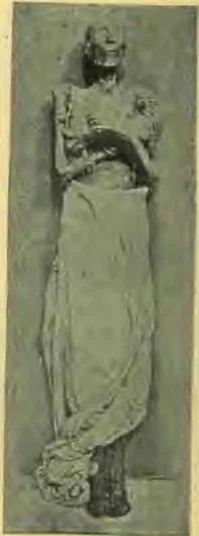
Mummy of Rameses II, found near Thebes, Egypt, in 1881.
Rameses II had many children. Why was it, then, that Moses, the Hebrew-adopted son of his daughter, should be counted as heir to the throne of Egypt? Did not the Bible writer speak thus of Moses’ heirship merely to make an interesting story? We think not. According to the revelations made by the archeologist, Rameses II had many wives, one of whom was his own daughter, the princess who adopted the Hebrew babe. Both daughter and father had Semitic blood in them, so did Moses, and Rameses II seemed proud of his foreign blood. This daughter is always represented as the queen, the royal wife of Rameses II. Her statue adorns temple and colonnade. He is the only Egyptian king who so honored his wife as to make her statue of equal size with his own. Usually the statue of the wife was diminutive, perhaps coming only to the knees of that of the king. It is evident, therefore, that Rameses II was strongly attached to his wife and daughter. She is said to have been the “idol and ruler of his heart.” It is not altogether strange, therefore, that even her adopted son should be made heir to the throne in preference to any of the other children.
The Throne Lost
But Moses by his impulsive act incurred the wrath of Rameses and had to flee to Midian, and so lost the throne of Egypt. In reality he had already renounced all claim to the throne, “choosing rather to suffer affliction with the people of God.” Merneptah, a son of Rameses II, was the successor of his illustrious father. He continued the oppression of Israel, and it was during his reign that the children of Israel left Egypt. His accession to the throne seemed to have been a signal for rebellion against the Egyptian throne. “The Libyans of Northern Africa, the inhabitants of the isles of the seas, peoples from Asia, arose not only to free themselves from the yoke of Egypt, but even to invade her territory.” It is not strange therefore that the king was unwilling to have the great multitude of Hebrews leave the country, for he might have felt they would but join themselves to his enemies, and be a greater menace to the nation when outside of the country than when in it.
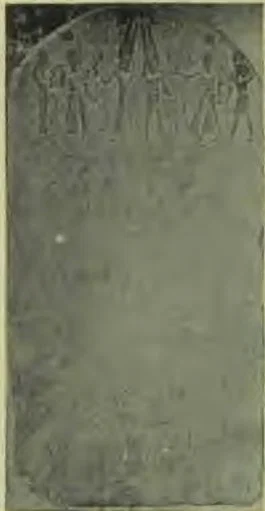
A tablet bearing Merneptah’s hymn of victory over his enemies contains the only reference to Israel found in any early tablet. The following lines form the concluding portion of the inscription:
“The kings are overthrown, saying: ‘Salaam!’
Not one holds up his head among the nine bows.
Wasted is Iehenu,
Kheta is pacified,
Plundered is the Canaan with every evil,
Carried off is Askelon,
Seized upon is Gezer,
Yenoam is made as a thing not existing.
Israel is desolated, his seed is not;
Palestine has become a widow for Egypt.
All lands are united, they are pacified;
Every one that is turbulent is bound by King Merneptah, who gives life like Rah every day.”
Merneptah associated his son of eighteen with himself on the throne. The son’s tomb has been discovered at Thebes. It was unfinished, which indicates that he died suddenly and early in life. May it not be that he was the one slain by the Lord on that fateful midnight?
All this story of Egypt’s kings and much more has been given to the world through the reading of inscriptions on pyramid and temple, and through the spade of the archeologist. We are assured that in the time of the end knowledge shall be increased. Verily, it has been so.
F. D. C.
[Besides the books referred to in this series of articles on archeology, the author is indebted also to “Empires of the Bible” for valuable information.]
Merneptah's Hymn of Victory, in which the name "Israel" occurs.