It is with natural feelings of regret for the friends and associations left behind, and with more or less anxiety for the perils of the long journey by sea as well as for the new conditions under which work must be taken up, that our missionaries set sail for distant lands today. But there is a feeling of security about a large boat. Nor wind nor tide will hinder its onward course. Far below, the mighty engines are throbbing night and day. The bunkers are full of coal, the storerooms of food. An army of workers is there to keep everything in spotless order. On the wide decks are sheltered places for the comfortable chairs, where one may watch the changing face of the sea hour after hour, with as much comfort as his physical condition will permit.
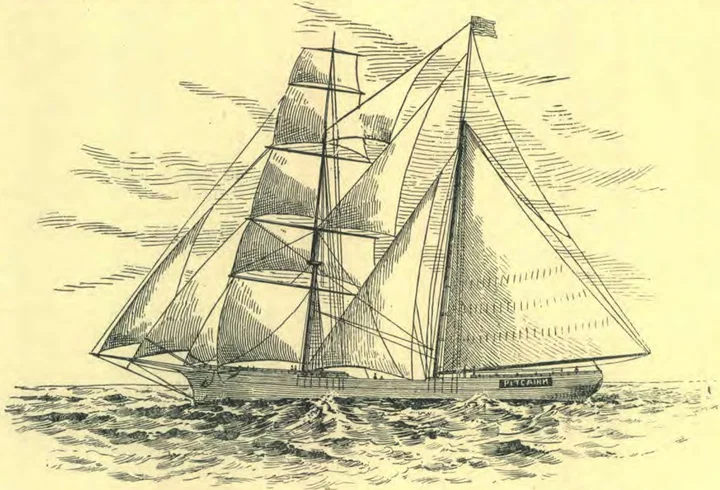
But the “Pitcairn” was a small boat. No provision was made for comforts not absolutely essential; and the passengers suffered severely, often the whole distance, from seasickness. Thus privation and exposure and suffering were not postponed till the journey was ended, but were entered upon at once.
It was twenty-five years ago last October that the “Pitcairn” left San Francisco on its first cruise. Many of the large and comfortable boats now sailing proudly out of the Golden Gate week after week, were then undreamed of. Before that gallant little company lay a new and untried world, fraught with dangers and hardships; behind them, “where the gangplank was,” lay all the delights and comforts of friends and home—never so precious or so prized as now. How they strained their eyes for the last dim outlines of the land they were leaving,—now fading, now appearing as a shadow of a low-hung cloud on the horizon’s rim,—now entirely lost to view! The friends who had come down to the wharf at Oakland the evening before to bid them farewell were safe on solid earth, going about their everyday duties,—and these early “Missionary Volunteers” were out on the wide ocean in their little boat! But not alone. The protecting hand of God was over the missionary ship, built by the loving offerings of his children, and it went safely on its way.
Writing of that first cruise, Brother E. H. Gates says:—
“There was little to break the monotony of the trip, as we did not see a vessel from the time we left home until we reached Pitcairn. The day after starting, we saw three whales, and occasionally schools of porpoises and flying fish. One day our tablecloth was lost overboard, and when we tried to recover it, we saw a large shark following close to the vessel.”
The little company suffered severely from seasickness; so it was not until the evening of October 30 that they were able to gather for evening worship on deck. “It was an interesting sight to see twelve or fifteen persons bowed together on the deck,” says Brother Gates, “the sound of flapping sails mingling with their prayers, while overhead the stars shone with a splendor seldom seen on shore. To stand on the deck of a swiftly sailing ship, surrounded by the rolling waves of a boundless ocean, and see the glory of the stars, and ‘the moon walking in brightness,’ is sufficient to inspire the Christian with feelings of reverence for his Creator.”
The “Pitcairn” at Pitcairn Island
The missionaries hoped to catch their first sight of Pitcairn Island on November 24, knowing that it was not far away. “All day long our eyes were strained to get the first sight,” Brother Gates says. “But the air was heavy, and a little before night, when we should have seen land if it had been clear, a heavy shower obliged the captain to put about, as he was afraid to get too close to the land in the night, there being no harbor. About eleven-thirty, however, the mate came to my room, saying that the island was in sight. I went on deck, and there, through the darkness, was the island we had so long waited to see, appearing like a mere speck on the horizon. The islanders were no less happy than the missionaries at this meeting.”
After resting a day or two the missionaries began public meetings. The people were hungry for the truth, and no matter how long a meeting was held, it was not too long for them. At five o’clock on the afternoon of Dec. 5, 1890, Elders E. H. Gates and A. J. Read administered baptism to sixty-four persons. On account of the heavy waves that broke in at the landing place, the rite was administered in a natural pool under the cliffs, which was filled by the heavy surf breaking over the rocks. At this time, however, it was quiet, and nothing hindered the impressive ceremony. The next day the ordinances were celebrated, and a few days later another baptismal service was held, when eighteen additional persons followed their Lord in this solemn rite. A church was organized, officers were elected, and elders and deacons ordained.
When the time came for the mission boat to leave the island, the people assembled for a season of prayer and to say farewell. A song composed for the occasion by Sister Rosa Young, was sung by all the people. Like the members of the church at Ephesus, the believers on Pitcairn wept when these dear friends who had come so far to bring them the blessed truths of the third angel’s message were finally obliged to depart.
Among the Islands
From Pitcairn Island the mission boat set sail for the Society Islands, twelve hundred miles away. Brother Gates wrote, “As we started, the British flag on the island was dipped in a parting salute, and ours was dipped in a return salute. By means of our glasses we could see the people on the cliff waving their handkerchiefs, although several miles away. Slowly the beautiful island faded from view, and at seven-thirty was lost to sight.”
Dec. 24, 1890, after assembling in the cabin to offer praise to God for his prospering and protecting hand, the passengers of the “Pitcairn” landed at Papeite, Tahiti. Here, too, a church was organized, officers were elected, and elders and deacons ordained. The members of the new church showed their desire top. 4 work for others by organizing a tract society of about seventy members. A substantial contribution was also placed in the hands of Brother Gates to be used in mission work.
The next stop was at Eimeo, a small island ten or fifteen miles from Tahiti, where John Williams first lived on his arrival from England, in 1817.
Raiatea, the largest of the Leeward Islands, which comprises the western part of the Society group, was next visited. Nearly sixty dollars’ worth of publications was sold, and a number of meetings were held. The people received the missionaries kindly, and bade them an affectionate farewell.
Rurutu, about three hundred miles south of Tahiti, was reached on Sabbath, April 4, 1891. Friends who had heard of the coming of the missionaries, met them and gave them a warm welcome. As in other islands visited, the truth was presented to the people, and our books and papers were sold and given away.
One week later the little mission boat reached Mangaia, a few hundred miles west of Rurutu.
The next morning after leaving Mangaia, the missionaries saw the high peaks of Rarotonga, which reach a height of over four thousand feet. Here they were kindly received, and invited to speak to the people. Here, too, they met an old man who remembered the time when Christianity was first brought to this island.
Aitutaki, in the Cook Islands, was next visited, and here also the seed-sowing work was done.
Leaving this group, the “Pitcairn” steered for Tutuila, one of the islands in the Samoan group, from which place, in May, 1891, it sailed for Apia, a seaport on the north coast of Upolu, Samoa. One hundred and fifty dollars’ worth of reading matter was sold to the people here, and literature was distributed on vessels in the harbor.
June 8 the “Pitcairn” left Apia, and three days later stopped at Vavau, the most northerly of the Tonga or Friendly Islands. There are about one hundred islands in this group. These are clustered into three natural divisions. The southern division is called Tonga, the middle Haapai, and the northern Vavau. “The natives of the Friendly Islands,” says Brother E. H. Gates, writing of this visit, “are the most intelligent and civilized of any we have found.”
In the Vavau group a stop of a little over two weeks was made. During this time over two hundred and twenty-six dollars’ worth of our books was sold. The Haapai group was next visited, and over one hundred dollars’ worth of books sold.
On July 12 the “Pitcairn” left for the Tonga group, and the next morning landed at Nukualofa, the neat little capital. Permission was given to the missionaries to carry on their work, and books to the value of two hundred and twenty-two dollars were sold. The book sales of the missionaries on the “Pitcairn,” for seven months, ending July 31, amounted to over one thousand dollars, besides many thousands of pages that were given away.
First Call at Fiji
Leaving Tonga, July 30, the “Pitcairn” had a safe and pleasant passage to Suva, Fiji. After staying about a week at this place, and leaving Brother Tay to circulate literature, the “Pitcairn” visited other islands of this group. Everywhere the missionaries were welcomed and treated kindly.
One day, on the island of Vanua Levue, Brother Gates rode on horseback into the interior. He says:— “In a secluded valley I met a dozen or more nearly naked natives, with painted faces, and all armed with large butcher knives. Had the same thing happened twenty-five years ago, I should have been served up as pot pie; but I had no fears, for the Fijians are as moral as any people that can be found in the Pacific. Christianity has done great things for Fiji, though there is yet room for improvement.”
September 21 the “Pitcairn” left Suva and sailed for Norfolk Island, which was reached nine days later. This beautiful island is described by Brother Gates as being “like a park from one side to the other. Formerly it was covered with a dense underbrush, but is now as smooth as a lawn.” Here the missionaries had the pleasure of meeting Capt. Joseph Bates, a nephew of Elder Joseph Bates, who had lived on the island nearly thirty years.
Home Again
From Norfolk, the “Pitcairn” sailed to New Zealand, reaching Auckland after a four days’ trip. June 27, the following year, the “Pitcairn” left Auckland for San Francisco, stopping at Pitcairn Island and other points on the way. The brethren and sisters on Pitcairn Island were of good courage, and plansp. 5 were laid to start a school and some industry there. Tithes and offerings to the amount of $234.76 were given to Brother Gates by the church treasurer.
This first cruise of the “Pitcairn” awakened a great deal of missionary enthusiasm. Everywhere the story of the distant islands was told, their needs were presented, and plans for further work were made. Loyal and hearty was the response to these calls. On Jan. 17, 1893, the “Pitcairn” began her second cruise. She had on board Mr. and Mrs. B. G. Cady, Mr. and Mrs. E. C. Chapman, and Mr. and Mrs. J. M. Cole; also Dr. M. G. Kellogg, Miss Hattie Andre, and J. R. McCoy. All these workers had responded to urgent calls, and were assigned to various places in the island field. They arrived safely at Pitcairn Island on the morning of February 19, thirty-two days after leaving San Francisco.
The Third Cruise
followed in a little less than eighteen months, the “Pitcairn” leaving San Francisco, June 17, 1894. D. A. Owen and family, Mr. and Mrs. G. O. Wellman, and Miss Lillian White, all of Battle Creek, Mich., had answered the call of these distant islands, and sailed on this trip, together with Dr. and Mrs. J. E. Caldwell, Mr. and Mrs. R. G. Stringer, Mr. and Mrs. Buckner, J. R. McCoy and daughter, and Maud Young. As usual, Pitcairn was the first island visited. The recruits were left at the various island stations, and counsel and help given to the workers already established.
The Fourth Cruise
While the missionary ship was on its third cruise, with its workers and other aids toward establishing the light of the third angel’s message in these islands, still others were volunteering for service. When the “Pitcairn” left San Francisco, on Wednesday, May 1, 1895, there were on board, besides the officers and crew: Dr. F. E. Braucht and his wife; Elder E. Hilliard, wife, and child; Elder J. D. Rice, wife, and child; E. S. Butz, wife, and child; R. A. Prickett and his wife; Captain Graham’s little boy; and a little Tahitian girl who had previously come to this country with Brother Read. The vessel sailed directly to Pitcairn Island, where Brother and Sister Butz were left to carry forward the school work. Tahiti was the next stopping place, where Brother and Sister Prickett were left. The boat then visited Rarotonga, the Tonga Islands, Fiji, and Samoa, returning to San Francisco Thursday, December 12.
The Fifth Cruise
May 19, 1896, the “Pitcairn” left San Francisco on its fifth cruise. Ten missionaries were on board for different points in the South Pacific. The various places where our work had gained a foothold were touched at; and these visits, though necessarily brief, were a source of great encouragement to the isolated workers.
It will be of interest to read one of the reports from Captain Graham concerning this last cruise of the “Pitcairn” as a missionary ship. July 20, 1896, he wrote as follows:— “The ‘Pitcairn’ dropped anchor in the quiet harbor of Papeite, Tahiti, July 8, twelve days from Pitcairn Island. We found the mission workers well and the work progressing. Since the last visit of the ‘Pitcairn,’ a number of native families have accepted the message, besides three French ladies. Brother Paul Deane has spent some time in holding meetings in outlying districts. Brother Bambridge, who speaks English, French, and Tahitian, has given up his occupation as blacksmith and wagonwright, and is now devoting all his time to gospel work, with very good success. Since our arrival, we have visited a district fourteen miles from Papeite, where a year ago there was but one Sabbath-keeping family; now five or six of the best families of the district are rejoicing in the light of the truth, several having been baptized. A church will soon be organized, and a house of worship built. A number of tracts have been printed and distributed, and the truth is finding its way to the hearts of the people. The prospects for solid, substantial growth are very encouraging. Brother and Sister Cady are becoming quite proficient in the language of the people, and are doing all they can to help them in various ways. They now have three bright young people in their family, and there are many others who, if given the same opportunity, might be trained for useful work.
“Elder Dexter and his wife have rented a small house in the city, and will spend some time here before going out to labor in other parts of the island. Brother Dexter has spoken three or four times already in the native tongue. Having lived here during his boyhood, he will not have to spend so much time in learning the native language as others do who come from abroad. The necessity of having a printer at work at once in Tahiti seemed so apparent that Brother and Sister Green have decided to stop here to take up that work. We expect the press here will be used to print tracts for the Cook Islands as well as for the Society Islands. Brother and Sister Prickett, who were left here a year ago, will go with us to Rarotonga to join Dr. Caldwell in medical mission work.”
The fifth cruise of the “Pitcairn” ended Nov. 27, 1896, when the mission ship dropped anchor for the last time in port at Oakland.
Thus was the work of giving the third angel’s message to the people of the South Pacific Islands begun. Its foundations were laid in sacrifice, and it was built up through hardships and loneliness and self-surrender. It was no easy work. Prejudice had to be met, opposition overcome; and in the islands, as elsewhere, and perhaps more than in many places, a lack of stability in the native believers caused discouragement and sadness to the workers. However, from these early seed-sowing days, and from the zeal and self-sacrifice of the missionaries in many places, a substantial work has been developed. This will be more fully described and brought down to date in another article.
A. B. E.