The Story of the Rebellion Against the Government of King Jehovah
By Carlyle B. Haynes
The Great War — No. 12
The Story of the Rebellion Against the Government of King Jehovah
The Center of the Truth Attacked
CARLYLE B. HAYNES
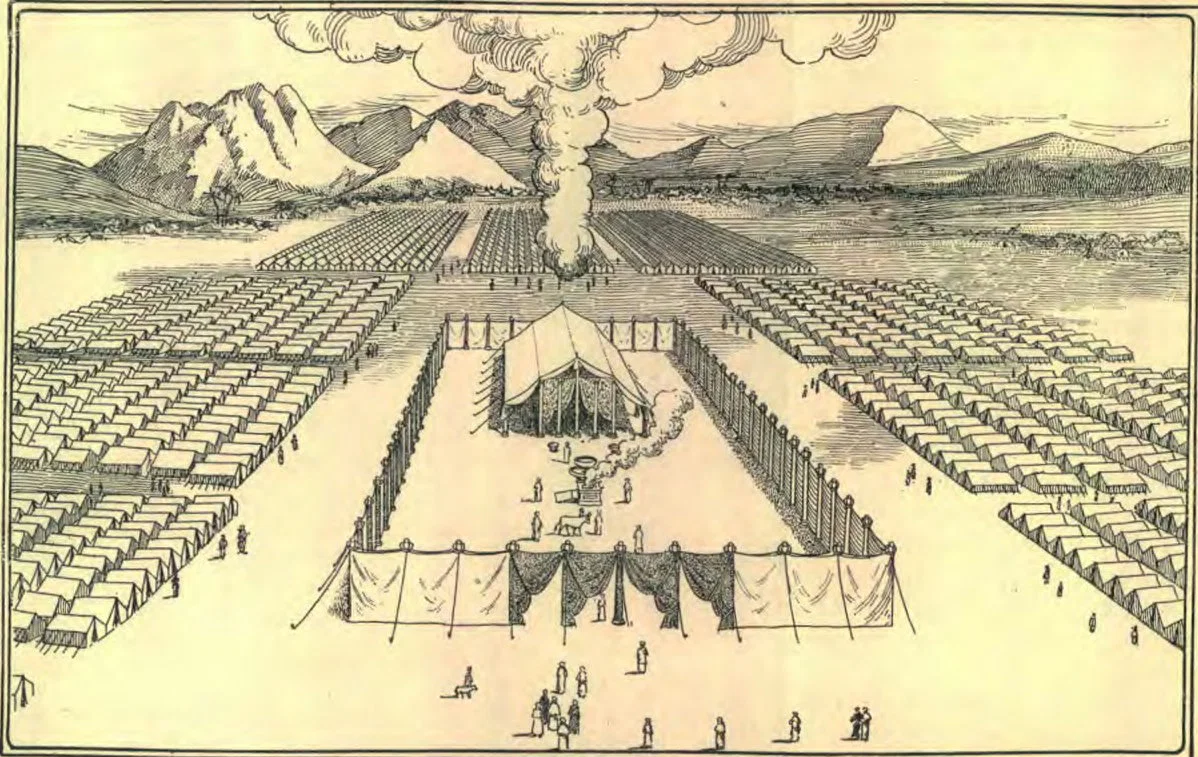
DIAGRAM OF TABERNACLE AND ENCAMPMENT
IN the great conflict between Christ and Satan on this earth, Satan has always directed his attacks against the very center of the truth of God. He has evidently given the revealed truth of the Bible much study, and knows just where to strike in order to corrupt the allegiance of the people of God.
Before the people of Israel were brought out of Egypt, the truth of God was preserved only in the hearts of those who were loyal to him. There was no written Bible in which the principles of the truth were taught; nor was there any place on earth where a teaching priesthood instructed the people in the truths of revealed religion. Altars to the true God were erected anywhere by his worshipers, and his truth was handed down from father to son.
And it was for this reason—that if the servants of God could be destroyed, then the truth of God would also be destroyed from the earth—that Satan worked so persistently, as shown in the last article, to slay every follower of God, and to blot the name of his people from the earth.
When the service of the sanctuary was instituted by the direction of God in the wilderness, Satan had another object for his hatred and for his attacks. And his hatred for the sanctuary was great, because in its services and ceremonies and in the furniture which it contained the entire truth of the gospel was revealed.
The Sanctuary
The sanctuary was the dwelling place of God (Ex. 25:8), and was a replica of the temple of heaven in which God dwells (verse 40). It was pitched always in the center of the encampment in the wilderness, three tribes of the Israelites pitching to the north of it, three to the south, three to the east, and three to the west.
The court of the sanctuary was oblong in shape, about one hundred and fifty feet in length and seventy-five feet wide. It was made with hangings of fine-twined linen, which were hung upon eighty pillars of brass set in sockets of brass, the hangings being attached with hooks of silver. Ex. 27:9-17.
The gate of the court was made of “needlework, of blue, and purple, and scarlet, and fine-twined linen: and twenty cubits [thirty feet] was the length, and the height in the breadth was five cubits [seven and a half feet].” Ex. 38:18. This gate always faced the east. Ex. 27:13-15.
Within the court there were but two articles of furniture. These were the brazen altar of burnt offering and the brazen laver. Upon the altar all the sacrifices of the children of Israel were offered, and the great brazen laver was used by the priests to purify themselves for their ministry in the tabernacle.
The Tabernacle
The tabernacle itself was erected in the court, on the west side, facing toward the east. The tabernacle was composed of two rooms, the holy place and the most holy place. The hangings of the door of the holy place were composed of the same materials as the gate of the court. Ex. 36:37, 38. In the holy place were three articles of furniture—the table of showbread on the right as one went in, the seven golden candlesticks on the left, and the altar of burnt incense directly in front of the veil which separated the holy place from the most holy place. All these articles were made of gold, or were overlaid with gold.
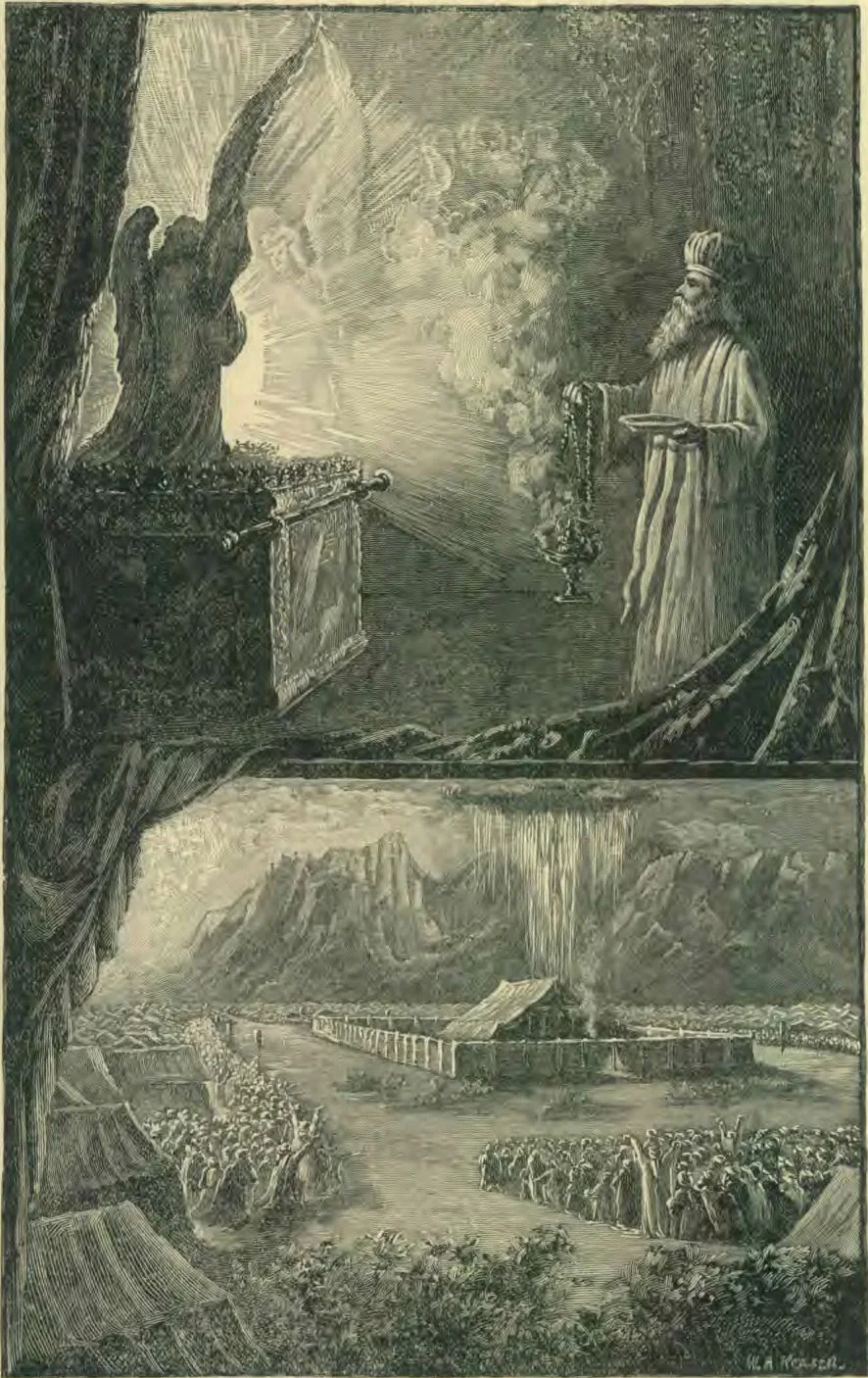
The veil separating the holy place from the most holy place was made of the same materials as the door and the gate (Ex. 26:31, 32), and was embroidered with gold thread with the figures of angels. It was hung on pillars of acacia wood which were overlaid8with gold. In the most holy place was but one article of furniture, the ark of the covenant. This was a hollow, oblong chest, overlaid with gold. Its cover was made of a solid piece of wrought gold, and was called the mercy seat. On each end of the mercy seat was the figure of an angel, and these angels were wrought from the same piece of gold as was the mercy seat itself. These angels stood with their wings outstretched over the mercy seat, and their faces were downward as if in adoration and worship.
In the ark of the covenant was the law of God, written on two tables of stone, as it had been given by God to Moses on Mt. Sinai.
The sides of the tabernacle were made of boards overlaid with gold and mortised into one another, making the tabernacle appear as if made of solid gold. The covering of the tabernacle was made of four curtains laid one on top of the other. The inner curtain was of fine-twined linen embroidered in thread of gold with the figures of cherubim. On top of that was laid a curtain of goats’ hair. This was covered with a curtain of rams’ skins dyed red, and above all was a covering of badgers’ skins. Ex. 26:1-14.
The Fullness of the Truth Revealed
In the furniture, the services, the hangings, the sacrifices, the ceremonies, and the priesthood of this tabernacle, all the truths of the gospel which have since been revealed in a fuller way were taught in type. No wonder, then, that Satan would attempt to destroy this tabernacle and the temple into which it later developed. As long as the tabernacle existed, it was a great witness to the true God.
In the Shekinah which appeared over the mercy seat the true God was revealed, and there he met with his people and gave them instruction. In the fourth commandment of the decalogue under the mercy seat his name as creator of the heavens and the earth was revealed. In the ten commandments which the ark contained was revealed the very foundation of the government of King Jehovah. The adoration and worship of all the heavenly universe was shown in the worship of the two angels on the ends of the mercy seat, and thus his lordship over all creation was shown. The duty of prayer and communion with God was shown in the altar of incense. The fact that Jehovah is the light of the world was shown by the ever-burning candlestick. That he provides all his creatures with food, and that he is the bread of life, was shown by the table of showbread containing twelve loaves. The guidance of the Holy Spirit was shown in the pillar of cloud and of fire which always hovered over the tabernacle and which led the people through the wilderness. The need of a Saviour from sin was shown by the sacrifice of the lamb every morning and evening. The fact that there was to be a vicarious sacrifice and a blood sacrifice for sin, was shown by the sin offering. The doctrine of a final reckoning and judgment for sin was shown in the yearly day of atonement. The teaching of a final extinction of sin and sinners was shown by the burning of the body of the sin offering which represented sin. The forgiveness of sins was taught by the transfer of the lamb’s innocence for the sinner’s guilt and condemnation. And, in short, every truth of the gospel will be found revealed in the sanctuary and its services. This must have been what David had in mind when he said, “Thy way, O God, is in the sanctuary.” Ps. 77:13.
The sanctuary, therefore, being so necessary for the preservation of the truth of God on earth, may be expected to be the great object of Satan’s hatred, and the one thing above all others which he will attempt to destroy. The next article will show how the great adversary attempted its destruction.