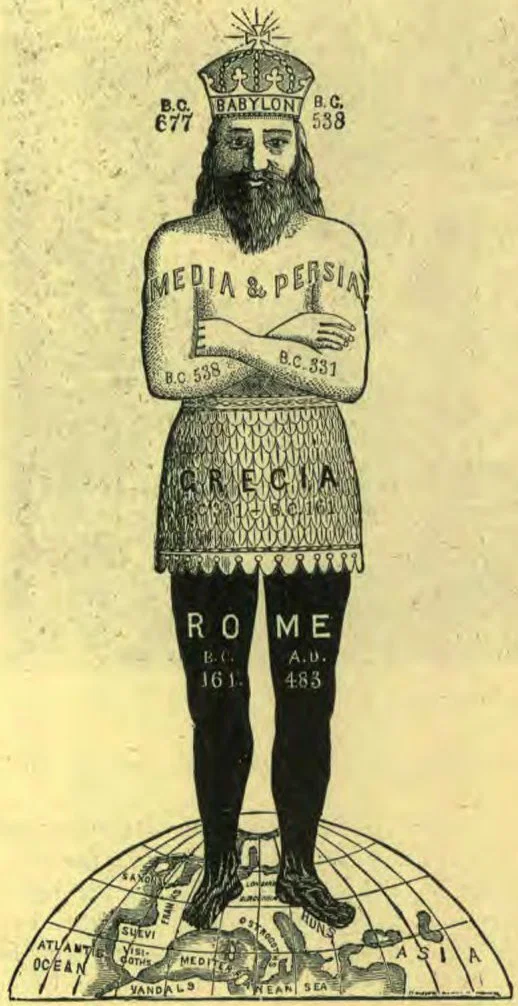
NEBUCHADNEZZAR’S DREAM

7%

Review and Herald Publishing Company · Battle Creek, Mich. · Mar 21, 1901

FromThe Youth’s Instructor, Vol. 49, No. 12.

Read the full edition

NEBUCHADNEZZAR’S DREAM

In about the year 607 B. C., Nebuchadnezzar, who was at that time the king of Babylon, had a most remarkable dream, given to him by the Lord, that he, as well as all who should live after his time, might know of some of the events that would happen on this earth, and more especially those things that God had decided should occur in the last days. And “all these things . . . are written for our admonition, upon whom the ends of the world have in reality come, study these Lord is pleased to have us, upon whom the ends of the world have in reality come, study these prophecies, and learn, as did King Nebuchadnezzar, “what shall be in the latter days.” Dan. 2:28.
Let us turn to the second chapter of Daniel, and beginning with the thirty-first verse, read the description of this wonderful image, whose form was terrible, and whose brightness was excellent. It seems that the image’s head was made of fine gold; his breast and arms were of silver; his sides and thighs of brass; his legs of iron; while his feet and toes were part of iron and part of clay. While Nebuchadnezzar, who was an image-worshipper, was looking in admiration at this great image, a stone that was “cut out without hands” smote the image upon its feet, and broke it in pieces, so that the iron, the clay, the brass, the silver, and the gold became as the chaff of the summer’s thrashing-floor: “and the wind carried them away, that no place was found for them; and the stone that smote the image became a great mountain, and filled the whole earth.”
To Nebuchadnezzar it must have been a severe disappointment to see so majestic an image destroyed by a power that was entirely beyond the control of human authority; and then, as if to deepen the impression upon the king’s mind, the Lord caused the whole scene to pass from his memory. This worried the king; and he called in the wise men of his court to recall to his mind, by the supernatural power they professed to have, the dream of the previous night, also to make known the interpretation thereof. This they were unable to do. Finally Daniel was called in; and he, through the wisdom given him of Heaven, told the king the whole matter, and plainly told him that the God of heaven had given Nebuchadnezzar his kingdom, and that after Nebuchadnezzar’s day, the glory of this mighty monarchy would pass into other hands.
Daniel told Nebuchadnezzar that he himself, as the representative of his kingdom, was this head of gold; and that after him would arise another kingdom, inferior to Babylon. Just as the breast and arms of silver succeeded the head of gold in the image, so another and inferior kingdom was to succeed that of Babylon. This we know really occurred. In the year 538 B. C., at the head of the armies of the Medes and Persians, Cyrus entered the city of Babylon, killed its reigning king, and took possession of the throne so lately occupied by Nebuchadnezzar himself. Read this interesting bit of history, as recorded in the fifth chapter of Daniel.
Below the breast and arms of silver in the image, came the sides of brass. So the Lord, through Daniel, told King Nebuchadnezzar that a third kingdom of brass should bear rule over all the earth; this we also know came about just as the Lord here said it would; for in the year 331 B. C. the Grecian armies overran the territory previously occupied by the Medo-Persians, and so became a universal kingdom.
But Grecia was not always to last; for as in the image the brass was succeeded by the legs and feet of iron, so the kingdom of Grecia, which the thighs of brass symbolized, was to be succeeded by another, an iron kingdom. This, as we well know, was none other than Rome. This change in the prophetic scene was accomplished in the year 161 B. C. by what is known as the famous league with the Jews; and soon following this, Rome became mistress of the whole world. The legs of the image, being composed of iron, fitly represented the real character of Rome in its earlier history; while the feet and toes, being part of iron and part of miry clay, showed that in its latter days the Roman kingdom would be partly strong and partly broken. The nations of Europe to-day are only the remains of the broken-up condition of that once iron-heeled monarchy.
For years we have been living in that part of the world’s history represented by the feet of the image. For years the crowned heads of Europe have married and intermarried among themselves, hoping thus to preserve the peace and national lines of that continent; but God has said that though they might mingle themselves with the seed of men, yet shall they not cleave one to another, even as iron is not mixed with miry clay. Verse 43. What care the people of Germany to-day that their emperor is the grandson of England’s late queen? Or what amount of intermarrying between the courts of Russia and England can avert the conflict that seems so sure to come?
How soon that stone, which is none other than the Rock Christ Jesus, shall smite these earthly governments, and cause them to become as the chaff of the summer’s thrashing-floor, we know not; but we do know that the next universal kingdom that will exist upon this earth will be the kingdom of our Lord and Saviour Jesus Christ. “Ask of me,” says God to his Son, “and I shall give thee the heathen for thine inheritance, and the uttermost parts of the earth for thy possession. Thou shalt break them with a rod of iron; thou shalt dash them in pieces like a potter’s vessel.” Ps. 2:8, 9. Soon those nations that are now strong as iron will be broken with a rod of iron, and those that are weak as potter’s clay will be broken as a potter’s vessel.
The stone was cut out without hands; even so shall the wicked be destroyed that night when the Saviour comes; for “in a moment shall they die, and the people shall be troubled at midnight, and pass away; and the mighty shall be taken away without hand.” Job 34:20. “And the kingdom shall not be left to other people, but . . . it shall stand forever.” Dan. 2:44.
The kingdom of Babylon was succeeded by that of Medo-Persia; Medo-Persia was succeeded by Grecia; Grecia was overthrown by Rome; and we now are living in the last days of Rome in its divided and weakened condition. The next great event is the setting up of the last universal kingdom, which will be that of our Lord Jesus Christ. Soon the time will come when the saints will possess the kingdom; for “the saints of the Most High shall take the kingdom, and possess the kingdom forever, even forever and ever.” Dan. 7:18. Praise God’s holy name! Can we not pray from the heart, “Thy kingdom come. Thy will be done in earth, as it is in heaven”?
OTHO C. GODSMARK.
1518 Wright St., Milwaukee, Wis.
(To be continued.)