MOTHER called him “Pal,” because Charles Orcutt Wilsen, Jr., seemed like too big a name for such a very little fellow. For that matter, Mrs. Charles Orcutt Wilsen, Sr., seemed like too big a name for such a very little woman as mother was, though that was not the reason the people who lived up over her head in the big brick apartment house called her “Wilsen.”
It was a part of the job to be called “Wilsen,” and she was called it very often, because when anything at all went wrong upstairs, from a leak in a faucet to the failure of an elevator, the people went to their house telephones and told Wilsen about it. She had to be polite—always—and pleasant—always—but not too cheerful; she had to weather storms of abuse about mistakes that were none of her making, apologizing for the janitor, justifying the manager, because she was only the complaint woman. For being only the complaint woman she was given, rent free, two cubby-holish rooms partitioned off from the dark, airless, trunk-filled basement, and for salary she received not quite barely enough. All of which, written so, sounds dreary. But it wasn’t. Because Mrs. Wilsen was not like that. Every day she told herself, very often she told Pal, that she was a fortunate woman.
You see, two years before, when her husband died, she had sat in one of the smallest rooms upstairs and looked with large frightened blue eyes into a future which it had seemed to her she could not face: a future without Pal. The long anxiety had stolen away too soon the part of her called youth; her friends lived far off, she had no money, she had nothing—nothing, that is, but Pal.
When the manager found that she could not pay the rent due him for the past month, he offered her the job, and the cubby-holish rooms, and the salary which was not quite barely enough. He had paid others twice the amount for the same work, but he knew that he did not have to pay Mrs. Wilsen, widow, so much. Other incumbents had held their positions for varying lengths of time, the shortest length being half an hour. And each of them had handed the job back to the manager with varying remarks.
At the time this story begins Mrs. Wilsen had owned the job, or, rather, it had owned her, for two years, and she had never thought of returning it to the manager. Then the manager proved himself an Indian giver: he threatened to take away the job he had given her. It was a certain day in November when the water had been turned off for an hour while the plumber was repairing a leak. She had answered thirty calls about it, during the one hour, and was standing, waiting to answer another, when the manager stumbled into her dark hall.
“Wilsen,” he said, “the tenants are complaining about the service you give them. They say your answers over the phone are inaudible, and that half the time instead of speaking up to them you stand and cough into the telephone.”
Mrs. Wilsen was sorry. She did have a slight cold, but it would soon be better.
“Well, you’ll have to do better,” he said, “or I’ll have to make a change.” Then, perhaps because she was so little and thin and white, “I’d be sorry to, but it is my business to keep the tenants satisfied. I have to answer to the owner, you know.”p. 11
Mrs. Wilsen knew, and then, timidly, she pointed to the telephone, high up on the wall, so high up, indeed, that by standing on her very tiptoes she could not quite reach its black rubber mouthpiece. “If we—if you could have that lowered a bit?” she suggested. “So that I could sit down to speak into it?”
“You are not,” said the manager, “expected nor intended to carry on long conversations. A brief, courteous reply—that is all, and surely not worth sitting down for.”
“I know,” she answered again, “but often I do have to talk to them for a long time. I can’t hang up the receiver while they are talking to me. Besides, I answer it so many times a day and”—it was her first complaint—“I do get—tired.”
“Well,” said the manager cheerfully, “I’m afraid you’ll have to make the best of it.”
The trouble was that she had been making the best of it for too long a time. One can’t make the best of very bad things forever. But Wilsen kept on trying to. She tried to speak more loudly and clearly into the telephone, and she tried to stop coughing as she answered it. But the cough persisted and finally forced her to understand its meaning. She was frightened. Pal’s daddy’s cough had been much like that in the beginning. Pal was so little a person to be left quite alone in the big world.
She knew that it was useless to send for a doctor, because she knew what the doctor’s prescription would be. That night she did the first seemingly selfish thing she had ever done. She moved Pal’s little bed away from the window, the window that looked out on the sidewalk, and put her own couch bed in its place. And, as she lay there, with wide-awake eyes, she tried to formulate some plans for Pal. But she could not. She could only listen to the tide of footfalls above her head: first a steady surge of them, diminishing as early nighttime changed into late nighttime, to occasional stealthy or hurried steps; ceasing for perhaps an hour of blessed quiet, and then, as morning came, rising again.
The bell of her alarm clock shrilled out its summons to another day. She was tired, more tired than she had been the evening before. She had a confused idea that she had worked hard all night long, listening. But, because there was nothing else to do, she crawled out of bed and began again to make the best of things. Perhaps, after all, she lied to herself, it was simply some bronchial trouble.
For three long working days, and for three long listening nights after that, she kept on making the best of it. The fourth day happened to be Thanksgiving. It would not be true to say that Mrs. Wilsen was thankful, because in the morning when her alarm clock rang she found that her body would not obey her; she found that, for a few hours at least, she would have to stay quietly in bed. Oh, how tired she was! How comfortable the bed did feel!
She had Pal answer the first complaint. He dragged a chair into the hall, as she directed, and stood on his tiptoes, and told the cross voice from upstairs that mother was just a little ill that morning, and asked it to tell him the trouble so that he might tell mother.
“The newspaper hasn’t been brought up,” Pal called to her.
“Tell them we will send it up immediately,” she instructed, and he answered into the telephone: “We will send it up im—im—”
“At once, dear,” she prompted.
“At once, dear,” he told the voice, and climbed down from the chair.
“I’m afraid,” he reported to mother, “they were cross about it.”
“Go and tell the janitor, pet,” she said, “to distribute the papers right away.”
When Pal came back from telling the janitor, he found the manager in mother’s room, talking to her, and her eyes were shiny wet.
“But on a holiday,” the manager was saying, “when all the men are at home! Naturally they object to having a child answer their calls. You’ll have to make an effort for today, at least.”
“I have made an effort,” mother answered.
“Well,” said the manager, “I am sure I don’t know what we are going to do. The janitor will have his hands full, and my wife and I have an engagement for the day.”
“Perhaps,” began mother, “a little later I may—” Then, noticing Pal standing bashfully just inside the door: “Run up on the sidewalk and play for a while, little man. Right on, now, as mother says.”
Pal knew that he must mind mother. But he hated dreadfully to leave her alone with a man who was making her cry. He hesitated an instant, and then he advanced and stood before the manager. “I’ve got to go,” he said threateningly, “but you mustn’t bother my mother. She’s ill. You mustn’t make her cry, ’n—’n—you’d better get right out of here now.” Sometimes, in moments of excitement, he lapsed into baby talk.
“Pal!” gasped mother. “Oh, shamey! So rude to Mr. Kliner! Run right upstairs now, as I told you.”
Pal went. He was frightened because of the rudeness. But the manager laughed. “A nice little chap,” he said. And then, quite unexpectedly, he added: “I’ll tell you what; I’ll phone for my doctor. He can likely give you something that’ll set you up.”
“Only—I—” stammered Mrs. Wilsen.
“Never mind about the bill,” interrupted Mr. Kliner, to his own surprise, as he went away.
In a few minutes Pal came back with a question in each of his blue eyes.
“What is it, Pal?” asked mother.
“Up there, a man,” Pal explained. “He said to me, ‘I hope your heart is overflowing with gratitude today, my child.’ What does that mean, mother?”
“Such talk to a baby!” scoffed mother inwardly, and then: “Today is Thanksgiving Day, dear. That means a day which people pick out from other days to say thank you to God for giving them nice things. The gentleman meant that he hoped you were saying thank you for all the nice things God has given you.”
“For what should I say thank you to God for giving me?” Pal questioned.
“Mother could tell you ever so many things, but it would be better if you could find them for your own self. We’ll play it. It’s a game. You go upstairs now and take a nice walk around the block. Don’t cross the street, keep right on the sidewalk, all the way around, and walk slowly. And then you come back and see whether you can’t tell mother something you have found that you can say thank you to God for.”
On his walk, Pal met a most interesting little girl, with red hair and a candy turkey; so he stopped for a while to play. When he finally came home again, he saw a stranger man sitting by mother’s bed, talking to her. But when Pal heard his voice, he could tellp. 12 that he was not bothering mother. It was a kind voice, sorry-sounding, and Pal stood quietly in the doorway so as not to interrupt.
“Little woman,” said the stranger man, “I always tell my patients the truth. There is not much question but that you have tuberculosis. But we have caught it early, and there is no reason on earth why you can’t be cured, absolutely cured. This climate is one of the best, so you can stay right here. But you must, of course, leave these rooms at once. There is not enough fresh air in here for a well person. Fresh air, plenty of it, is the first requirement.”
“But, Doctor,” began mother, “I can’t leave here—”
“Tut-tut-tut,” interrupted the doctor, “there is no such word as can’t. Of course you can. Plenty of fresh air—”
Right then mother saw Pal standing in the doorway. “Sh-h-h!” she warned the doctor. “Come here, dear,” she called to Pal. “This is my little son, Doctor. Pet, this is Dr. Ranamacher.”
Pal shook hands with the doctor, and in answer to his, “What is your name, son?” replied, “Charles Orcutt Wilsen, Jr. Not five yet, but I can read words and print letters.”
“Splendid,” said the doctor.
“Little braggart,” smiled mother. “You had best go now and walk around the block, say two times more, and see how many things you can find—what mother told you to find, remember?”
“I didn’t find anything this other time,” objected Pal, “but only a candy turkey, and it wasn’t mine.”
“Deary me!” deplored mother. “All the extra reason then why you should go on another hunt. Run along, pet,” she added, in the voice which always meant, “Mind mother.” Slowly Pal climbed the steps that led out of the dark basement up to the sunshiny sidewalk. He had heard that big tuberculosis word before, and his baby mind knew far more of its meaning than it should have known. It was an illness, a bad illness, that had taken daddy away. It could not take mother away, Pal felt sure of that, because little boys’ mothers just had to be, they couldn’t be taken away. But, unless they could get fresh air, mother would stay ill, and illnesses hurt people.
He came to the door of a garage and paused for a moment to peer in at the shining cars, standing there in lines. The object of his walk occurred to him; he was to find something to say thank you to God for. If he had one of those automobiles, now, to play with, that would be a big something. But he didn’t have it, and mother had told him never to stand in that doorway, so he walked on and stopped at the window, hoping he could see the cars from there. He shaded his eyes with his hands and pressed his pug nose tight against the glass. Then he saw IT. The sign, the almost unbelievable sign, staring at him in big black letters—
FREE AIR
Sitting just inside the door of the garage was a man wearing overalls, nice and dirty and comfortable-looking. Several times he had smiled a jolly, dirty-faced smile at Pal; so the boy was not at all afraid of him.
“Please,” he said, going over in front of the overalls man, “please, is your free air fresh?”
“Guaranteed absolutely fresh,” answered the man with a wide smile.
“Then,” said Pal, “if you please, will you give me some of it?”
“Well—now—about how much did you want?” inquired the man speculatively.
“As much,” Pal answered, “as you can pos-si-bly spare.”
“But you ain’t got nothing to carry it in,” quibbled the man.
“I—I’ll get something,” Pal assured him earnestly, eagerly. “So please wait and please don’t give it all away. I’ll come right back,” and he was off as fast as he could run.
The doctor was still talking to mother when Pal reached home; so he did not stop to explain. He paused just long enough to poke his head in at the door and call jubilantly, “I’ve found it, mother, something great big to say thank you for!”
In another part of the basement was a row of clean new garbage cans, kept there to replace the old cans when they had worn out. Pal selected one of these. It was exactly as high as his chin, and the space between the handles, on the sides of it, was nearly as far around as his arms could reach. But, some way, he managed to tug it up the steps, and then he pushed it and pulled it to the door of the garage.
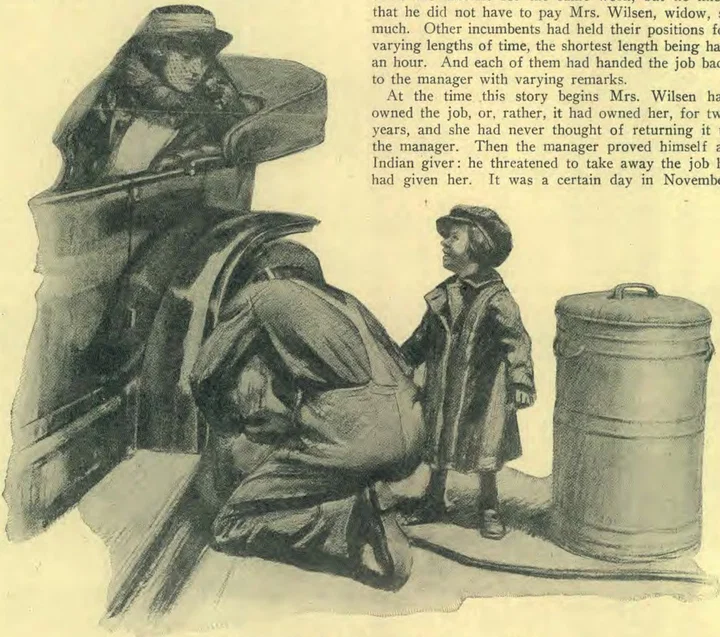
A big automobile was standing in front of the garage. In fact, it looked as if it were tied there by a long tube fastened to one of its wheels and going down into the sidewalk. The overalls man was talking to some people in the car, but when Pal came up pulling his can, the overalls man said, “Oh, ho, where is that big can going with that little boy?”
Pal smiled. He thought the man meant a joke and knew it was polite to smile at jokes.
“This little boy,” the man continued, with a wink at the people in the car, “has brought this can to get some free air. He was particular, though,” with another wink, “to make sure it was fresh before he decided to take it.”
“But,” explained Pal, feeling very uncomfortable, “it just had to be fresh.”
The lady in the car leaned out and smiled at Pal. He thought she was a very pretty lady, even though her hair was white.
“What,” she questioned interestedly, “did you want the fresh air for, dear?”
“For mother,” Pal answered.
“Oh,” said the lady, “has mother a car?”
“No,” said Pal, “she has tuberculosis.”
It seemed to Pal that the gentleman in the car said a naughty word, but he wasn’t sure of that. Nobody else said anything. The pretty lady was busy with her muff. The overalls man stooped down to look at the tubing.
Pal had an uncomfortable feeling that he had said something all wrong, so he tried to explain. “That’s why she has to have fresh air,” he said, “’count of that. But only we haven’t any, not down in our rooms. Reason of they are in a basement.”
Again there was the longest, deadest sort of a silence. But the pretty lady was looking at the gentleman in the car. That was all she did, just look, but after a time the gentleman answered as if she had spoken to him: “Of course, my dear! Of course!”
Then the lady turned and leaned out of the car again. Her eyes were shining as brightly as mother’s eyes could shine, sometimes. She smiled at Pal, but she spoke to the overalls man, who was still busy examining the tubing. “Fill the little fellow’s can for him,” she said, “fill it full of your best fresh air and then put it up here in the car, please. Because we are going with him to take it to his mother. Because,p. 13 and something about her voice reminded Pal of mother’s voice at nighttime, right after prayer time, “we are afraid that, possibly, this can may not hold quite enough, and, in that case, we are going to tell her that we have ever so much fresh air to spare, up at our home in the mountains, and we are going to persuade her to come up there and use some of it.”—Kay Cleaver Strahan, in American Magazine.