NATIONAL safety demands the elimination of the drink traffic. Why?—Because of the following true indictments made against it:
“It wastes millions of tons of food and fuel.”
One pound of coal is the average amount consumed in the production of every pint of beer. The 1,000 breweries and 200,000 saloons of this country use more than 14,000,000 tons of coal annually,—enough to give comfort to 6,000,000 soldiers in army cantonments, enough to send a fleet of 23 battleships 3,000 miles across the Atlantic to guard our transports, enough to heat 1,500,000 homes for six months, each home using 100 pounds a day.
According to the United States Census report for 1910, the brewers used three and one-half times as much coal for the production of malt liquors as the bakers use; nine times as much as the boot and shoe manufacturers; and almost four times as much as the printing and publishing industries. Think of it!
Schools, churches, and reputable businesses are closed, to save coal; while the brewers continue to burn up millions of tons of coal. It is not just. It is not good sense. It is not good business.
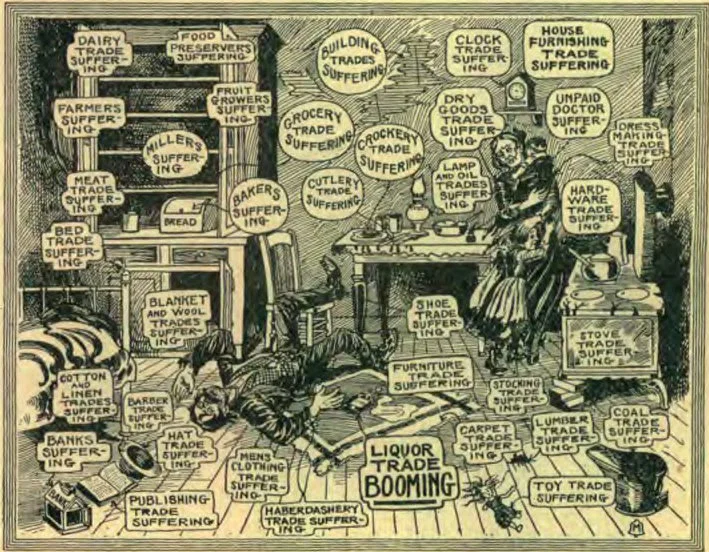
“It raises the cost of food for our homes.”
You cannot destroy food without making what is left cost more, or else cause some one to go hungry. The grain used in the making of liquor in America would feed the entire country for thirty days each year; it would add 11,000,000 loaves of bread to the daily output of our bakeries.
The barley alone wasted in the manufacture of beer would supply 8,000,000 persons with their normal bread ration.
Tons of sugar used in the making of beer would be gratefully received by the housewives of the country.
The brewers of the United Kingdom of Great Britain destroy once a month five weeks’ food supply for Scotland, or what submarines would destroy if they sank eight 6,000-ton food ships; and American brewers are about as active as the British in destroying food materials.
“It reduces the output of munitions and equipment.”
A department superintendent of one of the big tire factories in Akron, Ohio, uses sixty men in each shift. They are making gas masks, miners’ respirators, and other vital war material. That department is working only two shifts a day instead of three because of the scarcity of labor. They pay off on Friday. On one Saturday only six of thep. 14 sixty men in one shift reported for work. The superintendent says: “Ninety per cent of our labor troubles are due to booze. If the Government would shut down on the liquor traffic, we could increase our output enormously. There is no lack of labor. The only trouble is to keep it working full time.”
The Bessemer Coal and Coke Company, the Superior Fuel Company, and the Ford Colliery Company claim operating efficiency is being greatly lowered, and the output lessened at the rate of 2,000 tons of coal a day, because of drinking places contiguous to their plants.
“It imperils the shipbuilding program and helps the submarines.”
The shipbuilding program would be 20 per cent farther advanced today if the liquor traffic had been prohibited in April. This is a low estimate according to some authorities, who claim that the shipyards of the country are averaging only 48 hours a week, and the efficiency of their labor ranges from 50 per cent at the end and beginning of each week, to 90 per cent on Wednesdays and Thursdays.
“It congests railways, docks, and warehouse systems.”
The railroads of the country are carrying 7,000,000 tons of intoxicants yearly. Ten per cent of the freight cars available for use in this country are counted as a conservative estimate of the number required in hauling the carloads of alcoholic liquors consumed and the materials that enter into their production.
Robert Grant, of the New England Coal and Coke Company, said: “The greatest cause of delay to prompt delivery of coal in New England is due to labor, as intoxication is common.”
Three thousand trains a day are used to carry coal, sugar, grain, and other products to the breweries, says Ohio’s assistant fuel administrator. Thousands of refrigerator cars are regularly assigned to breweries and in daily use on the railroads of the United States, loaded to full capacity, carrying beer to saloons and blind pigs.
One million eight hundred thousand cars would be released for transportation of foodstuffs and coal to the people if the liquor traffic were abolished, says the Chicago Blade. In one month the fuel administrator of Philadelphia diverted to city institutions five cars of coal consigned to the breweries. National prohibition would divert all such cars to legitimate uses. Let us have it.
“It deprives the country of the services of thousands of soldiers whom it afflicts with insanity and disease.”
More than a year ago the Surgeon-General of the United States Army made the startling statement before the joint military committee of Congress that “more than half of the young men who applied for enlistment in the army and navy and were rejected, owed their rejection to drink and the excesses which those who drink so often indulge in.”
“It embitters the hearts of mothers who are willing to give their sons for war, but not for drink dividends.”
It is estimated that at various times the equivalent of eight full divisions of the French and British armies have been incapacitated because of disease usually contracted under the influence of liquor. Canada said: “Great numbers of our men never saw France. Canadian boys cried because they had no munitions. England reeled and beer flowed like water while thousands of our boys went down into their graves. We will never forget it in Canada.”
America will pass through this same bitter experience unless the liquor traffic is entirely divorced from the army both abroad and at home.
“It is the chief instigator of crime and insubordination.”
“The case at bar is the seventy-sixth murder case I have tried, either as State attorney or as judge during the past nineteen years. I have kept a careful record of each case, and I have to say that, in seventy-five out of the seventy-six, liquor was the exciting cause.”—Judge Butler, of Cairo, Illinois, at the close of a murder trial.
These are some of the reasons why the people of this nation now demand the immediate abolition of the unpatriotic, health-destroying, money-consuming liquor traffic.