The Alcoholocaust

10%

Review and Herald Publishing Assn. · Washington D.C. · Mar 26, 1918

FromThe Youth’s Instructor, Vol. 66, No. 13.

Read the full edition
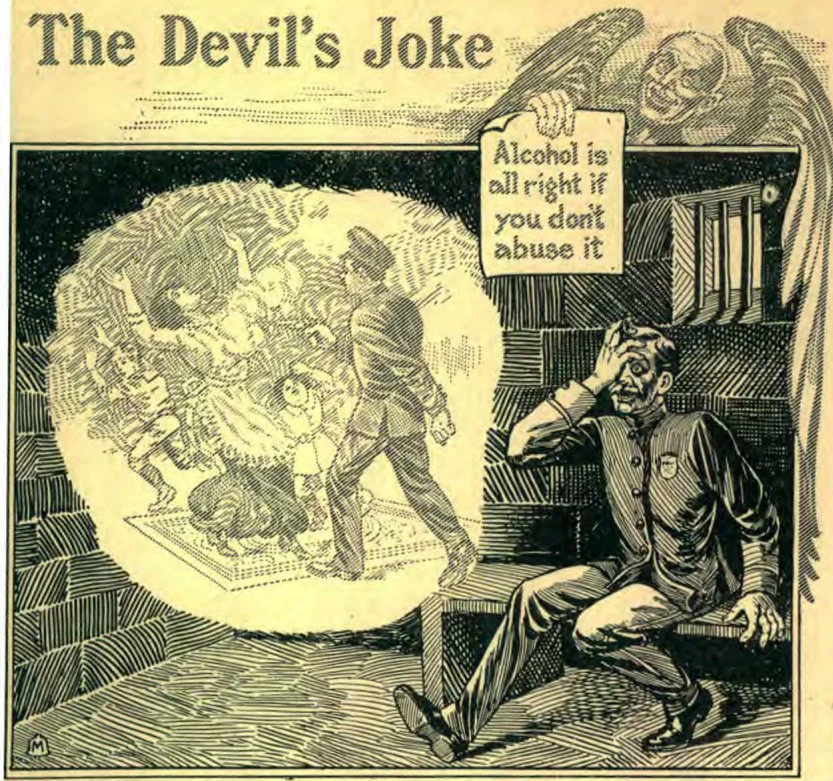
A New York policeman, crazed with drink from the “social glass,” killed his wife. When he recovered his reason, he was horrified to learn what he had done. In his pitiful remorse he cried, “It was the devil’s joke!” Yes, and a joke that has wrecked millions of other lives.

The Alcoholocaust

ALL my life I've wanted to tell Youth a few things. I don't expect many of them to listen, or to believe. But if even one does, then will the time and effort be well spent, and I shall be glad. . . .
“I've wanted to tell girls, ‘Don't drink.’ Clean men don't like it. It makes dirty men think dirty things of you. It coarsens your looks. It makes wrinkles in your face. It makes your figures fat and gross. It cheapens you in every way, physically, mentally, morally. And it's dangerous.”
“I've wanted to tell boys not to drink. It isn't that I'm an old prude. I know what I'm talking about. Booze stimulates the body for evil; and with body stimulated, the will weakens, the mind grows flaccid. It leads to nasty thoughts. And in nastiness of thought lies nastiness of action. And in nastiness of action lies sickness, and the horrid, rotting diseases of flesh and brain that make a man wish to God he had died instead! And before you, lie only years of shame, and torture, and horror,—the contempt of all decent people,—and when you want to grow up to be a clean man, and maybe have boys of your own, you cannot, because those boys will be as rotten, as diseased, as you are. . . . College coaches teach you to cut out alcohol, to live cleanly and regularly. Why? It isn't to please them, is it? It's because you can do better work; it's because it makes you strong, healthy, vigorous.”
“For, after all, your body is merely the machine in which you, as an individual, ride around. You wouldn't think of throwing sand in the gears of your automobile, would you? Then why throw alcohol into the gears of your body? Don't you care as much for your body as you do for your automobile? Then why take such good care of your automobile, and such poor care of your body? Bodies don't cost anything, you say? True. But you can buy a new automobile when the old one wears out, but you can never get another body. . . . Take care of it when it's young, or you'll be mighty sorry, when it begins to get old.”
“And I've wanted to tell parents: ‘Don't bring up your children in ignorance.’ If you don't think they've got sense enough ever to understand anything, then hire a keeper for them. But if you do turn them loose on life, at least point out the pitfalls. Would you send a child out to play in a meadow full of hidden wells? Then why send a child out to play in the fields of life that are full of poisoned traps a thousand times worse than death?”
“I knew the mother of two of the most beautiful girls I've ever seen. Before taking them out to dinner, she would split a pint of champaign between the two, to make their eyes bright, their conversation sparkling. Whose fault if these two girls go straight to hell and stay there? A mother like that isn't fit to have children. Nor is the husband of that mother fit to have children. They haven't even the sense of animals; they are a form of human swine beyond the contempt of decent people.”
“When God gives you the joy of having children, he gives you also the responsibility of their care. See to it that you fulfil that responsibility; nor by laziness, selfishness, and ignorance let them reap the fatal consequences of your own neglect.”
“Booze is an open cesspool on the highway of life. It should be filled in, graded off, and forgotten. And it should be done now.”—Porter Emerson Browne, in McClure's for February, 1918.