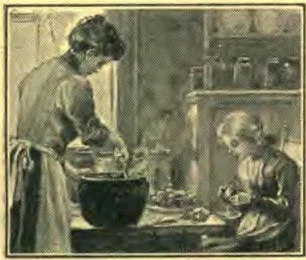
EVERY girl wants to be beautiful, and rightly so; but not all girls are blessed with beauty of face and form. But there is one kind of beauty which every girl may cultivate; and if she makes it the daily habit of her life, in time even the plainest features will take on a form of loveliness, the reflection of inner beauty.
What is it that every girl may cultivate? It is doing things in a beautiful way. The most humble task may be made lovely by doing it in a gracious way, and unconsciously the one who does this grows an inner beauty that radiates from her personality, giving it a charm all its own.
There is all the difference in the world between a task done in a beautiful way and the same task done in an unlovely way. This is true in the home, in school, in social life, in business, and in our church and Sunday school work, and every girl can cultivate the beautiful way of doing things. There are many tasks in the world that do not seem very lovely in themselves,—tasks that are hard and unapplauded and some that even seem like drudgery,—but if they are necessary tasks they are noble ones, and we can make them dignified and lovely if we do them in a beautiful way.
Then there are some tasks which come to all of us—like the simple one of saying “Good morning” to our families, which may be done in one of two ways. Have you noticed that some folks say “Good morning” in so ungracious a way as to upset others for hours and hours, while some give the greeting with such kindliness and charm as to cast a radiance over the entire day?
The motive which prompts a deed and the way in which we do it are quite as important as the deed itself. In every home, for example, dishes must be washed. Now, the daughter may help mother wash the dishes because she feels that she must, and she may sulk throughout the process. Or she may have chosen as an ideal to do things in a beautiful way; and knowing dishwashing to be a necessary task, she recognizes it as an opportunity for service, and with the fixed purpose of being truly helpful and doing all things in a lovely spirit, she washes the dishes, filling the kitchen and mother’s heart with sunshine as she does so. One may light a fire in a grate in so beautiful a way as not only to warm the physical bodies, but to cheer the heart and refresh the spirit as well. One may set a table and serve a meal in a way that will not only satisfy physical hunger, but give spiritual strength and comfort.
And this principle applies in our social life, our school and church work. The most brilliant social affair planned by a committee is a failure if jealousy or selfishness or touchiness is allowed to come in among the committee workers. The most remarkable record of a class president is not a success if the girl has worked from desire for praise or for self-glory. The most humble class task performed from the desire truly to serve and done in a beautiful way, with love the motive, is the real success. And so in all life’s relationships the spirit of our deeds, the way in which we do them, is the thing which determines their real value in the eternal reckonings. To do things, from the simple, most humble task of the daily routine to the most responsible and exalted one of special opportunity, in a beautiful way, is to grow in grace and loveliness, radiating beauty and joy wherever one goes. This is an ideal worthy of every girl’s choice.—Elizabeth Nevison, in the Visitor.