IN 1492, just about the time that Columbus was discovering the New World, a great stone meteorite was seen to fall from the sky in Ensisheim, Alsace. Its coming was accompanied by a loud, crashing noise. This stone from the sky was carefully preserved, and today pieces of it are to be seen at the Smithsonian Museum, Washington, D. C.
A famous stone that came crashing down in Phrygia in Asia Minor, about 200 B. C., was worshiped by the people as an idol. They called it Cybele, the mother of the gods.
The Kaaba, of Mecca, the sacred black stone which the Mohammedans worship as a holy relic, is a meteorite, and fell in the seventh century. A very large and ancient sky stone, the Casas Grandes ironstone, which weighs a ton and a half, fell in Mexico in prehistoric times. It was found by explorers in an old Mexican temple, swathed in mummy cloths, showing that it had been venerated as an idol.
In those days no astronomer could explain the sky stones, and many denied that they really fell. As late as 1772 it was insisted by French scientists that a stone reported to have fallen at Luce was only an ordinary rock that had been struck by lightning.
But in 1794 Chladni collected all the accounts of known meteorites, and called the attention of scientific men to the Pallas ironstone. It was found among entirely different rocks on the top of a lofty mountain in Siberia. It could not possibly have been carried there by man. The stone must have fallen from the sky. As if to prove Chladni right, an observed shower of meteorites fell that same year at Siena, and the next year a fifty-six-pound stone fell out of a clear sky almost at the feet of a man in Yorkshire.
The French still doubted, however, until a shower of stones occurred in 1803 near Paris, when over three thousand stones fell. Then every one was convinced. But in some ways man knows no more today about where meteorites come from than he did long ago.
The sky stones have no trace of animal or vegetable remains, so they can reveal nothing of life in other spheres. All the stones have a thin, dark, glasslike crust, the surface having been fused by heat. Yet very few are warm when they reach the ground, and some are icy cold. Sky stones have fallen on a stack of straw without setting it on fire, or in dry grass without even charring it.
At night a trail of light shows the fall of a meteor; but in daylight they fall without any such appearance. Usually there is a noise like musketry or thunder. Their speed has never been measured, but one 560-pound stone at Knya Linya, in Hungary, penetrated the earth to the depth of eleven feet, which shows it was falling at high speed. Some observers computed its speed at forty-five miles a second.
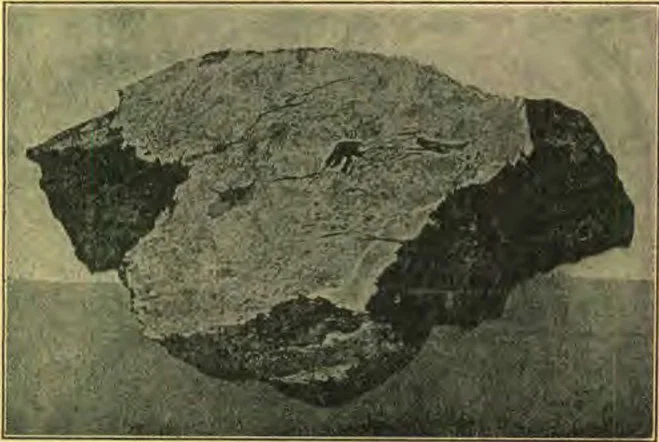
More than 650 falls and finds of meteorites are recorded. The largest known sky stone is the one Peary brought from Cape York, in Greenland. It weighs seventy-three thousand pounds. The next largest lies in the plain of Bacubirito, Mexico, and weighs fifty thousand pounds. The third is the Willamette meteor, in Oregon, which weighs thirty-one thousand pounds. These are all masses of meteoric iron. The largest mass of meteoric stone is the Knya Linya stone, which is now in a museum at Vienna, Austria.—Forward.