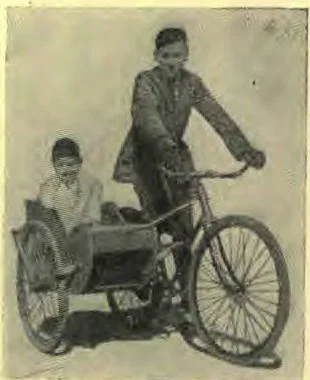
Constructing a Side Car for a Bicycle or Motor Cycle
THE accompanying illustration shows the construction of a simple side car for a bicycle, which may be enlarged for motor cycle use. The frame of the side car should be strong, light, and well made. Basswood will be found very durable for a light side car for a bicycle. The joints at the corners are lapped, with a small bolt run through them to hold the parts tightly together as at A. The frame is rectangular, 30 inches long and 16 inches wide, made of pieces 1¾ inches wide and ⅞ inch thick.
The sides of the body are built up of ½-inch boards fastened vertically to the frame, and a side rail placed 15 inches above the frame, which is used for supporting the seat and also as a means of attachment for band-iron braces to the bicycle. Screws should be used throughout for fastening the boards to the frame and rails. First fasten them to the side rails, then draw the curved line at the top and cut both sides out at the same time after clamping them together. Before fastening them permanently to the frame, lay a floor of ¾-inch boards. A single board 16 inches long placed on the side rails makes the seat. The back is put on in the same way as the sides.
The side wheel, which is an ordinary front bicycle wheel, is attached to the body of the side car with braces of band iron 1⅛ inches wide and 3-16 inch thick, the forward one being fastened over the side rail and the other to the upper rear part of the body.
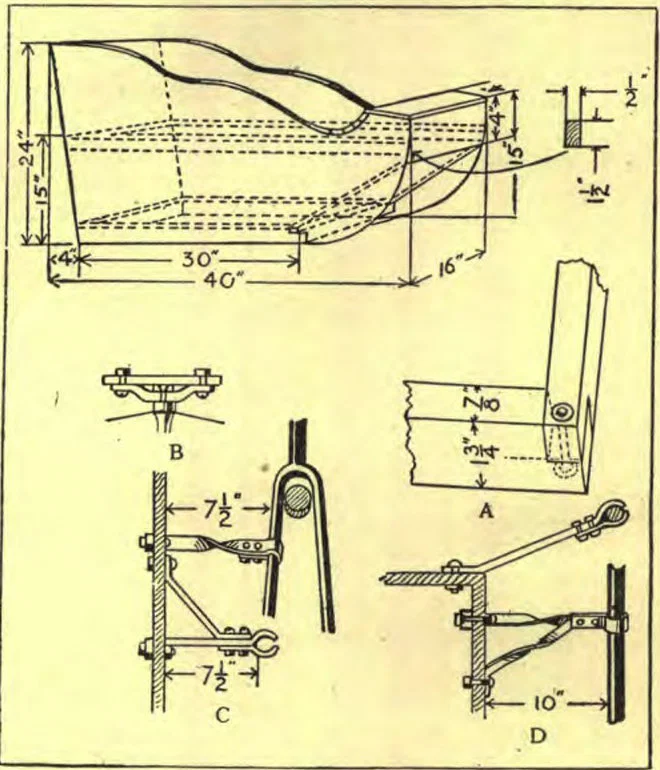
The inside end of the hub axle is supported by a piece of the same band iron shaped as shown at B, and bolted over the side boards to the frame back of it.
The same sized band iron is used for attaching the side car to the bicycle, one piece connecting the body to the bicycle frame between the large sprocket and the small one, and the other between the side rail of the body, through the boards to the tube connecting the seat and the rear-wheel hub. This is shown in C and D. The bars of the last attachment must be twisted slightly, as the drawing shows, to allow for the slant of the bicycle tube.
—Popular Science Monthly.