A few words will explain what a boomerang is—that wonderful weapon wielded so skilfully by the dusky aborigines of Australia. Used by the natives in war and the chase, it consists merely of a piece of stout wood bent in a curve, and having a length from two and a half to three feet, with a breadth of two to three inches. One side is convex, and the other flat, the curved side possessing a sharp edge.
At some time or another every boy has doubtless wished himself the possessor of a boomerang. Well, here are instructions for both making and correctly throwing a small-sized specimen of this strange and primitive but effective weapon.
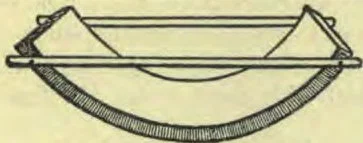
First procure a piece of well-seasoned hickory, about one foot long, three inches wide, and one inch thick. Then proceed to scald it thoroughly by pouring several kettlefuls of boiling water over it. The hickory will thus be rendered quite pliable. While in this condition it should be bent to the shape shown in Fig. 1. This may be quickly done with the aid of a vice; but if the reader does not possess one of these extremely useful implements, he can adopt a very simple and equally effective method.
Lay the piece of hickory plank on the table, with half of it projecting over the edge. Then, with one hand firmly hold in position the half resting on the table, and with the other bend down the unsupported half.
When the hickory has assumed the correct curve, two side pieces should be nailed on, as shown in Fig. 1. These are fixed temporarily to hold it in position while the wood dries.
Fig. 1.— Bending the Wood
When thoroughly dry, remove the side pieces, and saw the curved hickory into six strips, each one-half inch wide.
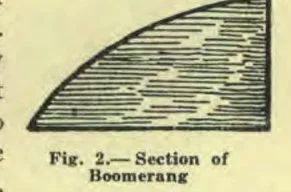
Fig. 2.—Section of Boomerang
The result will be six roughly fashioned boomerangs, and it only remains to trim them into shape with a pocketknife. One side should be left quite flat, while the other must be carefully rounded, the convex or outside curve being brought to a bluntish edge. The correct shape is clearly shown in the sectional diagram, Fig. 2. Lastly, round off the ends, and smooth down the surface of the wood with sandpaper.
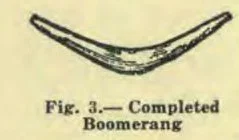
The finished boomerang should have the appearance depicted in Fig. 3.
Now go into an adjacent field or other open space, and try your luck at throwing this curious weapon.
Fig. 3.— Completed Boomerang
Grasp the boomerang at one end, which should possess crosscuts to give a grip, and keep the hollow or concave side away from you. Then throw it as if you wished to hit a spot on the ground about thirty yards distant. If possible, give it a slight downward twist with the wrist as it leaves the hand, thus imparting a spinning motion or “screw-back” to the weapon. Instead of traveling straight forward, and then falling to the ground, the boomerang will gradually ascend in the air, whirling round and round, and, taking a circular course, will sweep back toward you, finally depositing itself a few yards from your feet, the retrograde motion being produced by the bulged side of the weapon.
It is not advisable to throw the boomerang in the vicinity of a crowd, as in the hands of a novice its flight is liable to be a trifle erratic. —“Every Boy’s Book of Hobbies,” Cecil H. Bullivant.