WE once had a prairie dog, whom we named Napoleon on account of his extraordinary energy, courage, and acuteness. We had a pair of them, the other being Josephine, but there was nothing remarkable about her. Napoleon was a fat little fellow, but exceedingly strong and brave.
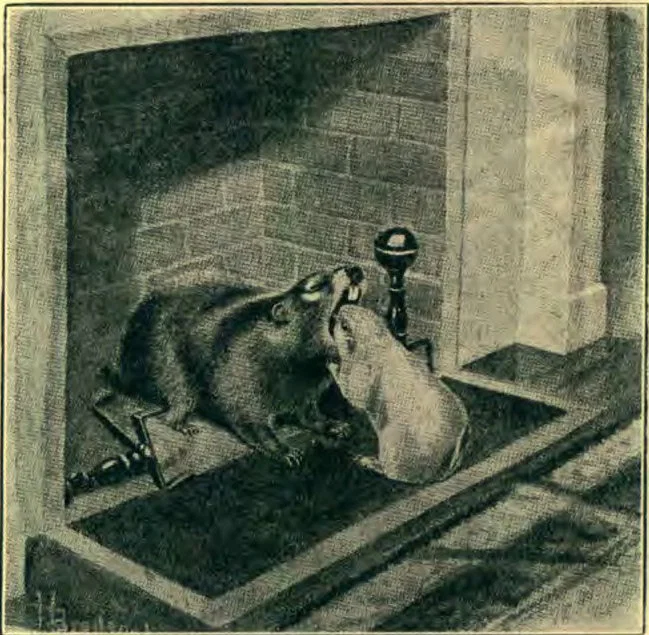
We had caught a young woodchuck. It was old enough to have all the undaunted ferocity of its species; and, indeed, it was already nearly three times the size of Napoleon. The woodchuck had been left in the sitting-room, where it had retreated into the unused fireplace, and sat, glaring furiously at every one who approached, and keeping its mouth wide open, except when, from time to time, it would close it with a fearful snap, loudly grinding its teeth together in the way peculiar to woodchucks. Some one now brought in Napoleon, and, to my horror, set him down on the floor. I was for snatching him up, feeling sure that the woodchuck would make an end of him; but my father said, “Let them be. We can interfere in time.” Napoleon, after investigating other parts of the room, trotted toward the fireplace. The woodchuck drew himself up and opened his mouth as wide as it would go, while his eyes gleamed with fury; and I held my breath in terror for my pet, who walked up to him, seeming greatly interested. Napoleon never paused an instant, but proceeded to examine the woodchuck’s wide-open mouth, thrusting his whole muzzle inside it, and then actually putting out his little pink tongue and sampling the roof of the woodchuck’s mouth! Every moment I thought, “Now—now it will be all up with Napoleon! Those awful jaws will shut and that will be the end.” But nothing of the kind happened: the woodchuck seemed entirely paralyzed; he did not relax a muscle,10but sat immovable, with mouth wide open, as he had done when Napoleon first approached. The latter made a long and leisurely inspection, first of the inside and then of the outside of the woodchuck’s mouth, and at last trotted away again, leaving the poor nonplused animal sitting calmly in the fireplace as before.
Napoleon lived for several years more, and at last died of old age (so we believe), his mate having previously escaped.—Mary B. Thayer, in St. Nicholas.