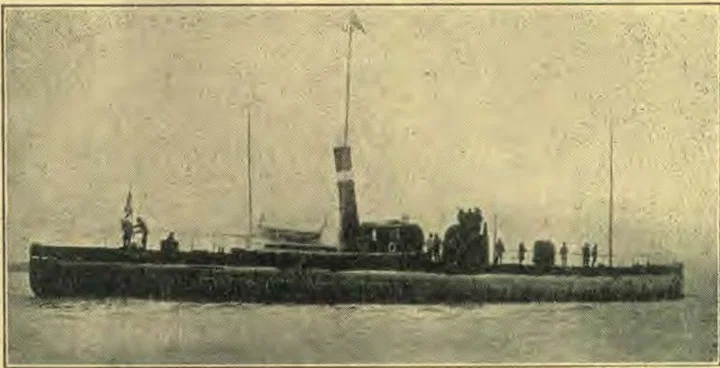
A FEW weeks ago one of our missionaries with his wife was compelled by ill health to leave the African mission field for England. When but three hours out from Liverpool a submarine sighted their boat, and in a few moments the sick man and his wife, with many others, were in lifeboats, drifting upon the surging sea, while their ship with their belongings went to the ocean’s bottom. Three of the lifeboats, with their occupants, soon followed the vessel to the depths, and in those that were saved the people sat in cold water up to their waists for three long hours before they were rescued.
A thousand similar ocean tragedies have taken place since our gallant “Lusitania” with its hundreds of men and women was sent to the bottom of the sea. Of course men everywhere would be alert to find ways of overcoming the sea menace. Mr. Russell Bond, in St. Nicholas, describes the main devices now in use in combating the submarine. He says: “There arep. 7 just three ways of dealing with the situation: the submarines may be penned in, so that they cannot get out of their bases into the high seas; they can be hunted down after they have got out to sea; or ships can be so carefully guarded and protected that the submarines will have no chance of injuring them.”
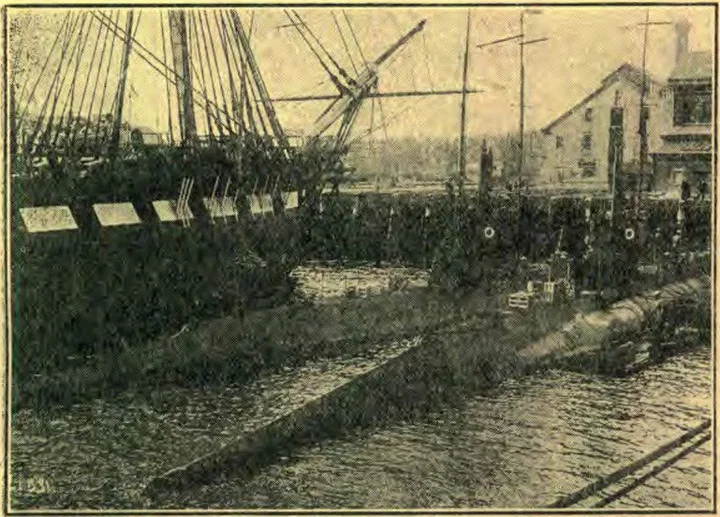
“Of course, if the first of these propositions could be carried out, it would settle the whole problem very nicely. Early in the war heavy steel nets were stretched across the English Channel, and although it has been very difficult to keep them in place on account of storms and tides and the sweep of floating seaweed, yet they have kept the enemy out of the channel, and the British have been able to send troops and provisions over to France with no interruptions. Now, if a similar net could be stretched across the North Sea from Scotland to Norway, a distance of two hundred fifty miles, the U-boat would be completely bottled in and would no longer give Atlantic shipping any anxiety. It may seem like a fantastic idea, but such a net has been designed and has been given serious consideration. It must hang down to a depth of at least two hundred feet, so that a submarine could not dive under it; and as it would be impossible to patrol the submerged part of the net, it must be built so that a submarine would not dare to touch it. By placing a bomb every twenty feet along the length and breadth of the net, there would be no chance for a submarine to cut its way through without exploding one of the bombs. A single bomb would be powerful enough to sink a submarine, but delayed-action fuses would be used, so that when one exploded, it would not set off any of the others about it. The cost of this net and the bombs on it is estimated at fifty million dollars. A truly enormous sum, but it is no more than the cost of a single week of U-boat warfare in ships and cargoes destroyed.
“Hunting Submarines
“In the early days of the war it was found that a small, fast motor boat was the submarine’s most dreaded enemy. Now a torpedo is usually set to run at a depth of at least eight or nine feet, so that the waves will not disturb the valve that controls its horizontal rudder. But these motor boats, or chasers, as they are called, are of such a shallow draft that a torpedo would pass harmlessly under them, and then they are so speedy that a submarine would have little chance of hitting them, anyway. It used to be that they carried a gun as powerful as that with which the submarine was equipped, and they were only too anxious to fight the U-boat if it came to the surface. Because a U-boat is blind under water it would have to come up now and then to get its bearings, particularly when operating in a harbor or near the coast, where it might run into a rock or a shoal.
“At that time submarines were rather fragile boats, and their skin was liable to be punctured by a shell from the chaser, when, of course, they would not dare to dive under the sheltering waves. But now submarines are equipped with heavy guns of much greater range than any that can be carried on the deck of a chaser, and they are armored so that their hull cannot easily be punctured. Then, too, they are larger and can operate out in the ocean, too far from land for the chasers to follow them in safety.
“The chaser has seen its day, and its place is now being taken by the destroyer, which is just as fast and yet is armed with guns that equal, if they do not outrange, those of the most powerful submarines.
“A Lesson from the Fish Hawk
“Probably the greatest danger to the submarine lies in the sky. From a considerable height above the water it is possible to see the dark outline of a submarine, as a fish hawk sees its prey, even when it is lurking far under the surface. And so the sea is now patrolled by aeroplanes, which can swoop down upon the submerged boat and put it out of commission by dropping a bomb on it. Unfortunately, it is very hard to drop a bomb from a rapidly moving plane with any degree of accuracy, and so a new type of aircraft has been invented, known as a Blimp. This is a cross between an aeroplane and a cigar-shaped balloon. This queer craft can cruise around leisurely; it does not have to travel at a rate of fifty to a hundred miles per hour just to keep up in the air. When it discovers a submarine it can stop and hover over the spot, taking careful aim before dropping its bomb. It can stay up in the air much longer than an aeroplane, for it does not depend upon the engine to lift it; and with its engine running slowly it can run longer on the same fuel.
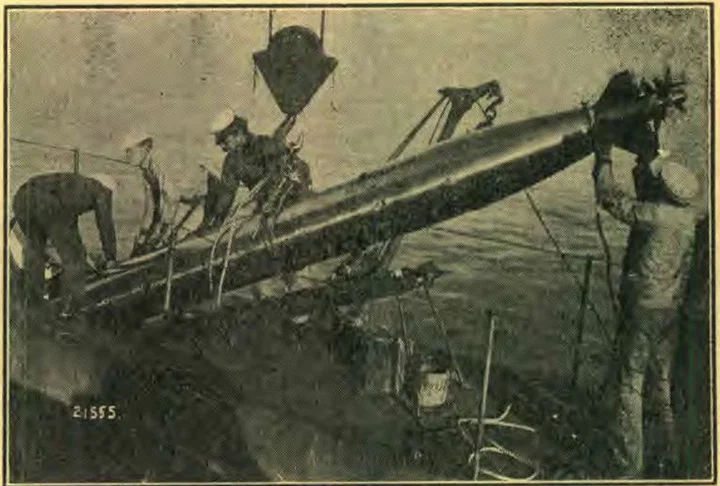
“But there is another scheme that is now beingp. 8 used which makes the aeroplane more efficient. Sometimes fish are killed in large numbers by exploding dynamite under water. The fish do not have to be actually hit by the dynamite; they may be at a considerable distance from it, and yet they will be either killed outright or stunned by the pressure-wave that travels through the water. This very scheme is used in fighting submarines. A bomb has been invented which will explode when it has sunk to a certain depth in the sea. It carries enough explosive to crush in the side of a submarine that is within a hundred feet of it. If the hull of the boat is not actually smashed, its seams will be sprung so badly that it cannot keep afloat. This blunderbuss type of shooting makes it much easier for the aeroplane to destroy its prey. ‘Depth bombs,’ as they are called, are also used by destroyers and other war vessels, which drop them where they suspect a U-boat may be lurking.
“Why Torpedo Nets Are Not Used
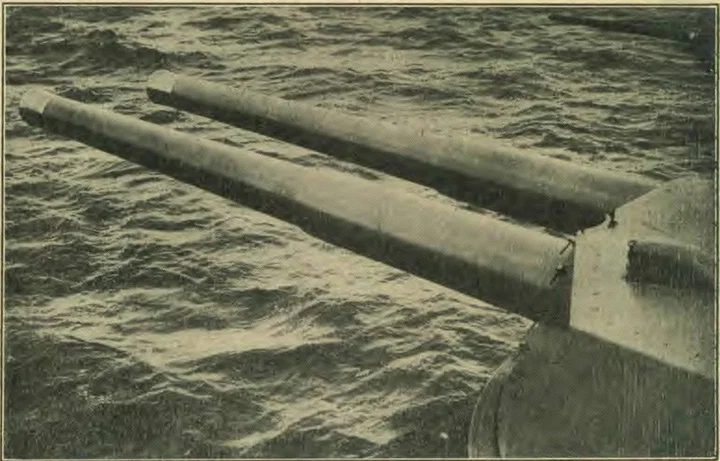
“When submarines were first invented they were intended for use against battleships and cruisers. They were feared mainly at night when a fleet lay at anchor; for then a submarine might creep up and let fly its deadly missile. Hence, war vessels were provided with nets which they could hang over the side of the ship to catch the torpedo and keep it from striking. But the modern torpedo will go off even when stopped by a net, and to save a ship from the destructive pressure-wave set up in the water, it must be netted at something like twenty feet from the boat. Now, if a merchant ship could protect itself with a petticoat of steel netting twenty feet from its hull, it would be safe from underwater attack. But to keep the netting there calls for cumbersome rigging that would be smashed in the first heavy sea. Besides, the drag of the net would slow down the vessel until it could only crawl along, and then there would be the difficulty, at the same time, of keeping the net from riding up to the surface.
“Lessons from Nature
“There are better means of protection; many of them we have learned from Mother Nature. The world is full of animals that live in constant fear of their lives because they have fierce, powerful enemies, but they manage to exist despite their enemies, some because they can run faster, some because they can dodge better, and some because they look so much like their surroundings that their enemies can scarcely see them. All the tricks by which nature protects its weaker children have been tried out by merchant vessels.
“Speed is one of the best protections. Most of the U-boat sinkings, so far, have been among the slower boats, those making under fifteen knots. A torpedo is an expensive missile and a bulky one too. Not many torpedoes can be carried by a submarine, and so, unless there is a very good chance of making a hit, the U-boat commander is not likely to shoot out such valuable ammunition, but will prefer to come to the surface and fight with his guns. The best submarine can make only eighteen knots on the surface, and if the merchant ship can do as well or better, its chances of escape are excellent, and besides it can return shot for shot from its own guns.
“Zigzagging
“One of the best tricks of the merchant ships is to keep dodging, not merely when it spies the wake of a torpedo, but all through the submarine zone. Instead of sailing a straight course, it proceeds first in one direction and then in another like a sailboat tacking against the wind, but constantly varying the angle and length of each tack. When a submarine sights a vessel it tries to get as near to its intended victim as possible without betraying its own presence. It notes the direction taken by the ship, and then proceeds at top speed under water to a point that will head off the vessel. It has to proceed blindly, by dead reckoning. only occasionally sticking up its periscope for a look. But it is rather disconcerting for Herr Commander to find that the ship which he saw sailing northeast five minutes ago has now turned southeast and is actually farther from him than it was before. The irregular dodging of the boat is really very baffling, and about all the submarine can do is to show itself and fight in the open.
“Hiding in Broad Daylight
“A great advantage of the submarine lies in the fact that it is very inconspicuous. Even when running on the surface it projects but a few feet above water level, while the ships it hunts have masts that tower high above them, and moreover, they usually pour out dense columns of smoke that blacken the sky to a great height. This smoke gives the U-boat commander his first hint that there is a ship about. He can see the smudge above the horizon when the boat that produces it is thirty miles or more away, down behind the curve of the earth. He can head for this smoke at top speed without fear of being seen. Presently he will see masts of the vessel projecting above the horizon, and then even the smokestack, while he himself will be absolutely invisible to the man on the bridge of thep. 9 ship, because he will be below that man’s horizon. So the U-boat commander will have plenty of time to size up the speed and general direction of the ship’s course and make his plans to intercept the vessel, before the captain of that boat has the least inkling that there is a submarine about.
“However, our merchantmen are now beginning to take precautions. They are beginning to use hard coal in the submarine-infected regions, so that a submarine must be within fifteen miles to see them. Some boats are even cutting down their masts and doing away with their funnels, to cut down still further their range of visibility.
“Artists to the Rescue
“There is another trick that merchant vessels are now working, known as “camouflage.” It is a scheme for fooling the U-boat by means of paint. It used to be that war vessels were painted a dark gray, so that they would be inconspicuous. We know now that such war paint makes a vessel more conspicuous than ever. Under the direction of artists, vessels are now painted so that there are no sharp outlines, and from a distance it is hard to tell their shape or where they start or end. The parts usually in shadow are painted light, and the lighter parts, dark. Peculiar colors are used that will blend with the surroundings. Waves are painted on the hull of the vessel, and queer stripes and spots are put on. An object painted a solid color is more easily seen at a distance than one whose surface is broken up by a lot of different shades. The leopard has been given its spots and the zebra its stripes for this very reason, and it is this trick of nature that our ships are making good use of.”