It is natural for Americans to think of Yellowstone National Park as the world's greatest geyser country. The number of geysers to the square hundred miles certainly makes it one of the most remarkable areas in the world. But Yellowstone Park contains neither the most gigantic geyser nor the most obliging. These are both found in New Zealand, a country so full of natural wonders.
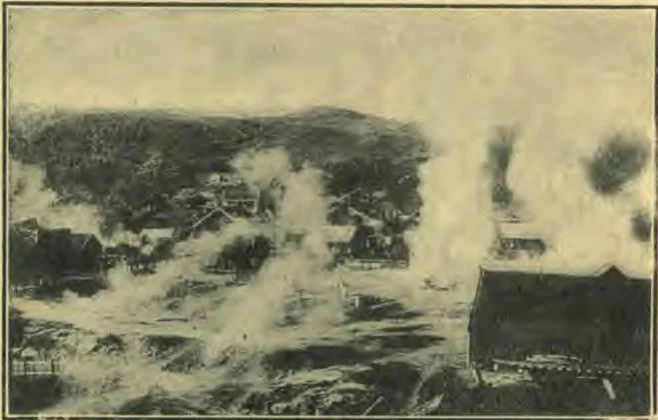
The Greatest Geyser in the World
was born in 1901, so that relatively it would still be somewhat of a baby if it were living today. Unfortunately, the Waimangu died an untimely death on Oct. 26, 1903, when the cold waters of a near-by creek penetrated the heated depths of its basin, and caused a most terrific explosion.
The circumference of the Waimangu geyser contained an area of two and a half acres. When in action, it threw up water, sand, and stones as high as twelve hundred feet. One bowlder weighing one hundred fifty pounds it hurled a quarter of a mile. Usually the eruptions were sideways, but occasionally the triplet geysers, of which the Waimangu was composed, played simultaneously. Then the eruption was directly upward, and much less dangerous. Today its vents are choked with sand to a depth of nearly fifty feet, and it seems very doubtful whether this greatest geyser of the world will ever again become active.
The Most Obliging Geyser in the World
is Lady Knox in the government reserve at Waiotopu, New Zealand. There is nothing that appeals to this geyser more strongly than a cake of soap. She must be a very clean Lady Knox, for it takes a big bag of soap bars to satisfy her. The results are worth the effort, however. Beautiful streams rise upward from fifteen to twenty-five yards in the air, and the wonderful colors that so greatly please the children — and the rest of us — are very much in evidence. Lady Knox blows bubbles on the most gigantic scale in the world.
Another geyser almost as wonderful as the Lady Knox is the Wairoa, at Whaka, which is also a government reservation. This geyser will not play unless it has been soaped, but invariably responds when a sufficient quantity of soap has been applied to it. It is possible, therefore, to appoint the time when the Wairoa shall play, and people from far and near are able to make arrangements to be present.
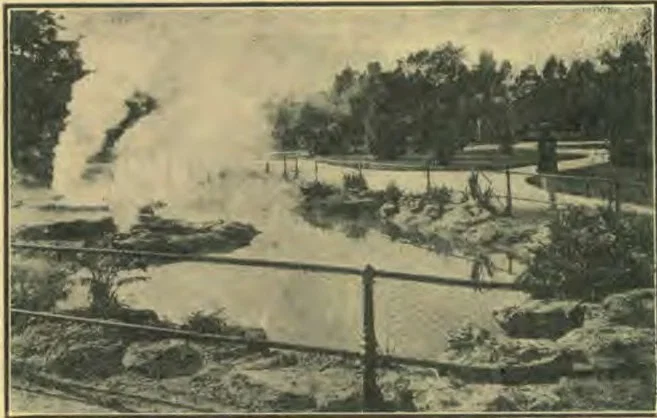
On one of these occasions recently, typical of many others, a little girl had been selected to perform the ceremony. She stepped forward, sweet and smiling, while great crowds looked on from the surrounding terraces. The official in charge handed her a white bag full of yellow cakes of soap. “Are you quite ready, Kathleen?” he asked her. “Yes, I am quite ready,” she answered. Then he took two or three handfuls out of the bag and cast them into the deep throat of the Wairoa. Kathleen opened the mouth of the bag and poured out the rest of its contents.
Startlingly Beautiful Results
A few minutes passed before the volume of steam began to increase. The usual time was ten minutes, but after ten minutes there was still no play. Twenty minutes, thirty minutes passed. Then people began to wonder whether this time the faithful geyser would fail to keep the appointment. A few seconds later there was a rumbling sound, followed presently by a stream of water which shot up and up. The spectators who had been gradually crowding near the Wairoa began to edge back. Another, and still another spurt ascended. Then came a hoarse roar and a rush of steam. Presently there arose a beautiful column of water, embellished with clouds of smoke. Fifty feet it reared upward, sixty, seventy feet. Higher and higher it climbed, until its column measured a hundred twenty feet or more.
During all this time there was a loud rumbling in the shaft. For more than a hundred feet around, the earth kept shaking. A hot breath fell upon those who ventured too near. But ten minutes after the play had started, the column suddenly went down. Apparently the soap had finished its work and the geyser refused to perform further.
Law Forbids Frequent Displays
The government of New Zealand has made it a law that the Wairoa and the Lady Knox shall only very rarely be tempted. Frequent play reduces the strength and beauty of these geysers. They have only a certain amount of material, and must not be too greatly impoverished.
In the regions of these geysers there is a basin covering an area of two acres. This is Champagne Pool, the waters of which contain sulphur and selenium to an unusually high degree. The precipitations of these solutions which are constantly renewed have for years added one inch annually to the basin's surface. This pool takes to sand more favorably than to soap. Soon after a good-sized shovel of sand is cast into the pool, the waters begin to simmer. Bubbles appear on the surface, and increase to untold thousands, which start to travel around the pool in circles almost as large as the circumference of the basin.— Gerrit Verkuyl.