An incomprehensible fascination seems to hover about polar waters and polar lands, for though explorers have suffered untold hardships, and even death, in the effort to explore these ice fields, yet every few years other intrepid men are found who are both willing and anxious to make an effort to chart polar regions.
As early as 325 B. C., explorers reached the arctic circle, but not until the eighteenth century was the antarctic reached. The regions of the arctic had, therefore, been for centuries a resort of adventurers in search of a route to the East when the antarctic was found.
After interest was really awakened in the antarctic continent, all of the leading civilized nations — England America, Russia, Germany, Belgium, France, and Norway — have had a part in the exploring of its lands and waters, and as a result of the work accomplished by these expeditions we have mountains, seas, rivers, bays, peninsulas, islands, and capes bearing the names of the leaders of the various expeditions.
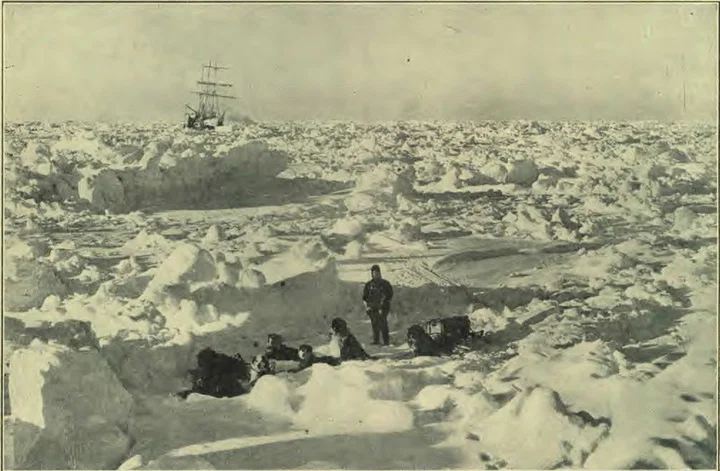
Among these, Sir Ernest Shackleton, who has made three expeditions to the south polar lands, has established the latest record. He accompanied Captain Scott in his dash for the pole in 1901, but broke down on the way back to the coast. In 1908 he returned with an expedition of his own, and got within ninety-seven miles of the pole, when he was obliged to turn back on account of shortage of provisions. On this second expedition, Mr. Shackleton, who was accompanied by Prof. T. W. Edgeworth David, of Sydney University, Australia, accomplished several important feats. “The discovery of a considerable fresh-water fauna and of a poor, but characteristic flora was one of the most unexpected results. Apart from many minor excursions and surveys, the expedition performed three journeys of the first importance, each of them surpassing any previous land work in the antarctic regions. Before winter set in, Professor David, with five companions, made the ascent of Mt. Erebus, starting from the winter quarters on the fifth of March, and gaining the summit at an altitude of 13,300 feet on the tenth. This was found to be the edge of an active crater, the abyss within being 900 feet deep, though rarely visible on account of the steam and vapors which rose in a huge cloud 1,000 feet above the summit.
“The second achievement was the attainment of the south magnetic pole by Professor David, with Mr. Douglas Mawson and Dr. Mackay. The third and greatest achievement of this remarkable expedition was Mr. Shackleton’s great southern journey,” when he came within ninety-seven miles of the south pole.
On Sept. 18, 1914, this successful explorer started on his third expedition. He with his main party, numbering fifteen, left England to join their exploring vessel, the “Endurance,” which was to await them at Buenos Aires. They sailed from that port on October 27, for South Georgia. Their plan was here to coal, then enter Weddell Sea, south of the Atlantic, and make their winter camp on the coast of Prince Luitpold Land, thence to cross the continent from Weddell Sea to Ross Sea, on the route reaching the south pole. Thence he was to go to Beardmore Glacier, where he was to meet the second part of his expedition, which was expected to start on the ship “Aurora,” from some Australian port, December 1, for McMurdo Sound, for the purpose of forming a supply depot at the foot of Beardmore Glacier for the transcontinental party when it reached this point on its way to McMurdo Sound.
(Concluded on the last page)p. 5
The Antarctic Explorations
(Concluded from page four)
But if there is any place on the earth where the plans of men miscarry, it is in polar regions. Instead of crossing the antarctic continent, the expedition, although the best equipped of all, returned without having reached the continent. The relief expedition which was sent out to meet him on the other side of the pole likewise had to return unsuccessful. Both expeditions had to leave parties behind.
“The ‘Endurance’ left the island of South Georgia in December, 1914, but as it approached the antarctic coast it was caught among the ice floes, from which it never escaped. In July the ice had piled about the ship in ridges forty feet high. By fall the pressure had become so terrific as to throw the ship up upon the ice. When the ice broke up, the ‘Endurance’ was so strained and leaky that she was abandoned on October 27, and sank a month later.
“The party rescued such supplies as they could, and camped all winter on the ice, which was drifting toward the north. In April they came within reach of Elephant Island, one of the South Shetland group. Here Mr. Shackleton left most of his party, and with five men set out in a small boat for South Georgia Island. This he reached two weeks later, and walked across the island over glaciers to Stromness, where there is a Norwegian whaling station. South Georgia Island had been visited by German scientists, but no one had ever ventured to cross it before. With a boat and crew provided by the Norwegians, Mr. Shackleton tried to rescue the party left on Elephant Island, but could not reach it, so he went to the Falkland Islands for help.”
The Hudson Bay Company gratuitously placed a vessel at the disposal of the British government to be used in rescuing the members of the expedition marooned on Elephant Island; but Mr. Shackleton, fearing to wait for the Hudson Bay Company’s ship, made his fourth attempt to rescue the men who had been waiting since April 24, by means of a steamship lent him by the Chilean admiralty. He was successful in this effort, and reached Punta Arenas, Chile, on Sept. 3, 1916, with all of the twenty-two men whom he found well, but somewhat hungry.