T. E. BOWEN
When Daniel and his three associate captives were torn from their childhood environments and taken to Babylon, little did they know of the high destiny to which God had called them. Little did they realize the wonderful work for the church, even until the close of time, that would come as the result of their fidelity to God when surrounded by idolaters in the heathen court of Nebuchadnezzar. Little did they know that they would take part in the affairs of the royal court of him who was king for the first time over all the nations of earth. Yet God foresaw all this when these four young men were carried away at the close of the terrible conquest of the Chaldean army that laid Jerusalem, the beloved city of God, in ashes and ruins.
The circumstances attending the captivity were counted a calamity to Israel. And so they were. God had borne long with Israel’s perversity. Warning after warning had been given this people by the faithful messengers from God,—Isaiah, Jeremiah, and others,—but many hearts remained impenitent. At last the terrible stroke was allowed to fall, and the kingdom of Israel, whose prosperity and glory under the reign of David and Solomon had become of world-wide renown, came to an end. The diadem was removed, the crown suspended until he should come whose right it should be to wield the scepter—Jesus Christ the Lord.
The four Hebrew captives, Daniel, Hananiah, Mishael, and Azariah, on reaching Babylon were among those sought out by the order of King Nebuchadnezzar, in whom was “no blemish, but well favored, and skilful in all wisdom, and cunning in knowledge, and understanding science, and such as had ability in them to stand in the king’s palace, and whom they might teach the learning and the tongue of the Chaldeans.” In modern terms we might speak of these young men as having a good all-round education, equal at least to the best of our college courses.

It was at this critical point of their matriculation into the highest university course among the Chaldeans that the supreme test came to these young men. Was this by chance?—No. It was at this point God sought to draw a sharp contrast between those who honored the laws of the King of heaven, and those who worshiped false gods.
“At the very outset of their career there came to them a decisive test of character [beyond their test of intellect]. It was provided that they should eat of the food and drink of the wine that came from the king’s table. In this the king thought to give them an expression of his favor and of his solicitude for their welfare. But a portion having been offered to idols, the food from the king’s table was consecrated to idolatry; and one partaking of it would be regarded as offering homage to the gods of Babylon. In such homage, loyalty to Jehovah forbade Daniel and his companions to join. Even a mere pretense of eating the food or drinking the wine would be a denial of their faith. To do this would be to array themselves with heathenism, and to dishonor the principles of the law of God.”—“Prophets and Kings,” p. 481.
In this test, coming at a time when it seemed the most difficult to live up to their cherished principles as Hebrews, who professed to reverence the true God who created heaven and earth, Daniel and his fellows unswervingly took their stand. Even though they had passed their entrance examinations, and had been directly honored by the great monarch of earth in being presented each day with food such as he himself ate, they refused their daily portion from the king’s table, knowing that in honor of the Chaldean gods a portion of all the king’s food had first been offered in sacrifice to idols. They used tact and good sense in making their request for other food; but though it should mean death to them, they purposed not to dishonor the God of their fathers by eating of food that had been dedicated to heathen gods, and thus identifying themselves with heathen worship. And the principle of this scripture, “Them that honor me I will honor,” was wonderfully wrought out in the immediate and later experiences of these noble youth.
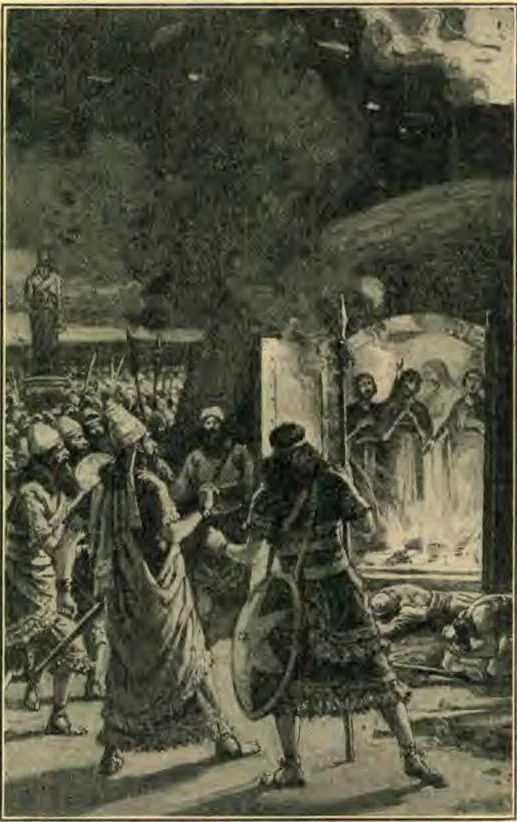
It was through the revelation to Daniel of the king’s dream that all the wise men of Babylon were saved from immediate execution, and these Hebrew young men were promoted above all their university colleagues to the highest posts of honor at the king’s court. Later, through the still greater test of loyalty to God, when all people were commanded by royal decree to bow in worship before the golden image, the three Hebrew rulers stood unmoved, and were honored by Christ in that he himself went in with them into the burning fiery furnace. And they were delivered.
By this deliverance from the power of the flames the knowledge of the true God was spread to the ends of the earth.
As we think of the dear young men today being called away from home, from loved ones, into an altogetherp. 8 new environment, surrounded largely by influences similar to those encountered by the four Hebrew youth, the study of their loyalty to God when the question of the worship of the true God was at stake, should prove of great help in determining what to do.
It should be very carefully noticed that it was always over the question whether God should be worshiped and obeyed, or whether, in obedience to the decree of the king, false gods should be worshiped, that Daniel and his fellows took their firm stand. In matters where this principle of honoring God by worshiping him and obeying his law was not involved, no record is given us of a refusal on the part of these young men, or in their later years, to follow the laws or decrees of the kingdom into which they were ushered. In this we believe is contained valuable instruction for us in this critical time upon which we have entered. It was by adhering to the principle and command, “Thou shalt have no other gods before me,” that caused the light of truth to shine far out into the heathen darkness of the world in Nebuchadnezzar’s day. Through the providences of God which compelled Israel to leave their native land, thrusting them in among the peoples of the earth, the true God was made known unto the uttermost parts of the earth. In the days of Israel’s prosperity, God had urged his people to carry this same light and truth to the heathen nations.
And who knows but that in the untoward experiences coming upon us at this time many shall be brought into contact with those who know the last warning message who might not otherwise hear it? Anyhow, our part is to manifest that loyalty to God and his truth that was seen in the lives of the four captives at Babylon, and Christ will see to it that that which follows shall result in helping to make known his truth to the honest in heart throughout the earth.