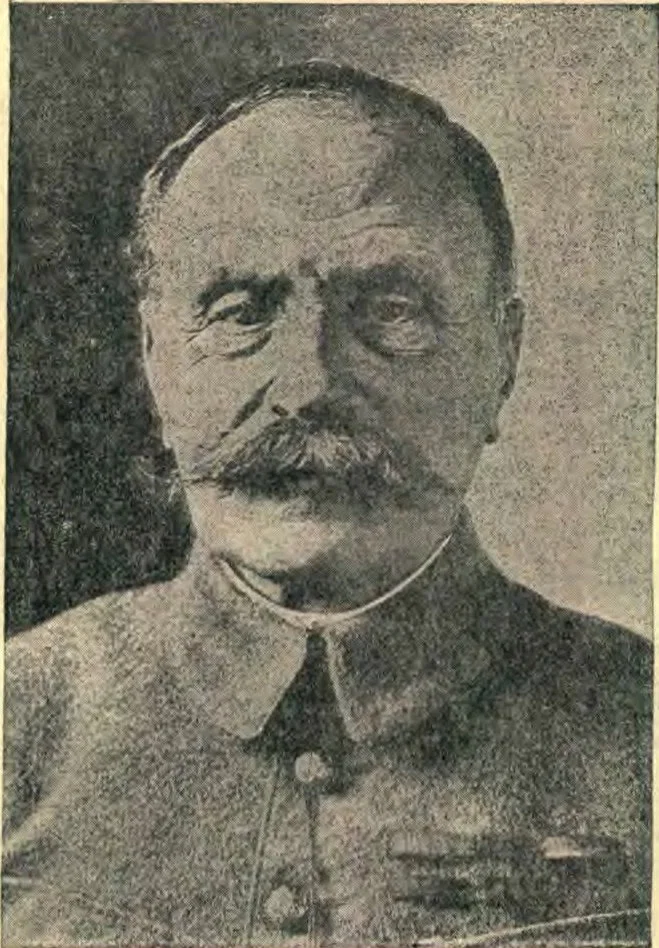
The Commander-in-Chief

2%

Review and Herald Publishing Assn. · Takoma Park Station, Washington, D. C. · Mar 18, 1919

FromThe Youth’s Instructor, Vol. 67, No. 11.

Read the full edition

The Commander-in-Chief

FERDINAND FÓCH is the idol of his countrymen and the hero of the great World War. His was the military genius which reorganized our forces in the face of a flushed, exultant foe, and led them to victory. The soldier, the gentleman, and the Christian are all combined in this one purposeful man—the marshal of France, the generalissimo of the Allies.

Childhood and Youth

Photo, Underwood and Underwood, N. Y.
MARSHAL FERDINAND FOCH
Photo, Underwood and Underwood, N. Y. MARSHAL FERDINAND FOCH
He was born Aug. 4, 1851, in the little mountain town of Tarbes, his father being an undersecretary of state in the prefecture of the Upper Pyrenees, and his early years were spent in this region rich in the traditions of such mighty warriors as Henry of Navarre and Napoleon Bonaparte. After finishing his work in the preparatory schools of Saint-Etienne and Metz, young Foch astonished his parents by deciding upon a military career, and accordingly made application for admission to the École polytechnique, the West Point of France. His brilliant work here soon distinguished him, and at the age of twenty-three, he was made captain in the artillery.

The Soldier

The young officer’s first real soldiering came during the Franco-Prussian War. The catastrophe which befell France in the loss of Alsace-Lorraine was a severe blow to his pride; although he suffered keen humiliation, he did not yield to depression, but set about to discover if possible the fundamental reasons why Prussia had won the struggle. Pursuant to this purpose he made an intensive study of strategy and military tactics, becoming a recognized authority on these subjects.

Director of the École de Guerre

When the great General Bonnal died, many names were submitted to the French premier as competent to head the great École de guerre (war school). But Mr. Clemenceau wanted a director above the ordinary, a leader for the young soldiers who was every inch a man, and so he himself decided to make the choice. The now “General” Foch never suspected, when the premier invited him to dine, that his name had been mentioned in connection with this honor. Suddenly, as dessert was served, Clemenceau remarked, “I have some good news for you, General. You have been appointed director of the École de guerre.”
“Director of the École de guerre,” repeated the bewildered general. “But, Premier, I am not even a candidate.”
“That may be, but you have been appointed, and I know you will fill the office capably,” replied the “Tiger of France.”
In this new capacity, he became the foremost teacher of the principles of strategy and tactics to the Frenchmen who were to take part in the World War. The strength of the Prussian Army, Foch taught his students, was due to the massing of their troops and their perfect organization for moving men and supplies. Its vulnerable point, he asserted, was the “absolute autocracy of the great headquarters, where plans were built, as an architect builds a house, impossible of modification if change became imperative.”
“You will be called upon later to become the brain of an army,” he told the young men in his classes, “so I say to you today: Learn to think.” He further taught them that the brain alone is not sufficient for thinking. The imagination, emotions, and aspirations must be centered upon the problem to be solved. Foch always maintained that the stirring strains of “La Marseillaise” helped the cadet to put on his soldier thinking cap. In his work as a teacher he emphasized the importance of individual responsibility, and trained his embryo officers to be men of judgment and initiative.
Part of his own rigid discipline was to look for the silver lining in every cloud. Optimism found in this quiet, purposeful soldier an ardent champion. He was often made the victim of politics, kept from his just deserts in the way of promotion, and assigned to seemingly unimportant commands, but “such was his fine confidence in life that he communicated to others, not his grievances, but his secret satisfactions.”

Called to Service in 1914

And then, in 1914, the terrible Great War gripped Europe. General Foch, recalled suddenly from a vacation to defend the frontier at Nancy, where he was commanding the Twentieth Corps, realized that the time had come when he was to put his theories to a practical test. The gallant Twentieth more than justified its peace-time reputation, and after the battle of Morhange, General Joffre intrusted him with the command of the Ninth Army. This was not, as might be generally supposed, an organized unit, but fragments of other organizations which had been badly broken up in the general retreat before the seemingly invincible Prussians. The retiring troops were engaged in violent rear-guard fighting, and discouraged as well, so it was no easy task which General Foch faced. But in a few days he accomplished the seemingly impossible, and the newly aligned battle front stretched from the channel to the Swiss border.

Battle of the Marne

The story of the battle of the Marne has been often told. At nightfall of the first day’s fighting, Foch’s new army had given ground practically everywhere. Morning brought an even fiercer German attack, but still the general did not flinch. Every temporary advance or forced retirement was made with perfect order and discipline. Even darker days followed, and it seemed that Paris must fall; yet at the sight of their leader, calm, courageous, and unafraid, the discouraged Frenchmen took heart. “The enemy,” he confided to them, “is trying to throw us back with such fury that I am sure it means things are going badly with them elsewhere, and they are seeking compensation.”
He was right. Von Kluck and Von Bülow were both retiring at his left, nevertheless Foch’s line was pushed back to the Aube River. Then Joffre sent the order: “The moment has come for the army to advance at all costs, and allow itself to be slain rather than give way.” The Ninth Army advanced against great odds. The day came on September 9, when the Prussians smashed its right wing, and wild with joy, began a premature celebration at La Fère-Champenoise, considering Paris within their grasp. That night Foch sent his now-famous message to the general headquarters: “My center gives way, my right recedes; the situation is excellent. I shall attack.” The gallant Forty-second Division was hurrying from his left flank to the rescue of their distressed comrades, and the surprised enemy found itself face to face with a new crisis. The Germans reeled, tried to reform their ranks, and then broke and fled in confusion. This daring attack saved the French capital. A few hours after the German evacuation, Foch established his headquarters at the scene of their ill-timed revelry.
With three fourths of his army beaten back it took a majestic faith for Foch to order an attack, but his was a faith which conquers despite difficulties. When the battle of the Marne was over, the Bishop of Cahors came to express his gratitude to the gray-haired general.
“Monseigneur,” answered Foch, “do not thank me, but Him to whom the victory alone belongs.”

Defense on the Yser

The German effort, broken at the Marne, was repeated six weeks later on the Yser. Foch was ordered to hurry his army to the threatened area, and with the same fearlessness he threw out his forces, in conjunction with the British and Belgian commanders, and attacked. It was on the eve of this battle that the unflinching warrior called the army chaplain to him and said: “Tomorrow we are to make a supreme effort in arms. Do you also make a supreme effort in prayer. All my trust is in God.” And after the victory was assured, he knelt in the dust of a shell-torn road, his war-scarred troops around him, and rendered homage to the great King in whom he trusts so implicitly.

Offensive on the Somme

The next task assigned General Foch was the organization of the offensive on the Somme, and even the enemy was forced to admire the superior planning which anticipated their every move, and brought the most carefully laid plans to disaster. At Dixmude, when it seemed that the French must surely be forced to retreat, it was Foch who ordered his soldiers to occupy higher ground, and open the sluices of the low country. This stroke of genius spread consternation throughout the Hun ranks, rendered hundreds of their large guns useless, and drowned their hope of victory in this direction.
In 1917 General Foch was made French chief of staff, and when the Allies realized the necessity of having a commander-in-chief, he was selected by unanimous consent. On March 26, 1918, he shouldered this gigantic task with the calm confidence that the armies he led represented the cause of right, and that right must win. France has since conferred upon this hero her highest honor—the title of Marshal of the Republic.
Marshal Foch’s belief in individual responsibility and judgment, which extends from the commanding officers to the humblest private in the ranks, is said to be the secret of the wonderful flexibility of his armies. “There probably never was before in history a battle fought in which every man comprehended as clearly as the commanders themselves what it was all about, and intelligently did their utmost to obtain the objective as at Château-Thierry.”

Foch’s Ten Commandments

This list of rules, drafted in the early days of his soldiering, and to which he still demands that his men adhere, are characteristic of their author, and well worth study:
“1. Keep your eyes and ears ready and your mouth in the safety notch, for it is your soldierly duty to see and hear clearly.
“2. Obey orders first, and, if still alive, kick afterward if you have been wronged.
“3. Keep your arms and equipment clean and in good order; treat your animals fairly and kindly, and your motor or other machine as if it belonged to you and was the only one in the world.
“4. Do not waste your ammunition, your gas, your food, your time, nor your opportunity.
“5. Tell the truth squarely, face the music, and take your punishment like a man; for a good soldier won’t lie, he doesn’t milk and is no squealer.
“6. Be merciful to the women of your foe and shame them not, for you are a man; pity and shield the children in your captured territory, for you were once a helpless child.
“7. Bear in mind that the enemy is your enemy and the enemy of humanity until he is killed or captured; then he is your dead brother or fellow soldier beaten or ashamed, whom you should no further humiliate.
“8. Do your best to keep your head clear and cool, your body clean and comfortable, and your feet in good condition, for you think with your head, fight with your body, and march with your feet.
“9. Be of good cheer and high courage; shirk neither work nor danger; suffer in silence, and cheer the comrades at your side with a smile.
“10. Dread defeat, but not wounds; fear dishonor, but not death, and die game; and whatever the task, remember the motto of the division: ‘It Shall Be Done.’”

The Christian and the Soldier

Yes, Marshal Foch led the Allied troops to victory, and dictated the humiliating terms of the armistice. But while the world at large sings his praises, and admirers try to explain his strategic moves by maps and diagrams, you will find the great general himself at worship in some quiet church, “humbly giving to God the glory, and absolutely declining to attribute it to himself.”

A Man of Prayer and Power

An American private, a California boy in France with the American Expeditionary Force, tells how one day he wandered into a quaint old church just back of the trenches. As he stood looking about him, a quiet, gray-haired man, with the eagles of a general on the collar of his shabby uniform, came in, and knelt in prayer. Only an orderly accompanied him. For full three quarters of an hour “the generalissimo of all the Allied armies was on his knees in humble supplication in that quiet church, while ten thousand guns were roaring at his word on a hundred hills that rocked with death. Millions of armed men crouched in trenches or rushed across blood-drenched terranes at his command. Generals, artillery, cavalry, engineers, and ranks fought and wrought across the map of Europe absolutely as he had commanded them,” and yet he counted it well worth his while to stop for a little communion with the great General, who never lost a battle. Most men as busy as Marshal Foch would feel that they could not spare this time. But we are told by those who know, that it “is no unusual thing for the commander-in-chief to do this. There is no day that he does not do the same thing, if there is a church within reach. He never fails to spend an hour on his knees every morning when he awakes from sleep; and every night it is the same. Moreover, it is not a new thing with him. He has done it his whole life long.”
One of his biographers says: “Men who do that which Foch does have no doubts. When Premier Clemenceau stood on the battle front with anxious heart, one look at the face of the general stilled his fears. He returned to Paris with the vision of sure and certain victory. The great agnostic statesman doubted, but the man of Christ did not doubt. The facts, then, in the case are that when the freedom of the world hung in the balance, the world turned to Foch as the one great genius who could save it from the Hun; and that Foch, who is perhaps the greatest soldier the world has produced, is, first of all, a Christian.”
When Marshal Foch was presented to President Wilson in Paris, he wore a plain service uniform without a single medal. The incident is characteristic of the man’s modesty, who has “neither time nor taste to talk about himself.” He is, according to his own statement, “a son of France, and a humble defender of human liberties.”
The great general is, as one writer declares, “a tender, heartbroken old father to whom the laying down of arms means not the leisure to wear laurels, but the right to sit again by his hearth, now desolate [for his only son was killed, and one of his daughters widowed by the war], and think back on happy days, and forward to a reassembled group in the house not made with hands.”
L. E. C.