COMETS

9%

Review and Herald Publishing Company · Battle Creek, Mich. · Jul 11, 1901

FromThe Youth’s Instructor, Vol. 49, No. 28.

Read the full edition

COMETS

As much has been said of late in the popular press regarding the sudden and unexpected disappearance of the three-tailed comet that so lately visited our solar system, it may be of interest to our INSTRUCTOR class to give some time to the study of these strange visitants, which so frequently emblazon our field of vision, and then as strangely take their hurried departure, many of them to the unknown realms of space, never again to return; at least, if they ever do come our way again, their whole form and conduct are so changed that we fail to recognize them.
We had hoped to have many a pleasant study with our INSTRUCTOR friends during the spring and early summer; but General Conference plans, like the comets we are about to study, often come unexpectedly across our pathways, and change all our prearranged ideas. We are glad to find ourselves pleasantly situated here in the sunny South, and thankful to have a part in the Lord’s great work of saving precious souls; and while these new arrangements bring to us many added cares and responsibilities, yet we hope to find time to spend an occasional evening with our friends, studying some of the many wonderful lessons God has so graciously placed within the reach of our mortal vision. As we do so, let us all look forward to that glad day when we shall see face to face, behold the land of “far distances,” and sing with the inhabitants thereof the praises of God.
Probably many of our readers felt disappointed when the comet that so lately flashed upon us, suddenly turned his tails in the opposite direction, and sped to—nobody knows where. Comets as a rule, are only visitors. They come unheralded; behave, while with us, in a most unaccountable manner, and leave just as mysteriously as they come. We know as little about them as any of the celestial phenomena. Personally, however, I am thankful for comets; for they prove most unmistakably the utter falsehood of that great foundation rock of infidel science,—the nebular hypothesis.
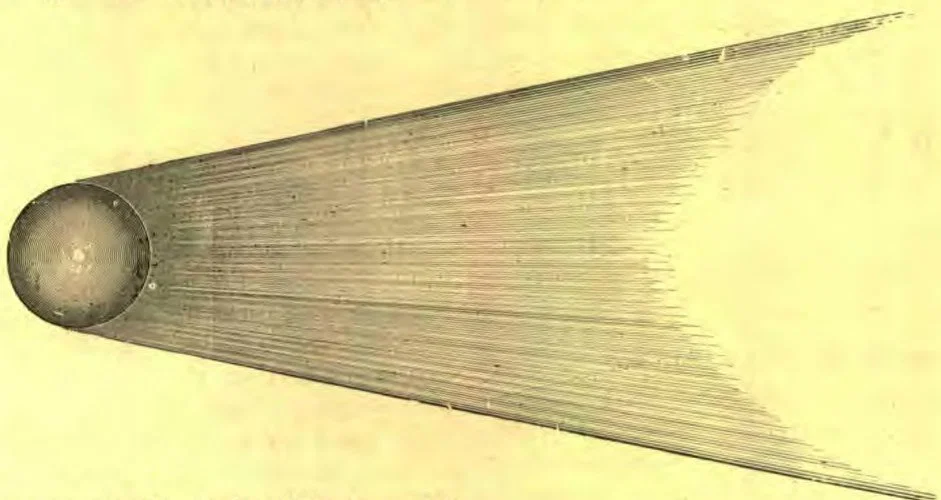
As we said, most of these comets are only visitors; yet there are quite a number which live in, and belong to, our solar system. These make, with some degree of regularity, periodic visits to the region of our sun; then retire, in a hurried manner, to the outer portions of our solar neighborhood. The accompanying illustration gives a general idea of the appearance of a single-tailed comet, as seen some distance from the sun.
The mind becomes bewildered when we try to grasp the immense size and fearful velocity attained by many of these bodies. It will be remembered that our earth is but a trifle less than eight thousand miles in diameter, and we think it quite a good-sized little ball; yet a comet no larger than our earth could hardly hope to be discovered by any one living here. The head of a comet—that which shows as a ball in the engraving—usually ranges from forty thousand to one hundred and fifty thousand miles in diameter. The comet that appeared in 1811 had a diameter of one million two hundred thousand miles, being forty per cent larger than our sun. The comet of 1680 was six hundred thousand miles in diameter. Imagine one of these tremendous bodies of light, followed by a hair-like coma, or tail, extending from it for a distance of from five million to fifty million miles. Several cases are cited where this stream of light exceeded one hundred million miles in length.
Now as to their rapidity: Our earth moves onward in its yearly journey around the sun at the speed of eighteen and one-half miles a second, or sixty-six thousand six hundred miles an hour; while the comet of 1680, mentioned above, traveled at the rate of eight hundred eighty thousand miles an hour; and one that was seen in 1843 moved at the rate of one million two hundred and sixty thousand miles each hour, or three hundred and fifty miles a second. The density of these bodies is exceedingly rare. Were it not so, they would produce general havoc in any system of worlds that they chanced to visit.
Even at the present day, comets are regarded by many as objects of superstitious reverence or abject terror. In 1456 one appeared whose size seemed equal to that of the full moon, its tail reaching from the horizon to the zenith. Such consternation was caused among the masses of Europe, that Pope Calixtus taught the people to pray that the Lord would save them from the devil, the Turk, and the comet.
DR. O. C. GODSMARK.
2005 Magazine St., Louisville, Ky.