At its normal height, the Santiam River flows over a bed of smooth, round cobblestones on the greater part of its journey from the mountains to the sea. Sometimes an immense boulder lies in its way; but the stream parts, and moves around the obstruction with a ripple and a laugh. At other places a wall of basalt lies across the path the stream would fain follow. Against this the water splashes; then, murmuring out a protest, it turns aside, and follows some other course. Again, two walls of rock may, for a short distance, confine it to a narrow channel. Through this the water rushes with a discontented roar, to spread out again upon its wide, cobblestone bed, or rest for a moment in some deep, dark pool.
But the river is up now. The boulders are covered so deeply that they cause scarcely a ripple on the surface of the water. The willows that used to line its banks, caught drifting reeds and rushes and twigs until they were no longer able to bear the strain; then they bent down before the rushing water, and now lie prone along the muddy bottom of the swollen stream. And there they will lie until the flood subsides, and the danger is past. Then they will slowly lift their heads; and when a shower washes the mud from their bright leaves, they will be none the worse for their experience.
Some of the trees that used to stand far up on the river-banks are now surrounded with water. Most of them stand unmoved, but some are torn up by the roots, and swept down the stream by the powerful current. Among the former is a great hemlock. At low water it stood near the river-bank, but now it is almost in the middle of the stream. That tree has stood through many a flood like this; and now from its great height it looks down with disdain at the water surging at its feet. Now and again the angry flood hurls against it a drifting stump or log. Its bark is scarred; its branches quiver; but the proud old hemlock does not give an inch. But down the stream drifts a great fir-log, which the angry river has stolen from the lumbermen above. One of its sawn ends is pointed down the stream, and it strikes the hemlock with terrific force. A shower of needles and twigs falls upon the water; there is a muffled snap among the roots of the noble tree; then the drifting log swings past, and continues its course down the stream.
But the hemlock no longer stands erect. One of its roots was broken, and, deprived of that support, it now leans slightly down the stream. Still it may stand, we think. But as we watch it closely, we see it slowly sinking. So slowly at first that the motion is scarcely perceptible, but it goes faster and faster until there is another muffled snap. Then, with a great splash, it falls, and is swept down by the current. Not far below stands one of those walls of basalt. Against this the tree is hurled, top first.
The top is broken off, the branches are shattered and split; and when the hemlock swings clear of the wall, it is no longer a noble tree, but only a drifting log.
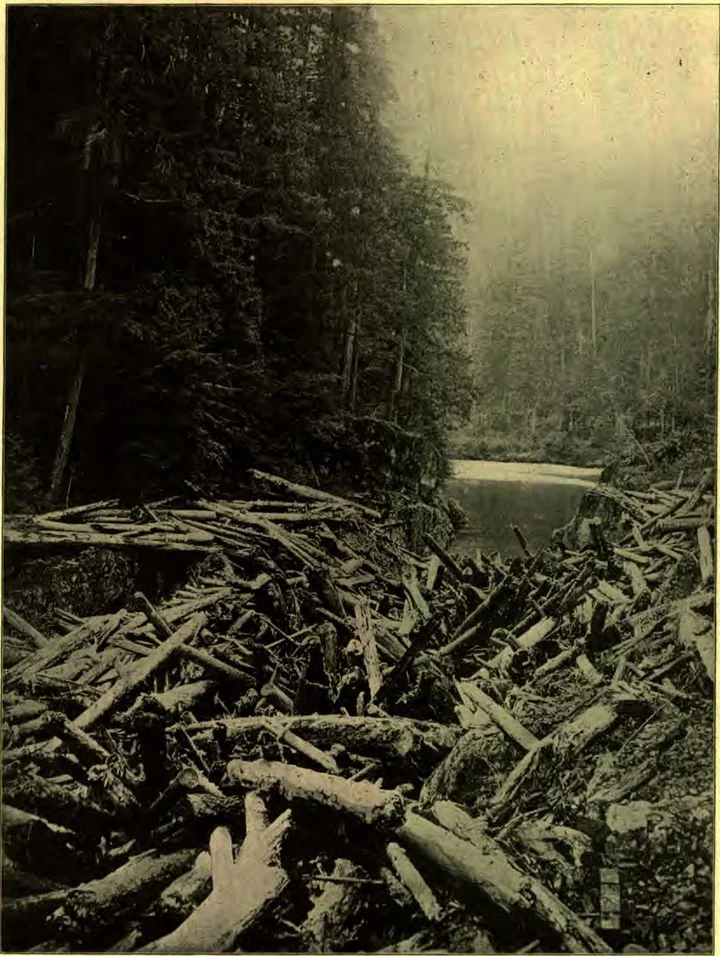
We hear a sullen roar; and as we hurry down the stream, we see the log swept into a narrowp. 218 cañon with race-horse speed. Now at the mercy of the flood, it is dashed against one wall; then as the end swings out, it is hurled against the other, until the remaining stumps of its disfigured branches are crushed and broken off close to the trunk. Just before it reaches the foot of the cañon, and the smooth water beyond, one end is caught in a niche in the rocks, the other end is dashed against the opposite wall; and there the log lodges. It is only a log; but it is a giant still, and all the mad waters of the flood are powerless to move it now.
Another drifting log is thrown against the hemlock; but it lodges alongside, and helps bear the strain. Still another is dashed against these two; but it glides under, strikes the rocks just below, catches the hemlock in the crotch of one of its broken limbs, and serves as a brace. Again and again the surging waters carry trees, and logs, and stumps into the cañon, and hurl them with terrific force against the jam; but there they lodge, and serve only to make the jam more firm.
All this happened years ago. The hemlock, and many of the other logs that helped begin the jam, have long since fallen into decay, and their remains have been washed away by succeeding floods. But each year more driftwood has been added to the jam; and now it fills the whole cañon. So firmly are the logs lodged, that it would require tons of dynamite to move them; and so tightly are they packed together, that when one stands on the top of the jam, he can scarcely hear the ripple of the water underneath.
J. EDGAR ROSS.