Visiting Solusi Mission's Outschools: Henry's School
By Raleigh P. Robinson
Visiting Solusi Mission’s Outschools — No. 3
After leaving Samuel’s, a five hours’ drive down the Gwaai River toward the Zambesi, brought us to Henry’s school, which is our farthest outschool. It is eighty miles from the main station, and one hundred miles from any center of civilization. We found this part of the country quite different from that through which we had been passing. Henry lives on the west bank of the river, on each side of which for many miles the country is covered with jungle and heavy timber.
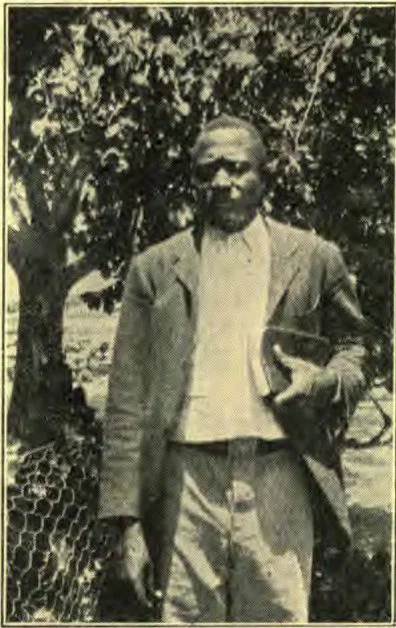
HENRY, AN EFFICIENT WORKER
In this timber live several different species of the African antelope. The little red stembuck, which is the smallest of the many antelopes, and the black sable, one of the largest, are found here. I saw many tracks of the sable and koodoo, and had the pleasure of seeing a large male sable. The koodoo has the long, beautiful spiral horns, while those of the sable are three feet in length and curve gracefully backward.
When we arrived at Henry’s, in the middle of the afternoon on Friday, we outspanned near his houses under two large nondo trees. By the time Sabbath was over I had become so interested in Henry’s work, his people, and the country, that I decided to stay over Sunday. This gave the mules that much more rest before starting on the hard three and one-half days’ trip home.
Like Samuel, Henry is one of the outschool teachers who had been longest connected with the mission. He speaks better English than any of the other teachers. I could sit down and talk with him on any common topic. He has a pleasant, jovial disposition, yet he is very earnest in his work and has a close walk with God. The people look to him as a father, though he is still a young man; and his home seemed to be the center of the community. Henry was a member of the Wesleyan Mission before coming to our mission. His wife was also a member of that mission, but since they were married, two years ago, Henry has taught her the Sabbath truth. She with another woman will be baptized with the candidates of our present baptismal class.
I found Henry doing as much work as any of the other teachers, if not more. At dark Friday evening he and his family came out to sit, and visit, as I supposed, with us around our big camp fire; but it was not long till I learned that there was to be a meeting. Soon people began to come, and in a short time we had a complete circle of more than twenty men, women, and children around our fire. Henry told me he always has a Friday evening prayer and social meeting. He has organized a Sabbath school of thirty members, and the most of these attend the Friday evening meeting. During the first part of this meeting they study the Sabbath school lesson.
What impressed me most was the testimony meeting; yes, a testimony meeting away down there in the edge of a great African jungle, a hundred miles from civilization, in the midst of African heathenism.
More than half of that company stood up and testified to the power in Jesus’ name. There was no hesitation, hardly a moment being lost between testimonies. Several of the mothers with babies on their backs stood up and spoke; and while I could not understand all that was said, yet I could understand enough to greatly interest me. One mother said she thanked God that he had kept her through another week. A herd boy said he praised God for sending a teacher so he could learn. Another mother thanked God for the many blessings she had received. The earnestness which gave expression to the thanks, indicated that the recipients of these blessings had a clear and true understanding of God.
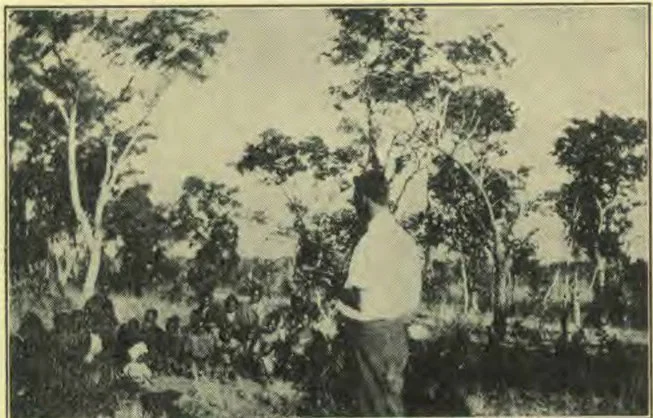
Sabbath morning Henry rang his plowshare bell for Sabbath school. In a little while the natives began to gather, but in a very different place from that in which the Sabbath keepers in the homeland meet. Their Sabbath school was conducted under the spreading branches of a great forest evergreen. There were about thirty present, and Henry conducted the one large class. It was indeed interesting to see and hear the members, the majority of whom could not read, answer the questions promptly. It is wonderful how readily the native learns the Word of God.
There were fifty of the jungle people present at the church service, which followed the Sabbath school, and they listened with the most careful attention during the entire forty-five minutes I spoke. At the close of the service I told Henry to announce that there would be meeting again in the afternoon. Henry’s regular company of twenty-five attended this meeting. I gave them a short, practical health talk. I had had an opportunity of seeing something of their physical needs, having attended to those needs as best I could after the morning service.
Most of Sunday was spent in a long tramp through the jungle looking for wild honey; but in the evening we had the fourth and last good meeting with Henry’s little company. We enjoyed much of the blessing of God during the two days spent with these people, and personally I shall never forget the pleasant visit.
At break of day Monday morning we were on our way home, but we had to go off the road a few miles to get Ralph, another one of our outschool teachers, and move him and his family to a place near the main station. We reached his home in the middle of the afternoon, Monday. Hearing a noise in a near-by kraal6, I asked Ralph what it was. He said the natives were having a beer drink there. Having never seen a native beer drink, I walked down to the kraal. An accompanying picture shows a portion of what I saw. The men were sitting around several earthen pots close to the huts, while the women were in the foreground. The picture shows how the Matabeles make their huts, also how the married women wear their hair. They keep it cut close except the tuft on top of the head.
THE SABBATH SCHOOL UNDER THE TREES, HENRY TEACHING
Ralph called the people together for a meeting that evening. Thirty-five gathered around the camp fire, and we had a service quite different from any other we had held. The people there were much opposed to schools, and when in my talk I said something about the need of schools, they immediately resented it. Some were still under the influence of the afternoon beer drink, and they were the ones who talked most. We could hardly close the meeting in order.
Tuesday morning we did not get started till eight o’clock, but reached the Zuzumba River that night, where we had outspanned for dinner on the trip out. From the time we left Ralph’s till we reached home, we had company, for in addition to myself and the two boys with me, were Ralph and his wife and baby, and two girls who live with them. This made an interesting company at camping times, especially in the evening. This close contact with the natives gave me a very good opportunity to learn more of their ways.
Wednesday night we reached the little Tjobusi River, where we made camp for the last time. We reached home Thursday forenoon, having traveled one hundred and sixty miles. It was indeed a welcome place after ten days and nights of camp life out in the wilds, with no companions but the natives. While the constant jabbering of their language was a help to me in learning it (for most of the time I heard nothing else), yet at times it would become tiresome. I saw only four white men on the whole trip.
In summing up the work of the trip I found that there were eighty children in the four schools visited; that I had spoken to two hundred and sixty-five persons in the eight meetings held; and that I had pulled fifteen teeth, besides doing what else I could to help the people physically as well as spiritually.
Four weeks later I made a similar trip of eight days, in another direction, visiting more of our outschools.
In our school here at the main station we have an attendance of one hundred and fifteen, requiring five teachers,— Mrs. Robinson, myself, and three natives. We have had many precious experiences since we took up the work two and a half years ago, but we need more help to do the work as it should be done.